
Achieving real wok hei at home isn’t about owning a high-BTU restaurant burner; it’s about hacking the physics of flavor with controlled combustion.
- The key is not ambient heat, but surgically applying intense, targeted flame with a handheld torch to volatilize oil and liquids.
- Success depends on a non-negotiable tool (a carbon steel wok) and understanding the fine line between the Maillard reaction and acrid carbonization.
Recommendation: Master the torch as a finishing tool, not a primary heat source, to create the “breath of the wok” without burning your food or setting off smoke alarms.
Every serious food enthusiast eventually hits the wall. You’ve bought the carbon steel wok. You’ve prepped your ingredients meticulously. You crank your home stove to its absolute maximum, yet the result is… fine. It’s a decent stir-fry, but it lacks that elusive, smoky, soul-satisfying essence of a restaurant dish. It’s missing the “breath of the wok,” or wok hei. The common wisdom says you can’t achieve it without a commercial burner roaring at 100,000 BTUs or more. This guide argues that common wisdom is wrong.
The secret isn’t about brute force heat; it’s about surgical precision and a bit of kitchen hacking. We’re going to bypass the limitations of a residential kitchen by thinking like an engineer. The goal isn’t just to cook food, but to manipulate chemical reactions. We will explore how to use an unexpected tool—a simple handheld blowtorch—to create controlled combustion, generating that signature smoky flavor right where it’s needed. This isn’t about setting your food on fire; it’s about understanding the science of flash-volatilized aromatics and applying heat with strategic intent.
Forget the idea that your stove is the only heat source. By combining the steady heat of your burner with the intense, focused power of a torch, you can create the specific conditions that give rise to wok hei. This guide will walk you through the essential gear, the critical safety protocols, the science of smoke, and the advanced techniques that turn a good stir-fry into an unforgettable one. It’s time to stop compromising and start hacking your way to flavor.
For those who prefer a visual introduction, the following video offers a fantastic overview of what makes the ‘breath of the wok’ so special, setting the stage for the practical techniques we’re about to explore.
To master this culinary hack, we’ll break down the process into clear, manageable steps. This article covers everything from the safe use of a torch and fire prevention to choosing the right gear and managing smoke, ensuring you have a complete roadmap to achieving authentic wok hei in your own kitchen.
Summary: Hacking Your Way to the “Breath of the Wok”
- Handheld Torch: Is It Safe to Flame Your Stir-Fry for Wok Hei?
- Flash Point Awareness: How to Prevent a Grease Fire When Flambéing?
- Carbon Steel vs Non-Stick: Why Teflon Cannot Handle Wok Hei?
- Managing Indoor Smoke: How to Stir-Fry Without Setting Off the Alarm?
- Maillard vs Carbonization: When Does “Smoky” Become “Burnt”?
- Why Charcoal Grilling Provides a Smoke Ring That Gas Cannot Replicate?
- Precision Cooking: Is a Sous-Vide Stick Worth It for Turkey Breast?
- Liquid Smoke vs Smoked Paprika: Which Adds the Most Authentic BBQ Flavor Indoors?
Handheld Torch: Is It Safe to Flame Your Stir-Fry for Wok Hei?
Let’s get straight to the point: yes, using a handheld torch is not only safe when done correctly, it’s arguably the most effective hack for generating real wok hei in a home kitchen. The goal isn’t to cook the food with the torch, but to use it for controlled combustion. Wok hei’s signature flavor comes from oil droplets and liquid splashes hitting a superheated surface and igniting into a flavorful aerosol. A torch allows you to create this effect on demand, even if your stove can’t get the wok’s rim hot enough. The technique involves quick, targeted bursts of flame, especially when adding liquids like Shaoxing wine or soy sauce, to achieve aromatic volatilization.
According to extensive testing by culinary experts at Serious Eats, the torch method works best as a finishing technique. After your ingredients are mostly cooked on the stovetop, a final, sweeping pass with the torch for about 15 seconds imparts that crucial char and smoky note. This surgical application of heat is the key. You’re not trying to imitate a jet engine; you’re painting with fire. Choosing the right tool matters: a propane torch offers more power for a faster effect, while a smaller butane torch gives you more precision. Maintaining a distance of 6-8 inches is crucial to kiss the food with flame rather than scorch it.
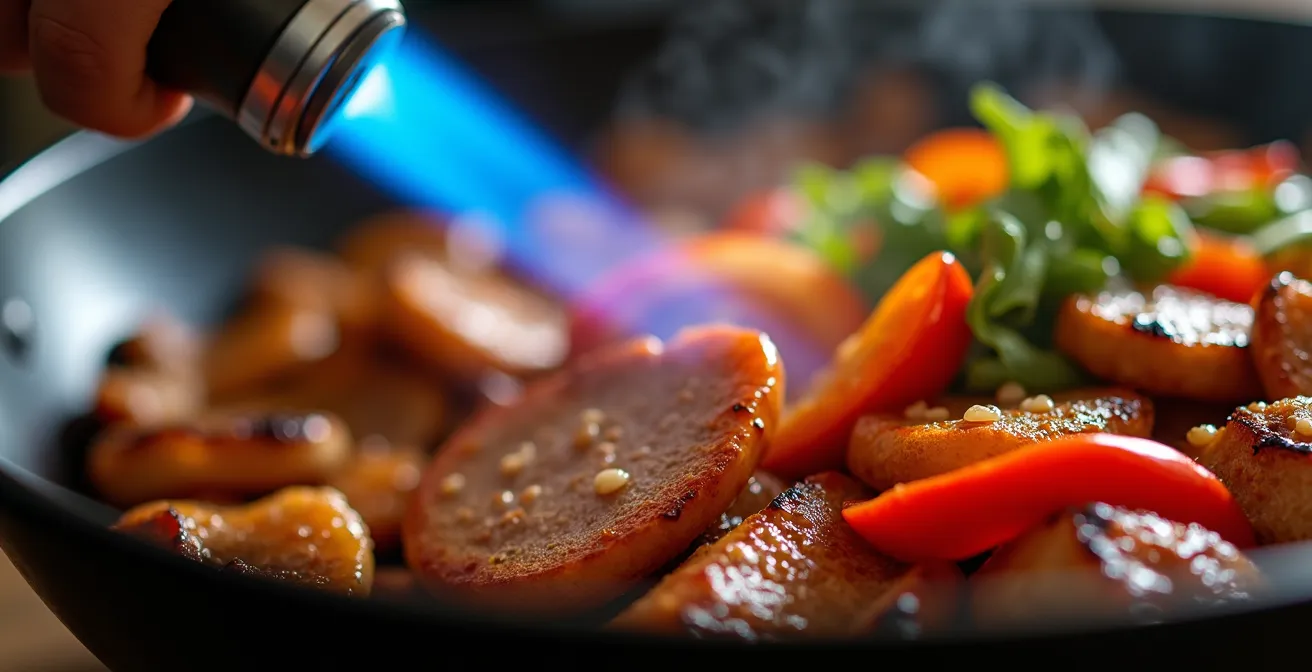
As this image shows, the magic happens at the point of contact. The flame isn’t just heating; it’s chemically altering the surface of the food and the oil, creating complex compounds that our brains register as “smoky” and delicious. The key is to keep the food moving—tossing constantly—while applying the flame in short 2-3 second pulses. This ensures even exposure and prevents any single piece from turning to carbon. This technique, when mastered, is the closest you’ll get to the real deal.
Flash Point Awareness: How to Prevent a Grease Fire When Flambéing?
Embracing the kitchen hacker mentality means embracing responsible risk. Using a torch near hot oil requires unwavering attention to safety. The single most important concept to understand is the flash point—the temperature at which oil vapors can ignite if an ignition source (like your torch) is present. For most cooking oils, this is well above their smoke point. The danger isn’t just hot oil, but the aerosolized, vaporous oil in the air above the wok. This is why ventilation isn’t just for comfort; it’s a critical safety measure to disperse these flammable vapors.
The science of flavor creation happens at specific temperatures. According to temperature research, the Maillard reaction that is crucial for wok hei begins between 250°F and 300°F. High-heat searing pushes temperatures well beyond this, increasing the risk. Therefore, you must have an emergency plan. Never, ever use water on a grease fire; it will cause an explosive eruption of flaming oil. The correct response is to smother the fire by cutting off its oxygen supply. Sliding a lid over the wok is the fastest and most effective method. Having a box of baking soda nearby as a secondary extinguisher is also a professional-grade precaution.
Before you ever light the torch, you should have your fire safety protocol mentally rehearsed and your equipment ready. This is non-negotiable. Being prepared doesn’t mean you expect a fire; it means you are a serious cook who respects the power of the elements you’re working with. High heat is a tool, and like any powerful tool, it demands respect and a clear plan for when things go wrong.
Your Wok Hei Fire Safety Protocol
- Immediate Action: If flames appear, immediately slide the wok lid over the pan to cut off the oxygen supply. Stay calm.
- Kill the Heat: Switch off the burner completely, but DO NOT attempt to move the flaming wok.
- Wait It Out: Keep the lid securely on for at least 30 seconds to ensure the flames are fully extinguished and the oil has cooled below its flash point.
- Absolute Don’t: Never use water. It will turn the grease fire into an explosive spray.
- Backup Plan: Always keep a box of baking soda within arm’s reach to dump on the fire as a last-resort suppressant.
Carbon Steel vs Non-Stick: Why Teflon Cannot Handle Wok Hei?
If the torch is the technique, the carbon steel wok is the theater where the magic happens. This is not a matter of preference; it’s a matter of physics. Non-stick coatings like Teflon have a maximum safe temperature of around 500°F (260°C). Pushing them higher causes the coating to break down, releasing toxic fumes and ruining the pan. Wok hei, however, requires surface temperatures that can reach 650-750°F (340-400°C) or more. Attempting wok hei in a non-stick pan is not only ineffective but also dangerous.
A well-seasoned carbon steel wok, on the other hand, is built for this abuse. The “seasoning” is not just a coating; it’s a layer of polymerized oil that has bonded with the metal, creating a slick, non-stick surface that only gets better with use. As renowned food scientist J. Kenji López-Alt explains, this surface is key. In a WIRED video on wok chemistry, he notes:
That black oxide not only aids in giving it non-stick properties but more importantly it actually transfers flavor to your food.
– J. Kenji López-Alt, WIRED video on wok chemistry
This microporous surface is hydrophilic (it attracts water), which promotes the intense searing and Maillard reaction needed for wok hei. Teflon is hydrophobic (it repels water), causing ingredients to steam in their own juices rather than sear. This is why stir-fries in non-stick pans often end up soggy. Cast iron is a viable alternative due to its high heat retention, but its weight and slow response time make the characteristic tossing motion of stir-frying difficult.
This comparative data highlights why material choice is foundational. Without a vessel that can safely withstand and effectively transfer extreme heat, the torching technique is useless. The following table from a guide on restaurant techniques breaks down the critical differences.
| Material | Max Safe Temperature | Wok Hei Capability | Surface Properties |
|---|---|---|---|
| Carbon Steel | 650-750°F (340-400°C) | Excellent – Creates ideal conditions | Microporous seasoned surface promotes Maillard reaction |
| Cast Iron | 700°F+ (371°C+) | Good – Excellent heat retention but heavy | Retains heat well but slow to respond to temperature changes |
| Teflon/Non-stick | 500°F (260°C) max | Poor – Cannot reach required temperatures | Hydrophobic surface causes ingredients to steam rather than sear |
Managing Indoor Smoke: How to Stir-Fry Without Setting Off the Alarm?
You’ve embraced the torch and the carbon steel wok. Now you face the inevitable byproduct: smoke. Generating wok hei means generating smoke, and the goal is to manage it so effectively that your smoke detector remains blissfully silent. This starts with understanding the power gap you’re bridging. A home stove might produce 12,000 BTU, but according to equipment specifications, commercial wok burners can output anywhere from 65,000 to over 200,000 BTU. Our torch hack helps close that gap, but the smoke is the evidence. Your first line of defense is a powerful range hood.
You can test your hood’s effectiveness with a simple piece of paper: if it doesn’t stick to the vent while it’s on high, your hood’s CFM (cubic feet per minute) rating is too low to handle serious wok cooking. In this case, you need to create your own ventilation system. The most effective hack is to create negative pressure in your kitchen. Place a simple box fan in a nearby window, facing outward. This actively pulls the smoky air out of the room, creating a current that directs the smoke away from your detectors and living spaces. Opening a window on the opposite side of the house can further improve this airflow.
Technique also plays a role in smoke management. Instead of sustained, roaring high heat, think in aromatic bursts. Add splashes of wine, stock, or soy sauce in short intervals. This momentarily cools the pan, reduces smoke, and creates flavorful steam. As a last resort for particularly sensitive smoke detectors (photoelectric models are more prone to cooking false alarms than ionization types), you can temporarily cover the detector with a shower cap or plastic wrap secured with a rubber band. This should only be done immediately before cooking and removed the second you are finished. It’s a pragmatic solution for a temporary problem.
Maillard vs Carbonization: When Does “Smoky” Become “Burnt”?
The line between a divinely smoky wok hei and a tragically burnt stir-fry is incredibly fine. Mastering this technique means training your senses to recognize that line. The flavor we seek comes from the Maillard reaction, a complex chemical dance between amino acids and reducing sugars that creates hundreds of new aromatic compounds. It’s the same reaction that browns a steak and toasts bread. Carbonization, on the other hand, is simply burning. It’s what happens when the Maillard reaction goes too far, obliterating those complex flavors and leaving behind a single, acrid, bitter note of carbon.
Your nose is your best guide. Perfect wok hei smells nutty, complex, and savory—almost “meaty.” A burnt dish smells sharp, acrid, and unpleasant. Your eyes are the second line of defense. Watch the fond—the browned bits that stick to the wok. If they are a glistening, deep brown and dissolve easily when you deglaze with liquid, you’re in the Maillard zone. If they are dry, black, and flaky, you’ve crossed into carbonization. A key factor is sugar. Many marinades use soy sauce or mirin, which contain sugars that caramelize and then burn much faster than proteins can undergo the Maillard reaction. This is why it’s critical to pat marinated meat completely dry before it hits the hot wok.
Timing is everything. In a properly heated wok, wok hei develops in a matter of 2-3 minutes. Anything beyond that is venturing into dangerous territory. This is also why the tossing motion is so important. As one analysis notes, simply stirring under super-high heat will likely lead to burning. Tossing continuously allows for better mixing, ensuring every piece of food gets a momentary kiss from the hottest part of the pan before being cycled back up the cooler sides. It’s a constant, rapid rotation between searing and resting.
Why Charcoal Grilling Provides a Smoke Ring That Gas Cannot Replicate?
To truly master indoor smoke, it helps to understand outdoor smoke. The “smoke ring” on barbecued meat is a chemical reaction between myoglobin in the meat and nitrogen dioxide from burning wood or charcoal. Gas grills don’t produce these compounds, hence no smoke ring. This is a different process from wok hei, but it teaches a valuable lesson: the source of the smoke defines the flavor. Wok hei isn’t the flavor of burning wood; it’s the flavor of flash-combusted cooking oil. As one contributor on the Big Green Egg forum astutely observed, “Most of wok hei results from the oil droplets that arise from tossing ingredients basically being ignited by the flame of a wok burner.”
This is the precise reaction our torch hack is designed to replicate. We are creating micro-ignitions of volatilized oil and sauce. This understanding opens the door to even more advanced techniques. For the truly adventurous, there’s the “smoking ember” method. This involves finishing a stir-fry, taking it off the heat, and placing a tiny heat-proof bowl inside the covered wok. In that bowl, you place a single, glowing hot piece of binchotan charcoal and a single drop of oil. After 30 seconds, the dish is infused with an authentic, clean charcoal smoke that complements the wok hei.
This hybrid approach demonstrates the pinnacle of flavor hacking: understanding that different smoke compounds (like guaiacol from burning wood lignin vs. aldehydes from burning oil) produce different flavors. By combining the oil-based smoke of wok hei with the wood-based smoke of an ember, you can layer complexity and create a flavor profile that is truly unique and deeply satisfying. It’s about deconstructing flavor and reassembling it with intention.
Precision Cooking: Is a Sous-Vide Stick Worth It for Turkey Breast?
One of the biggest challenges in high-heat stir-frying is the narrow window for success. A few seconds too long, and your perfectly tender chicken breast becomes tough and dry. Here is where another piece of modern kitchen tech becomes an invaluable ally: the sous-vide immersion circulator. While often associated with delicate items like turkey breast or steak, its real value for a wok hacker is in creating a fail-safe for proteins. This is the “Sous-Vide-to-Wok” two-step method.
The process is simple: you first cook your protein (chicken, beef, pork) to its perfect final temperature in a sous-vide water bath. A chicken breast cooked at 145°F is guaranteed to be juicy and tender through and through. Once cooked, you chill it, pat it completely dry, and it’s ready for the wok. Now, the wok’s job changes. It’s no longer responsible for cooking the protein, only for imparting flavor and texture. You can get your wok screaming hot and sear the pre-cooked protein for just 30-45 seconds. This is long enough to create a beautiful crust and generate wok hei, but not nearly long enough to overcook the interior. It removes all the guesswork and stress.
This technique separates the task of “cooking for doneness” from “cooking for flavor.” By handling the first part with the precision of sous-vide, you free yourself to focus entirely on the high-heat theatrics of the second part. This is especially effective when using a torch to finish, as testing data demonstrates that top torches like the Bernzomatic TS8000 can create a deep, browned crust in minimal time. The result is the best of both worlds: perfectly cooked, tender protein with a deeply savory, smoky, and expertly seared exterior.
Key Takeaways
- Embrace the Torch: A handheld torch is your primary tool for hacking wok hei, used for controlled, surgical bursts of flame to ignite volatilized oil.
- Safety is Non-Negotiable: Understand oil flash points, perfect your ventilation, and have a fire-suppression plan (lid and baking soda) before you begin.
- Carbon Steel is King: Only a well-seasoned carbon steel wok can safely handle the extreme temperatures required for creating the Maillard reaction without breaking down.
Liquid Smoke vs Smoked Paprika: Which Adds the Most Authentic BBQ Flavor Indoors?
We’ve established that real wok hei comes from controlled combustion. But what if you want to push the smoky illusion even further? This is where a final layer of flavor hacking comes in, using pantry items to build complexity. Liquid smoke and smoked paprika are often used to mimic BBQ flavor, but for our purposes, they must be used with extreme subtlety to support, not overwhelm, the delicate wok hei. Think of these as a final audio mix on a song—they add depth and polish.
The “Wok Hei Illusion” formula is a careful layering of these elements. First, at the very end of cooking and off the heat, add one single, tiny drop of a neutral liquid smoke, like hickory. Too much, and your dish will taste artificial. Next, drizzle a high-quality toasted sesame oil (not raw) for a nutty, authentically Asian aromatic base. For the visual and flavor element of char, make sure to include slightly blackened scallion whites or slivers of garlic in your stir-fry. Finally, a dusting of high-quality Spanish smoked paprika (Pimentón de la Vera) into your final sauce provides a warm, smoky finish that complements the sharper notes of the torch-generated wok hei.
Ultimately, all these techniques—from heating your wok on an outdoor grill for more power to using a blowtorch for precision heat—are about one thing: control. A study of alternative methods confirms that a blowtorch is a fantastic way to control oil combustion and concentrate heat exactly where you want it. By combining the physical act of torching with the sensory illusion of these finishing ingredients, you are creating a complete experience. You are building a flavor profile that tells your brain “wok hei,” even if it was born from a collection of clever hacks rather than a single 200,000 BTU burner.
You now have the full arsenal of a wok hei hacker. You understand the tools, the science, and the safety protocols. The next step is to get in the kitchen, fire up that torch, and start practicing the art of controlled combustion to transform your stir-fries forever.