
The collapse of choux pastry is not a single baking error, but a structural failure where the internal scaffolding of starch and protein doesn’t set before the internal steam pressure subsides.
- A weak foundation is created if the flour-water paste (panade) isn’t cooked enough to properly gelatinize the starch.
- A premature drop in oven temperature, often from opening the door, causes the steam to condense, leading to an immediate and irreversible deflation of the semi-set structure.
Recommendation: Treat each stage of the process—from cooking the panade to drying the baked puffs—as a non-negotiable scientific control point to guarantee a stable, hollow, and crisp result.
There is no moment more defeating for a baker than pulling a tray of beautifully puffed, golden-brown gougères from the oven, only to watch them sigh and deflate into sad, wrinkled discs. You followed the steps, you watched the clock, and yet, the magic vanished. The common advice is often a list of superstitions: don’t peek, use a wooden spoon, pray to the baking gods. While some tips hold a kernel of truth, they fail to address the root cause of the problem.
The success or failure of choux pastry is not a matter of luck; it is a direct result of physics and chemistry at play within your oven. It is a controlled battle between two powerful forces: the explosive pressure of internal steam pushing outwards and the structural integrity of the dough resisting collapse. When the structure wins, you get a light, airy, and crisp pastry. When the steam pressure gives out too soon, you get a dense, soggy failure. The secret isn’t in a magic ingredient, but in understanding how to manage these forces from start to finish.
This guide abandons baking myths in favor of a scientific investigation. We will dissect the cause-and-effect relationship at each critical stage, from creating the initial paste to the final, crucial drying period. By understanding the ‘why’ behind each step, you can transform your choux pastry from a source of frustration into a consistent and impressive achievement. We’ll examine the core principles of steam leavening and structural cooking, even drawing lessons from seemingly unrelated items like Yorkshire puddings and pizza to build a complete mastery of the technique.
Summary: Why Your Choux Pastry Collapses and How to Dry It Properly
- The “V” Shape Test: How to Know You’ve Added Enough Eggs?
- Why You Must Not Open the Oven Door for the First 20 Minutes?
- How to Poke Holes to Release Steam and Ensure Crispness?
- Bread Flour vs Cake Flour: Which Holds the Structure Better?
- Why Uneven Piping Leads to Burnt Small Puffs and Raw Large Ones?
- Cold Batter or Hot Oil: What Makes Yorkshire Puddings Rise High?
- Top, Middle, or Bottom: Where to Place Pizza for a Crispy Crust?
- Cornstarch or Flour: Which Thickener Creates the Smoothest Custard Cream?
The “V” Shape Test: How to Know You’ve Added Enough Eggs?
The “V” shape test is not merely a visual cue; it is a precise measurement of viscosity, which is critical for the dough’s ability to expand and hold its shape. The initial paste, or panade, is a mixture of water, butter, and flour cooked to achieve starch gelatinization. This process causes starch granules to swell and absorb water, creating a thick, glue-like base. However, this paste on its own is too stiff to expand. Eggs are added to provide three essential components: additional liquid for steam, fat for tenderness, and, most importantly, protein for structure.
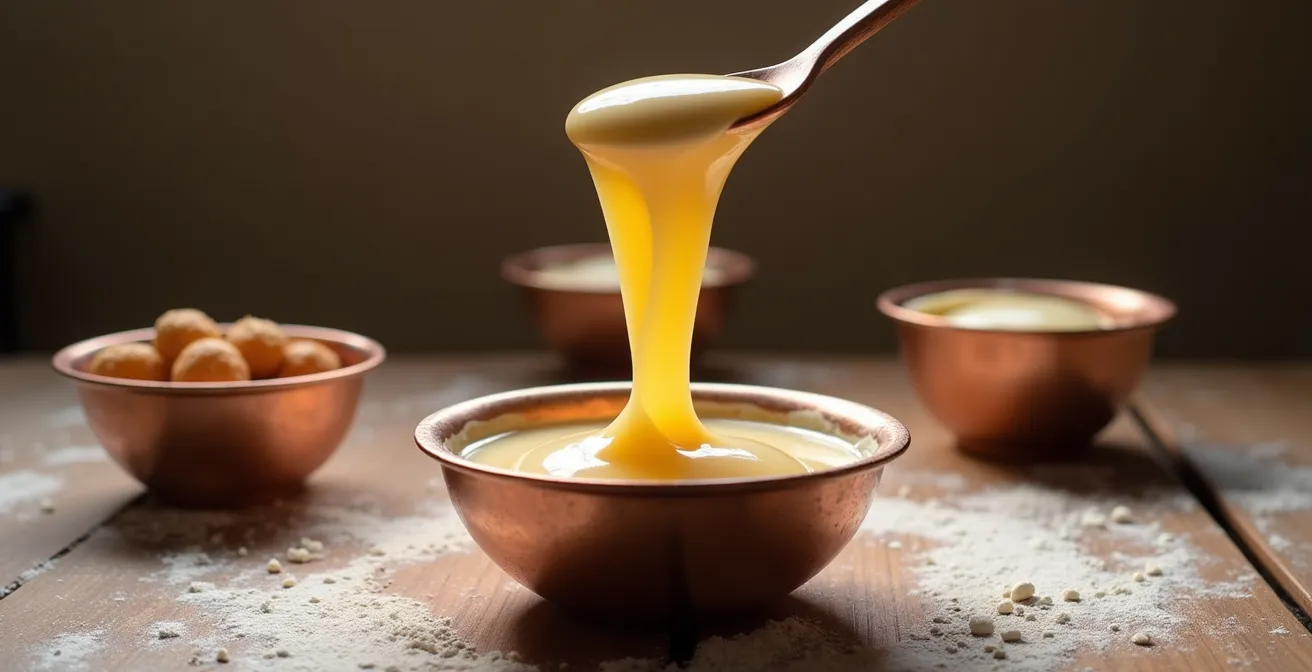
As you incorporate the eggs, you are creating an emulsion. Too few eggs, and the dough will be too stiff to inflate. Too many, and it will be too slack to hold its shape, spreading out on the baking sheet. The perfect consistency is achieved when the proteins from the eggs are balanced with the gelatinized starch. Nutritional analysis showing that a typical choux contains a significant protein component underscores the importance of this structural element. When the batter slowly falls from a spoon and forms a distinct “V”, it indicates that the ideal viscosity has been reached—thin enough to expand under steam pressure, but thick enough to maintain its form as the protein coagulation begins in the oven.
Why You Must Not Open the Oven Door for the First 20 Minutes?
The initial phase of baking choux pastry is a violent, high-pressure event. Choux is not leavened by yeast or baking powder, but by a massive and rapid expansion of steam. A high initial oven temperature (typically 400-425°F or 200-220°C) is non-negotiable because it causes the water within the batter to convert to steam explosively. Scientific measurements show that water vapor expands to nearly 1700 times its original volume, acting as a powerful internal force that inflates the pastry from the inside out. This is the “oven spring” that creates the signature hollow interior.
During the first 20-25 minutes, this internal steam pressure is fighting to lift a structure that is still soft and malleable. The egg and flour proteins have begun to set, but they have not yet cooked and dried into a rigid, self-supporting shell. Opening the oven door at this critical juncture introduces a rush of cool air, causing a catastrophic drop in temperature. This thermal shock causes the internal steam to rapidly cool and condense back into water, instantly eliminating the pressure that was holding the puff up. The weak, semi-set walls have nothing to support them and immediately collapse. It is a point of no return. As a professional pastry guide notes, this rule is absolute.
Don’t open the oven door for at least first 25 minutes. Open the oven door only when the pastry shells are nice and golden.
– Professional pastry tutorial, Sweet & Savory Ultimate Guide to Choux Pastry
Only after the structure is fully expanded and has turned a deep golden brown has enough moisture evaporated and enough protein coagulated to create a rigid shell that can support itself. At that point, the door can be opened without risk of collapse.
How to Poke Holes to Release Steam and Ensure Crispness?
Successfully puffing the choux is only half the battle; the final texture is determined in the drying phase. Once the pastries are golden brown and structurally set, their interiors are still filled with superheated steam. If they are removed from the oven and left to cool as is, this trapped steam will condense into water, turning the crisp outer shell into a soft, soggy mess from the inside out. The goal is to facilitate the escape of this moisture before it can cause damage.
Poking a hole in each pastry is a method of controlled depressurization. A case study on the science of the process revealed that poking holes immediately after the main baking time allows the high-pressure steam to escape forcefully, preventing it from slowly condensing. This immediate venting is far more effective than letting the pastries cool at room temperature. Returning them to a turned-off or low-temperature oven with the door ajar allows the remaining residual moisture to gently evaporate rather than condense, resulting in a demonstrably crisper and more stable shell that stays that way for hours.
Plan of Action: Professional Steam Release Technique
- Remove the choux pastries from the oven once they are fully risen and a deep golden brown.
- Work quickly to immediately pierce the base or lower side of each pastry with the tip of a sharp knife to create a small vent.
- Return the pierced pastries to the turned-off oven and prop the door open slightly with a wooden spoon. Let them dry for at least 10 minutes.
- For pastries destined for very wet fillings (like crème pâtissière), slice them in half horizontally and return them to the cooling oven, cut-side-up, for an additional 5-10 minutes of drying for maximum crispness.
This final drying step is what separates a good cream puff from a great one. It ensures the shell has the structural integrity to hold fillings without becoming soft and is the key to making pastries that can be prepared ahead of time.
Bread Flour vs Cake Flour: Which Holds the Structure Better?
The choice of flour is a crucial variable that directly impacts the strength of the final pastry shell. Flour’s primary contributions are starch, which gelatinizes to form the paste’s body, and protein (gluten), which forms an elastic network that becomes the pastry’s structural scaffolding. Different flours have different protein levels, which dictates the strength of this network.
Bread flour has the highest protein content, and chemical analysis demonstrates that bread flour contains a 12-13% gluten potential. This creates a very strong, robust structure that is excellent at trapping steam and resisting collapse, making it ideal for larger structures like éclairs that need to support heavy fillings. However, this strength can come at the cost of tenderness, sometimes resulting in a chewier texture. At the other end of the spectrum, cake flour has a very low protein content (7-8%) and creates a structure that is too weak to effectively trap the powerful force of expanding steam, often leading to cracking or collapse.
This comparison shows how flour type directly influences the final outcome. All-purpose flour, with its mid-range protein content, often provides the best balance of structural integrity and tenderness for general-purpose choux like cream puffs or gougères.
| Flour Type | Protein Content | Best Application | Structure Result |
|---|---|---|---|
| Bread Flour | 12-13% | Eclairs, sturdy structures | Strong shell, may resist expansion |
| All-Purpose | 10-11% | Versatile, cream puffs | Balanced elasticity and tenderness |
| Pastry Flour | 8-9% | Delicate pastries | Tender but may crack |
| Cake Flour | 7-8% | Not recommended | Too weak to trap steam |
The correct flour provides the necessary protein scaffolding to contain the steam during expansion and then set into a rigid, stable structure. Choosing a flour that is too weak is a common but often undiagnosed reason for failure.
Why Uneven Piping Leads to Burnt Small Puffs and Raw Large Ones?
The principle of thermodynamics dictates that an object’s rate of cooking is directly related to its surface-area-to-volume ratio. When piping choux pastry, inconsistent sizes and shapes create a tray of pastries that will bake at drastically different rates. Small puffs or thin, wispy parts of larger puffs have a high surface area and low volume. They cook extremely quickly, often browning and burning before the larger, thicker sections have had enough time for their internal structure to fully set.
If you pull the tray from the oven when the small puffs are perfectly golden, the large ones will still be raw inside and will collapse. If you wait for the large ones to bake through, the small ones will be burnt. This creates an impossible dilemma rooted in inconsistent piping. Professional testing has even shown that the type of piping tip used has a measurable impact; a star tip significantly increases surface area through its ridges, which helps form a rigid scaffolding earlier in the baking process, promoting more even cooking across the pastry.
Consistency is key. Using a template drawn on your parchment paper can help ensure uniform size and volume for every puff. This guarantees that every pastry on the tray requires the same amount of time to expand, set, and dry. An excellent professional technique is to use one puff as a canary in the coal mine.
Pipe one very small test puff on the corner of your baking sheet. Its rapid browning will serve as a real-time indicator of the oven’s intensity
– Professional baking technique, Article analysis of piping impact
This “test puff” allows you to gauge the baking speed without sacrificing a full-sized pastry, ensuring that your main batch bakes evenly and predictably.
Cold Batter or Hot Oil: What Makes Yorkshire Puddings Rise High?
The dramatic rise of Yorkshire puddings offers a parallel lesson in the power of steam leavening, but with an emphasis on thermal shock. While choux pastry relies on a hot oven to turn its internal moisture into steam, Yorkshire puddings maximize this effect by introducing an extreme temperature differential. The batter is typically chilled, while the fat in the baking tin is heated until it is smoking hot.
When the cold batter hits the searingly hot fat, the liquid at the base and sides of the pudding instantly vaporizes, creating an explosive burst of steam. This sudden, violent expansion forces the center of the batter upwards, creating the characteristic tall, hollow structure with a crispy exterior. The principle is the same as in choux pastry—leavening via steam—but the method is amplified. The greater the temperature difference, the more rapid and powerful the steam production, and the higher the rise.
This reinforces a key takeaway for choux: the importance of a fully preheated oven. Placing choux in a lukewarm oven that is still coming up to temperature will result in slow, gentle steam production that is not powerful enough to inflate the pastry before the exterior sets. Just as a Yorkshire pudding needs the shock of hot oil, choux needs the immediate, intense heat of a ready oven to achieve its maximum oven spring.
Top, Middle, or Bottom: Where to Place Pizza for a Crispy Crust?
The quest for a crispy pizza crust provides another relevant scientific lesson, this time in the mode of heat transfer. Ovens heat food through convection (hot air circulating) and radiation (from heating elements), but a truly crisp base is often achieved through conduction—direct contact with a hot surface. For pizza, this is why a preheated baking stone or steel is so effective. It transfers a massive amount of heat directly and efficiently into the bottom of the dough, driving off moisture and creating a crisp, browned crust.
This principle is directly applicable to the final drying stage of choux pastry. While the initial puffing relies on ambient oven heat, ensuring the bottom of the pastry is fully cooked and dry is crucial for stability. A soggy bottom, a common problem, occurs when there is insufficient bottom heat to drive off the last of the moisture. Placing the baking sheet on a lower rack, closer to the bottom heating element, can help ensure the base becomes crisp and firm.
Just as a pizza placed on a top rack might have a cooked topping but a pale, soft base, choux pastry baked without adequate bottom heat may look golden on top but harbor a weak, damp foundation prone to collapse after cooling. The position within the oven is not arbitrary; it is a tool for directing heat where it is needed most to achieve the desired structural outcome.
Key takeaways
- Choux pastry’s rise is a physical process driven entirely by steam pressure, not a chemical reaction from baking soda or yeast.
- Success is a race against time: the pastry’s protein and starch structure must cook and set into a rigid shell before the internal steam pressure fades.
- The final drying phase, which removes residual internal moisture, is as crucial as the initial baking phase for achieving a long-lasting, crisp texture.
Cornstarch or Flour: Which Thickener Creates the Smoothest Custard Cream?
Examining the thickeners used for custard cream offers a final, critical insight that loops back to the very first step of making choux: cooking the panade. The choice between cornstarch and flour for a custard is a lesson in the different properties of starch molecules. Cornstarch is almost pure starch, which gelatinizes to create a translucent, glossy gel. It has a high thickening power but can sometimes result in a brittle texture when cold.
Flour, on the other hand, contains both starch and protein. When used as a thickener, it creates an opaque, more “creamy” texture, but it requires more careful cooking to eliminate a raw floury taste. The proteins in flour can also interfere with the starch’s ability to form a perfectly smooth gel, sometimes leading to a slightly gummier result. The smoothest custards are often made with cornstarch precisely because it lacks these proteins.
This distinction directly informs our understanding of the choux panade. In that initial step, we are not just mixing ingredients; we are cooking flour in water to fully hydrate and gelatinize its starch. This is identical to the principle of thickening a gravy or a sauce with a flour-based roux. Failing to cook the panade long enough—until it pulls away from the sides of the pan and a thin film forms on the bottom—means the starch has not been properly activated. An undercooked panade is the root cause of many failures, as it creates a weak foundation that simply cannot support the structure, no matter how perfectly the subsequent steps are executed.
Armed with this scientific understanding of steam pressure, protein coagulation, and starch gelatinization, you are now equipped to troubleshoot any issue. You can approach your next batch of choux pastry not as a hopeful baker, but as a culinary investigator, systematically applying these principles to diagnose problems and achieve consistently perfect, crisp, and impressively puffed results.