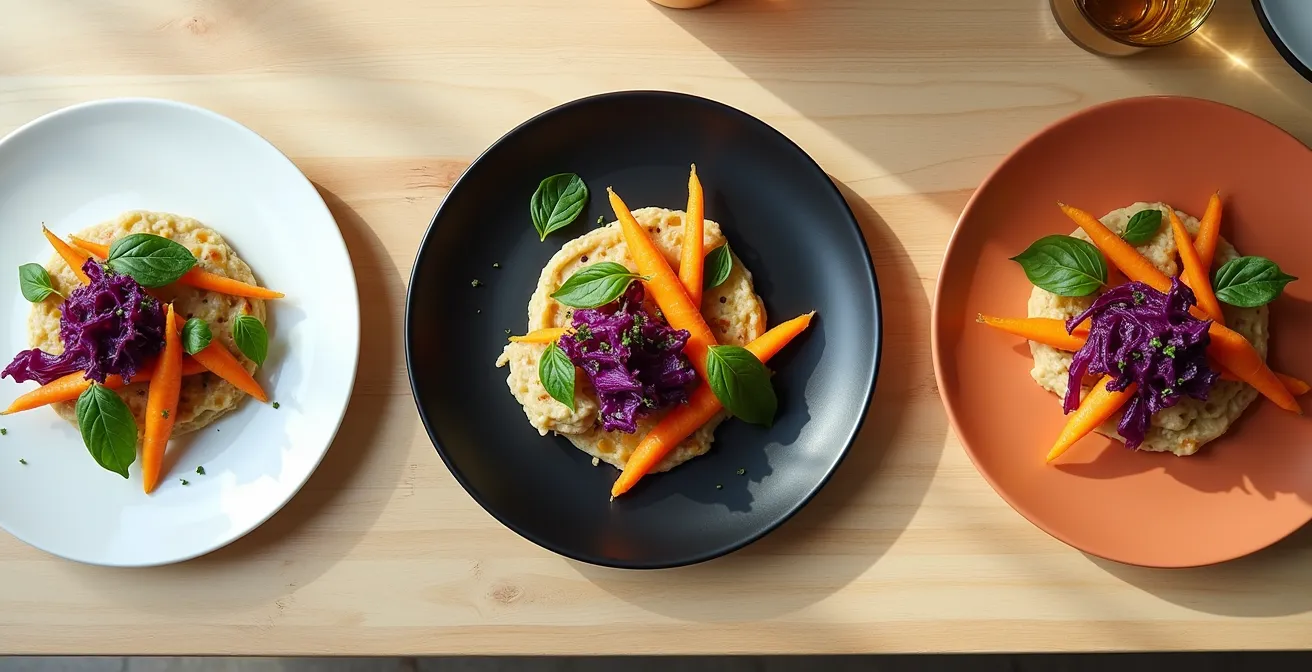
Most believe feeling full is a simple matter of stomach capacity. The reality is a fascinating illusion orchestrated by your brain. True satiety isn’t about volume, but about sensory satisfaction. This article deconstructs the key psychological triggers—from texture and aroma to color and timing—that convince your mind you’re satisfied, empowering you to control your appetite by managing perception, not just portions.
You’ve finished a large meal, yet you still feel… unsatisfied. You find yourself grazing, searching for something more, even though your stomach is physically full. This frustrating experience isn’t a failure of willpower; it’s a sign that you haven’t satisfied your “visual hunger.” For chronic overeaters, this is a familiar battle, often addressed with generic advice like “eat more protein” or “drink water.” These tips scratch the surface, but they miss the fundamental point.
The feeling of fullness is a complex psychological event, a story your brain tells itself based on a flood of sensory data. But what if the real key to feeling satisfied wasn’t just about what or how much you eat, but about manipulating the sensory cues that convince your brain the meal is complete? The answer lies not in deprivation, but in a deeper understanding of the behavioral science of eating. It’s about becoming an architect of your own sensory experience.
This guide will move beyond the platitudes and explore the powerful, often subconscious, mechanisms that govern your appetite. We will dissect how your senses of touch, smell, sight, and even your perception of time can be harnessed to achieve satiety faster and with less food. By understanding these principles, you can transform your relationship with food from a battle of wills into a satisfying sensory journey.
In the following sections, we will delve into the specific sensory and psychological triggers that influence fullness, providing you with a science-backed toolkit to master your appetite from the inside out.
Summary: The Behavioral Science of Satiety
- Crunch, Cream, Chew: Why You Keep Eating When Food Lacks Texture Variety?
- Retronasal Olfaction: Why Holding Your Nose Eliminates Flavor?
- The 20-Minute Rule: How Long Does It Take for the Brain to Register Satiety?
- Red vs Blue Plates: How Crockery Color Influences Appetite?
- Sorbet or Ginger: How to Reset Your Taste Buds Between Rich Courses?
- Crunch vs Creamy: Why Monotextural Desserts Feel Boring?
- Nose Blindness: How Cooking Smells Prevent You From Tasting Your Own Food?
- Social Dieting: How to Eat Mediterranean at a Restaurant Without Breaking Your Diet?
Crunch, Cream, Chew: Why You Keep Eating When Food Lacks Texture Variety?
The mind craves novelty, and this is especially true for the palate. The phenomenon known as sensory-specific satiety explains why you can feel completely full from a savory main course, yet suddenly have room for a sweet dessert. Your brain isn’t just tired of eating; it’s tired of that specific sensory profile. When a meal is texturally monotonous—all soft, all creamy, or all liquid—your brain gets bored quickly and continues to seek a new stimulus, which you interpret as hunger. This is why a bowl of plain soup is often less satisfying than a chunky stew with the same calories.
This isn’t just a feeling; it’s a measurable physiological response. The physical act of chewing and breaking down varied textures sends powerful signals to the brain. In fact, research published in Scientific Reports demonstrates that solid foods reduce hunger by 4.97mm more than liquid foods on visual analog scales. Incorporating contrasting textures—the crunch of nuts in a creamy yogurt, the crispiness of croutons in a smooth soup, the chew of whole grains alongside tender vegetables—keeps the brain engaged and interested. This textural complexity makes the meal feel more substantial and satisfying, signaling fullness long before you’ve overeaten.
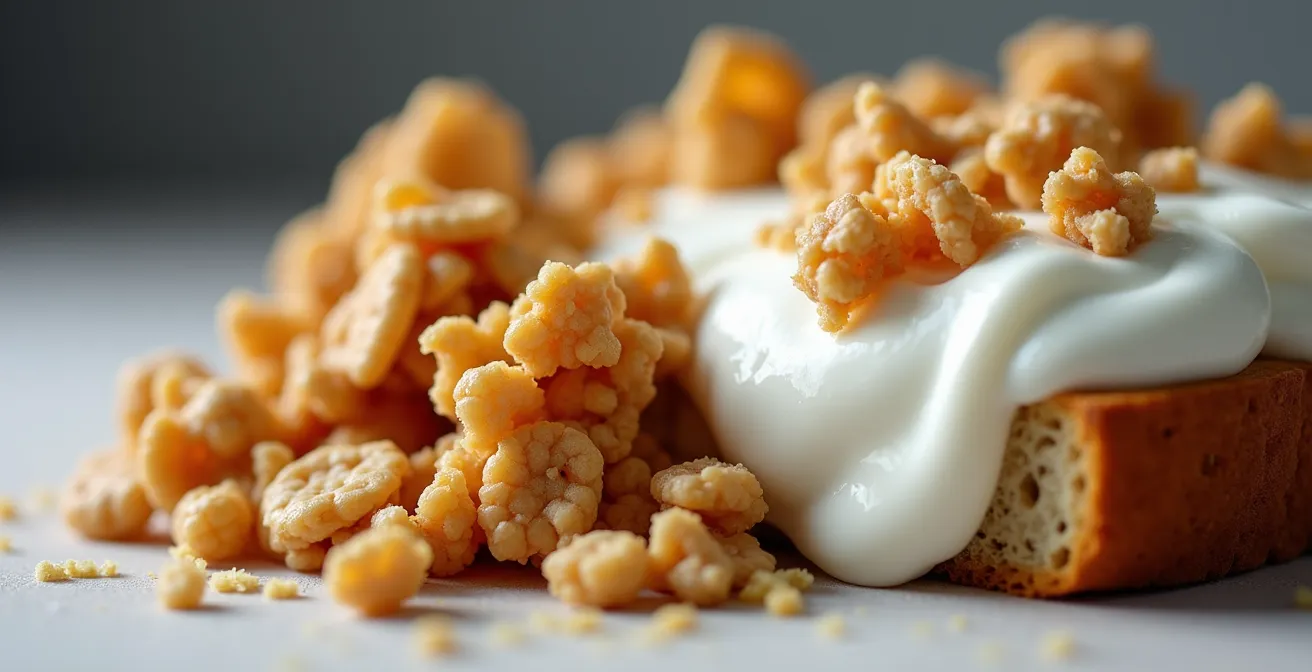
As you can see, the dramatic contrast between crunchy and smooth elements creates a more dynamic and engaging eating experience. Each bite offers a new sensory discovery, preventing the “boredom” that drives you to keep eating. By consciously building meals with a variety of textures, you’re not just making them more interesting; you are directly engaging the brain’s satiety mechanisms.
Retronasal Olfaction: Why Holding Your Nose Eliminates Flavor?
Have you ever noticed that food tastes bland when you have a cold? That’s because what we perceive as “flavor” is not primarily a function of our taste buds. It is a fusion of taste (sweet, salty, sour, bitter, umami) and, most importantly, aroma. This aroma reaches the brain through two pathways: orthonasal olfaction (sniffing through your nose) and retronasal olfaction, where aromatic compounds from the food in your mouth travel up the back of your throat to your olfactory receptors. Without this retronasal pathway, an apple and an onion, both sweet and crunchy, become difficult to distinguish.
This link between smell and eating is so powerful that it directly influences our hunger hormones. The sight and smell of appealing food act as external cues that trigger a physiological hunger response, even if your stomach is empty. As pioneering psychiatrist Petra Schüssler explained following her team’s research at the Max Planck Institute:
The findings of our study demonstrate, for the first time, that the release of ghrelin into the blood for the regulation of food consumption is also controlled by external factors.
– Petra Schüssler, Max Planck Institute of Psychiatry
Her research revealed that mere exposure to the smell and sight of food can cause a significant physiological reaction. This is the science behind “visual hunger.” A study by the Max Planck Institute reveals a 24% increase in brain metabolism when we are exposed to food stimuli, driven by a spike in the hunger hormone ghrelin. This means that simply smelling a bakery can make you physiologically hungrier. To feel full, a meal must deliver not just calories, but a rich aromatic experience that satisfies this deep-seated sensory expectation.
The 20-Minute Rule: How Long Does It Take for the Brain to Register Satiety?
One of the most common reasons for overeating is a simple mismatch in timing. You eat too quickly for your brain to catch up. From the moment you start eating, a complex cascade of hormonal signals is initiated. Your gut begins to release satiety hormones like cholecystokinin (CCK), peptide YY (PYY), and GLP-1. These chemical messengers travel through your bloodstream to your brain, where they bind to receptors in the hypothalamus and signal that you are becoming full. However, this entire process isn’t instantaneous; it takes approximately 20 minutes for these signals to peak and for the brain to register a clear sense of satiety.
When you eat a meal in five or ten minutes, you can easily consume far more calories than you need before your brain gets the “stop” message. This is a crucial vulnerability for chronic overeaters. You are essentially flying blind, relying only on stomach stretch, which is a much cruder and less reliable indicator of fullness than hormonal feedback. Honoring this 20-minute delay is one of the most effective behavioral changes you can make. It requires a conscious effort to slow down and give your body’s sophisticated signaling system time to work.
By implementing simple pacing strategies, you allow your natural satiety mechanisms to function as intended, helping you recognize fullness and stop eating when you are truly satisfied, not just when you are uncomfortably stuffed. The following plan provides a practical framework for putting this principle into action.
Your Action Plan: Evidence-Based Pacing Strategies for Satiety
- Start meals with a broth-based soup or salad to trigger early satiety signals.
- Practice the ‘fork down rule’ – place utensils down between bites to slow your eating pace.
- Incorporate high-protein foods that stimulate PYY and GLP-1 hormone release.
- Stay hydrated, as the brain often mistakes thirst signals for hunger.
- Eat without distractions (like TV or phones) to allow your brain to process satiety signals effectively.
Red vs Blue Plates: How Crockery Color Influences Appetite?
The size, shape, and even the color of your dinnerware can dramatically influence how much food you serve yourself and how satisfying that portion feels. This is not a matter of taste but of cognitive bias, most notably the Delboeuf illusion. This optical illusion causes us to perceive a circle as smaller when it’s surrounded by a large concentric circle compared to when it’s surrounded by a small one. In culinary terms: the same portion of food looks smaller on a large plate, prompting us to serve ourselves more, and larger on a small plate, helping us feel satisfied with less.
However, the illusion’s power is moderated by another crucial factor: color contrast. Research from Van Ittersum and Wansink demonstrated this effect clearly. When there is a low contrast between the food and the plate (e.g., pasta with Alfredo sauce on a white plate), the edges of the food “blend” into the plate, making the portion seem smaller and leading people to overserve. Conversely, a high contrast (e.g., the same Alfredo pasta on a dark red or blue plate) makes the portion “pop.” The food’s boundaries are clearly defined, making the portion appear larger and more substantial. This can lead to a subconscious reduction in the amount of food served and consumed.
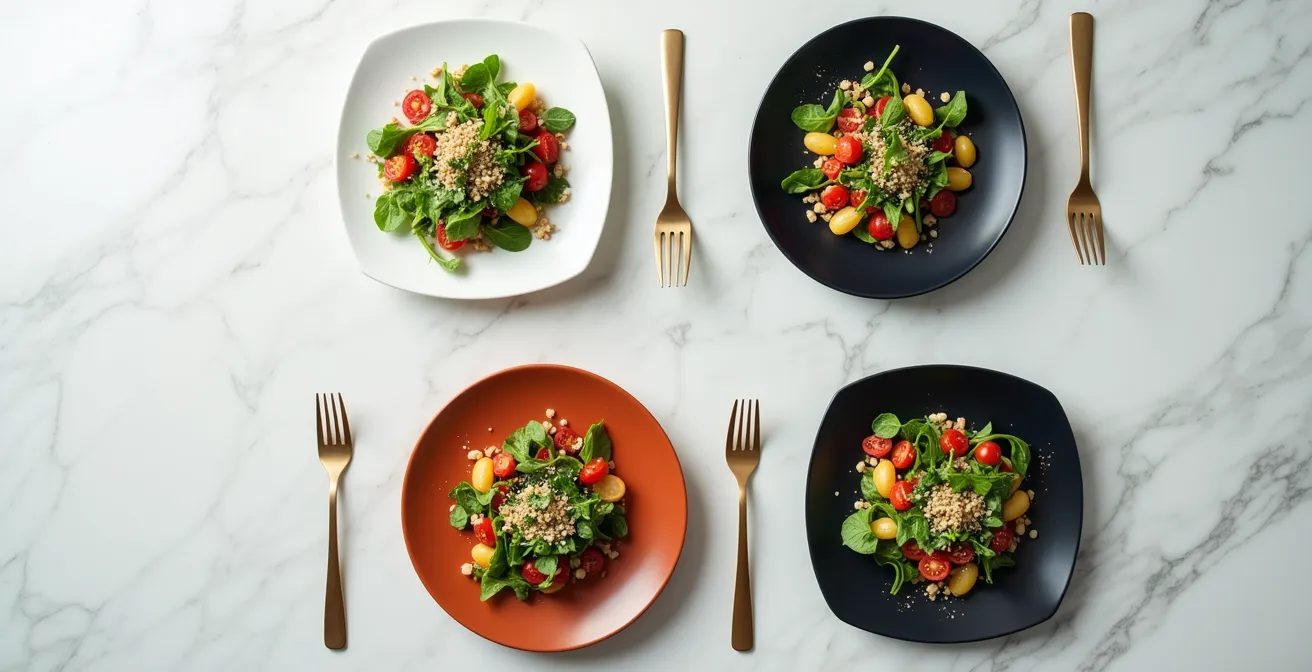
Therefore, the common advice to “use a smaller plate” is only half the story. To maximize the psychological effect, you should use a smaller plate that also has a high color contrast with the food you are eating. An in-depth analysis of portion perception biases confirmed that these visual cues are powerful, non-invasive tools for managing intake. Choosing blue plates for starchy foods or red plates for green salads are simple behavioral hacks that leverage this powerful illusion to help you feel satisfied with more reasonable portions.
Sorbet or Ginger: How to Reset Your Taste Buds Between Rich Courses?
During a multi-course meal or when consuming particularly rich foods, you can experience a form of sensory fatigue known as gustatory adaptation. Your taste buds become desensitized to the dominant flavors, making each subsequent bite less flavorful and less satisfying. This diminished pleasure can inadvertently drive you to eat more, searching for the satisfaction you experienced with the first few bites. To combat this, high-end restaurants employ palate cleansers, a small intermezzo course designed to reset your taste buds and prepare them for the next flavor experience.
The mechanism behind a palate cleanser is one of neutralization. Its purpose is to wash away lingering food particles and strong flavors, while providing a neutral or contrasting sensory signal. The ideal cleanser is typically light and not overpowering. Temperature plays a key role; a cool item like a small scoop of citrus sorbet is effective because the coldness provides a mild “shock” to the palate, heightening sensitivity. The acidity from the citrus also helps to cut through rich, fatty residues.
Another classic example is pickled ginger, served with sushi. The sharp, pungent, and slightly sweet flavor of the ginger effectively clears the palate of the flavor of the previous piece of fish, allowing you to appreciate the distinct nuances of the next. Simpler options can be just as effective: a sip of sparkling water, a bite of a plain cracker, or even a piece of crisp apple can help reset your sensory baseline. Using a palate cleanser isn’t about being fancy; it’s a strategic tool to fight hedonic adaptation, ensuring each part of your meal is experienced with maximum sensory acuity, which in turn leads to greater satisfaction with less food.
Crunch vs Creamy: Why Monotextural Desserts Feel Boring?
The principle of sensory-specific satiety applies with particular force to desserts. A dessert that is texturally one-note—like a simple mousse, a plain pudding, or a basic ice cream—can quickly become uninteresting. This is a direct result of hedonic adaptation, the psychological principle that the pleasure derived from a stimulus decreases as we become accustomed to it. The first spoonful of a creamy chocolate mousse is blissful. By the tenth spoonful, the pleasure has diminished significantly, yet you may keep eating out of habit or in a futile attempt to recapture that initial rush.
This is why the best desserts almost always feature textural contrast. Think of a crème brûlée: the smooth, rich custard is made infinitely more exciting by the brittle, crunchy layer of caramelized sugar on top. Consider a classic apple crumble: the soft, warm apples are balanced by the crunchy, buttery oat topping. This variety keeps your brain engaged, fighting off hedonic adaptation and making the experience more satisfying with every bite. The added texture forces you to slow down and chew more, further contributing to satiety signals.
This effect has been validated by research. For instance, a 2024 study on food texture perception found that participants consumed fewer calories in subsequent meals after eating chunky-textured foods compared to smooth ones, suggesting a greater and more lasting satiety effect. By choosing or creating desserts with multiple textures—creamy, crunchy, chewy, soft—you are providing your brain with a more complex and engaging problem to solve. This complexity translates into a more profound sense of satisfaction, allowing you to feel content with a smaller portion.
Key Takeaways
- Satiety is a psychological event, not just a physical one; satisfying the brain’s senses is crucial.
- Sensory variety, especially in texture and aroma, prevents the “boredom” that leads to overeating.
- Visual cues like plate size and food-plate color contrast directly influence portion perception and consumption.
Nose Blindness: How Cooking Smells Prevent You From Tasting Your Own Food?
Have you ever spent hours cooking a delicious meal, only to find you have little appetite for it when it’s finally served? This common phenomenon is a clear example of olfactory adaptation, colloquially known as “nose blindness.” When you are continuously exposed to a specific scent, your olfactory receptors become saturated and temporarily stop sending signals about that smell to your brain. This is a survival mechanism that allows your nose to remain sensitive to new, potentially dangerous scents in your environment.
While you are cooking, you are bathed in the rich aromas of your dish for an extended period. Your brain gradually tunes them out. Since flavor is predominantly perceived through retronasal olfaction (smell), this desensitization means you will experience a blunted, less vibrant version of your own food’s flavor compared to your guests, who are smelling it for the first time. This diminished sensory pleasure can be deeply unsatisfying and may even lead you to oversalt or over-season your food in a subconscious attempt to taste *something*.
Professional chefs have long known about this and use simple tricks to combat it. To reset your olfactory receptors before you eat, you can:
- Step outside into fresh air for a few minutes before serving the meal.
- Smell something completely different and neutral, like coffee beans, to “cleanse” your nasal palate.
- Add a final layer of fresh, contrasting aroma right at the end of cooking, such as a squeeze of fresh lime juice or a sprinkle of fresh herbs.
By taking a brief break from the cooking environment, you allow your olfactory system to reset. This ensures you can enjoy the full flavor and aroma of your hard work, leading to greater sensory satisfaction and a more accurate sense of fullness.
Social Dieting: How to Eat Mediterranean at a Restaurant Without Breaking Your Diet?
Eating out presents a perfect storm of challenges for anyone trying to manage their intake: large portions, social pressure, and an abundance of tempting choices. However, by applying the psychological principles of satiety, you can navigate a restaurant menu, even a rich Mediterranean one, with confidence. The key is to shift your focus from restriction to strategic choices that maximize sensory satisfaction.
First, weaponize the Delboeuf illusion to your advantage. Restaurant plates are notoriously large. Ask for your meal to be served on a smaller “appetizer” or “salad” plate. This simple swap can make a standard portion feel more abundant. In fact, research on the Delboeuf illusion indicates a potential 20% decrease in food intake when using plates that are just 20% smaller in diameter. Furthermore, pre-commit to your choices. Decide what you will order before you arrive, when your rational brain is in control, to avoid impulsive decisions triggered by the menu’s enticing descriptions and aromas.
When ordering, prioritize a Mediterranean style of eating that is naturally high in satiety triggers. Start with a broth-based soup or a colorful salad to initiate early satiety signals. For your main, choose grilled fish or lean protein (protein-first eating) and ask for double vegetables instead of the standard starch. This combination delivers on texture, color contrast, and the powerful satiety effects of protein. The following table summarizes how these visual and behavioral strategies can impact your intake.
| Strategy | Effect on Intake | Mechanism |
|---|---|---|
| High color contrast (food vs plate) | 10-21% reduction | Enhanced portion awareness |
| Smaller plate size | 20% reduction | Delboeuf illusion |
| Pre-commitment to menu choice | 15-30% calorie reduction | Reduced impulsive decisions |
| Protein-first eating | 12-18% reduction in total meal | Early satiety hormone release |
By combining these strategies, you are not “dieting” in the traditional sense; you are skillfully managing the sensory and psychological cues of your environment to align with your goals, allowing you to enjoy a social meal without derailing your progress.
Ultimately, achieving a healthy relationship with food is not about a battle of willpower or a life of restriction. It is about understanding that feeling full is a conversation between your body and your brain. By learning to speak the brain’s language—the language of sensory cues—you can guide that conversation. You can become the architect of your own satisfaction, using texture, aroma, color, and time to craft meals that are not only nourishing but also profoundly and efficiently satisfying. This knowledge transforms you from a passive consumer into a mindful participant in your own well-being.
Start today by applying just one of these principles. Observe how it changes your experience. You will find that the power to feel full and content has been within you all along—you just needed to know how to unlock it.