
The secret to authentic French chocolate mousse is not adding more ingredients like cream or butter, but mastering the technique with just four essential components.
- The texture is defined by the quality of the chocolate and the precision of the folding, which creates a stable aerial structure.
- Safety and flavor are addressed through understanding the ingredients, from the risk of raw eggs to the role of a spirit in enhancing the chocolate.
Recommendation: Focus on mastering the ‘geste’—the specific, deliberate movements of folding—rather than altering the classic, purist ingredient list.
For the Francophile host, serving *mousse au chocolat* is a statement. It is a dessert that seems simple, yet its perfection is a hallmark of true French culinary understanding. Many recipes, in an attempt to be “richer” or “easier,” will call for butter, heavy cream, or other additions. This is a misunderstanding of the dessert’s soul. An authentic mousse is not about density; it is about an ethereal, aerial structure that carries the pure, unadulterated flavor of fine chocolate. The common advice to simply “use good chocolate” or “fold gently” is a platitude that ignores the science and tradition behind the craft.
But what if the key was not in a long list of ingredients, but in the profound understanding of just four? The true art lies in the *savoir-faire*—the technical knowledge of how chocolate, eggs, sugar, and a single spirit interact to create something sublime. This is the path of French purism. This guide does not just give you a recipe; it imparts the technique. We will deconstruct every choice, from the percentage of cocoa in your chocolate to the specific gesture required to fold the egg whites without deflating your efforts. You will learn not just what to do, but precisely why you are doing it.
For those seeking a different kind of classic, the following video offers a popular musical interlude from a different era. It provides a brief pause before we return to our culinary focus.
In the sections that follow, we will explore the technical decisions that separate a good mousse from an unforgettable one. We will address the critical questions that define the final texture, flavor, and appearance of this iconic dessert, transforming you from a home cook into a confident practitioner of French culinary tradition.
Summary: A Chef’s Guide to Perfect 4-Ingredient Chocolate Mousse
- 70% vs 50% Chocolate: How the Fat Content Changes Mousse Texture?
- Pasteurized Eggs: Are They Necessary for Safe Chocolate Mousse?
- Can You Freeze Chocolate Mousse Without Ruining the Texture?
- Grand Marnier or Rum: Which Spirit Best Lifts Dark Chocolate Notes?
- Whipped Cream or Shaved Chocolate: How to Finish Mousse Visually?
- How to Fold Egg Whites into Base Without Deflating the Air?
- What Does “Napper” Mean and How to Do It Correctly?
- Cocoa Powder vs Real Chocolate: Which Delivers More Intense Cocoa Notes in Baking?
70% vs 50% Chocolate: How the Fat Content Changes Mousse Texture?
The choice of chocolate is the most crucial decision you will make. It is not merely a matter of flavor, but of physics. The final texture of your mousse—whether it is light and airy or dense and fudgy—is dictated by the cocoa and fat content of your chocolate. A common misconception is that a higher cocoa percentage always means better mousse. This is not necessarily true; it simply means a *different* mousse. The key is the ratio of cocoa solids (for flavor) to cocoa butter (for fat and structure).
A 50% chocolate contains more sugar and often more added cocoa butter relative to its cocoa solids. This results in a softer, more fluid melted base, which is easier to fold egg whites into. The final product is typically lighter, more aerated, and sweeter. Conversely, a 70% or higher chocolate has less sugar and a higher concentration of cocoa solids. This creates a denser, more intensely flavored *ganache* when mixed with the egg yolks. It requires a more skilled hand to fold, but the reward is a mousse with a profound, complex chocolate character and a firmer set. This is the choice for the purist.
To understand this balance, it is useful to compare the compositions directly. The following analysis shows how the fat and cocoa solid ratios impact the final texture of the mousse, a detail that is fundamental to the culinary science of this dessert.
| Chocolate Type | Cocoa Content | Fat Content | Texture Result |
|---|---|---|---|
| 50% Dark | 30% nibs + 20% butter | 35% total | Lighter, more aerated |
| 70% Dark | 65% nibs + 5% butter | 37.5% total | Denser, fudgier |
| 75% Dark | 70% nibs + 5% butter | 40% total | Rich, intense |
Pasteurized Eggs: Are They Necessary for Safe Chocolate Mousse?
A traditional *mousse au chocolat* uses raw eggs. This is a non-negotiable component of its authentic texture; the unheated proteins in the egg whites provide the unique lift and structure that cooked versions cannot replicate. However, this raises a valid concern for any responsible host: food safety. The primary worry is Salmonella contamination. While modern food production has drastically reduced this issue, the risk, however small, still exists. For a chef, addressing this concern is part of the craft.
It’s important to put this risk into perspective. According to food safety experts, the risk of getting salmonella from a raw egg is about 1 in 20,000. For most healthy individuals, this is an acceptable risk, especially when using fresh, high-quality, refrigerated eggs. However, for guests who are pregnant, elderly, or have compromised immune systems, this risk is not advisable. So, are pasteurized eggs necessary? The answer is: it depends on who you are serving. A purist will always prefer the texture of fresh, raw eggs, but a professional always prioritizes the safety of their guests.
If you must serve guests who are in a higher-risk category, using pasteurized eggs is the only responsible choice. You can purchase them commercially, or if you are committed to the process, you can pasteurize eggs at home with precision. This ensures safety without resorting to a “cooked” mousse recipe that would compromise the classic texture. It is a compromise, but a professional one.
Can You Freeze Chocolate Mousse Without Ruining the Texture?
A common question for hosts planning a dinner party is whether this delicate dessert can be made in advance and frozen. The answer is yes, but with a critical understanding of what happens to the texture. Freezing a mousse is possible, but it fundamentally changes its structure. The beautiful, delicate network of air bubbles created by the folded egg whites is held in a fragile water-based emulsion. When you freeze it, the water turns into ice crystals.
The size of these ice crystals is the enemy of a smooth texture. A slow freeze will create large, disruptive crystals that give the thawed mousse a grainy or spongy feel. The key to successful freezing is to do it as quickly as possible to encourage the formation of very small micro-crystals. Once made, portion the mousse into its serving vessels, cover tightly with plastic wrap touching the surface to prevent a skin from forming, and place it in the coldest part of your freezer. According to professional chefs, a properly prepared mousse can be frozen for up to two months. When it’s time to serve, you must thaw it slowly and gently in the refrigerator for several hours, never at room temperature, which would cause it to “weep” or separate.
The image below illustrates the difference. On one side, the fresh mousse has a smooth, homogenous surface. On the other, the previously frozen mousse shows subtle changes to its surface sheen, a result of the ice crystal formation and thawing process.

While a frozen mousse will never be quite as perfect as one served fresh, it is a very acceptable compromise for the sake of convenience. It will still be delicious, but a discerning palate will notice a slight loss of its ethereal, airy quality. The texture becomes slightly denser and more compact. It is a trade-off between absolute perfection and practical preparation.
Grand Marnier or Rum: Which Spirit Best Lifts Dark Chocolate Notes?
In a four-ingredient mousse, the spirit is not an optional splash of flavor; it is a functional component. Its role is twofold: it adds a layer of aromatic complexity and, more technically, the alcohol helps to temper the egg yolk and chocolate mixture, preventing it from becoming grainy. As Chef Jean-Pierre notes in his discussions on the classic recipe, the alcohol serves as a “tempering agent for the sabayon.” The choice of spirit, therefore, should be a deliberate one, designed to complement, not overpower, the chocolate.
The two classic choices are a dark rum or an orange-flavored liqueur like Grand Marnier. They offer very different effects. Dark rum, with its notes of vanilla, caramel, and oak, amplifies the deep, roasted notes of the cocoa. It adds warmth and depth, making the chocolate taste more intensely of itself. It is a harmonious pairing. Grand Marnier, on the other hand, provides contrast. Its bright, bitter orange notes cut through the richness of the chocolate, lifting the flavor and adding a layer of fresh acidity. This creates a more vibrant, dynamic flavor profile.
Ultimately, there is no single “correct” answer. The choice is a matter of the chef’s intent. Do you wish to amplify the chocolate’s inherent character, or do you wish to create a compelling contrast? An experienced chef understands how different spirits interact with the chocolate’s profile to achieve a desired effect.
This comparative table from a detailed analysis of flavor pairings breaks down the decision-making process for the aspiring chef.
| Spirit | Flavor Notes | Effect on Chocolate | When to Add |
|---|---|---|---|
| Grand Marnier | Orange, citrus terpenes | Brightens, cuts richness | To warm mixture |
| Dark Rum | Vanilla, woody esters | Amplifies cocoa notes | Folded at end |
| Chartreuse | Herbal, botanical | Contemporary complexity | To warm mixture |
Whipped Cream or Shaved Chocolate: How to Finish Mousse Visually?
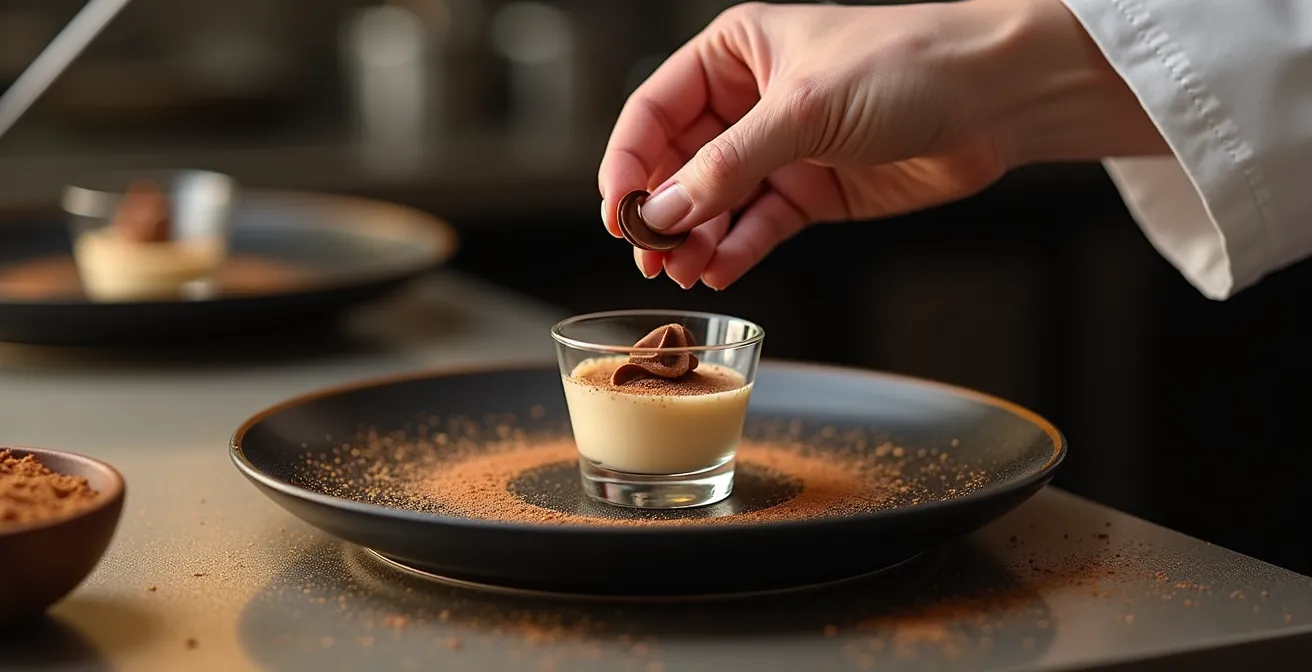
In the French culinary philosophy, the garnish—or *la finition*—is not an afterthought. It must have a purpose. For chocolate mousse, American-style presentations often involve large dollops of sweetened whipped cream or a blizzard of sprinkles. This is contrary to the French principle of purism. The finish should respect the dessert, adding a subtle contrast in texture or a visual accent that enhances, rather than hides, the mousse itself.
The most traditional and respected presentation is also the most simple. A case study on presentation standards reveals a simple truth: in most authentic French bistros and restaurants, chocolate mousse arrives with a simple dusting of high-quality, unsweetened cocoa powder on top. As culinary experts note, often it is just that. *C’est tout* (that’s it)! This is not laziness; it is confidence. It shows that the mousse itself is the star, and its flavor needs no masking.
However, for a host wanting to add a touch of elegance, there are several purist-approved techniques. A few delicate chocolate curls, created by running a vegetable peeler along the side of a room-temperature bar of chocolate, add visual height and a pleasing textural snap. A sprinkle of flaky sea salt (like *fleur de sel*) provides a surprising crunch and enhances the chocolate’s sweetness. Toasted nuts or a single candied violet are also acceptable. The key principle is restraint. The garnish is a quiet grace note, not a competing melody.
How to Fold Egg Whites into Base Without Deflating the Air?
This is the moment where a chocolate mousse is made or broken. You have a dense, rich chocolate base and a light, cloud-like pillow of whipped egg whites. The goal is to combine them into a homogenous mixture while preserving as much of the air from the whites as possible. Simply stirring them together will cause the whites to collapse, resulting in a dense, sad pudding. The technique of folding, or *le geste*, is a precise, deliberate motion that must be learned.
The first step is crucial: you must lighten the chocolate base. Take about one-third of your whipped egg whites—this is your “sacrificial” portion—and mix it vigorously into the chocolate. Do not be gentle here. The goal is to slacken the dense chocolate mixture, making it more receptive to the remaining whites. Now, the real folding begins. Add the rest of the whites on top. Your tool should be a large, flat spatula.
The motion is like a paddle wheel. Cut down through the center of the mixture to the bottom of the bowl, then scrape along the bottom towards you, and “fold” that portion of the mixture up and over the top. After each fold, rotate the bowl a quarter turn. This ensures you are incorporating everything evenly. You must work quickly but gently. The enemy is over-mixing. You should stop folding when there are still a few small, pea-sized wisps of white visible. These will incorporate themselves as you portion the mousse. This is the sign of a skilled hand; mixing until perfectly uniform is a beginner’s mistake that deflates the mousse.
Your Action Plan: The Art of Folding
- Sacrifice the First Third: Vigorously mix about 1/3 of the egg whites into the dense chocolate base to lighten its consistency.
- Master the Paddle Wheel Motion: Use a large spatula to cut down the center, scrape the bottom of the bowl towards you, and fold the mixture over the top.
- Rotate the Bowl: After each complete fold, turn the bowl a quarter turn to ensure even and gentle incorporation.
- Know When to Stop: Cease folding when you still see small, pea-sized wisps of white. These will disappear during portioning. Do not overmix.
- Work with Speed: A cold base and cold whites maintain structure. Work efficiently to prevent the mixture from warming and the whites from deflating.
What Does “Napper” Mean and How to Do It Correctly?
In the world of professional plating, language is precise. To elevate your dessert presentation from homemade to restaurant-quality, it helps to understand these terms. One of the most useful is “napper.” In French culinary vocabulary, *napper* means to lightly coat a food or the surface of a plate with a sauce. The goal is to add a thin, elegant layer of flavor and color, just enough to cover the surface without drowning it. It is an act of subtlety.
This is different from “glacer” (to glaze), which implies a thick, shiny coating, or simply “saucer” (to sauce), which can be less precise. *Napper* implies control and elegance. For a chocolate mousse, a chef might *napper* the bottom of the bowl or plate with a thin layer of *crème anglaise* (vanilla custard) or a vibrant raspberry coulis before placing a quenelle of mousse on top. This creates a beautiful color contrast and adds a complementary flavor—the vanilla’s creaminess or the berry’s acidity—to cut through the chocolate’s richness.
A popular professional technique involves spooning a small amount of sauce onto the plate and then using the back of the spoon to drag it across the surface, creating an artistic swipe of color. This action both “nappes” the serving area and creates a dynamic visual element. It is a simple gesture that demonstrates confidence and a professional understanding of plating. Mastering this technique is a small detail that makes a significant impact on your guests’ experience.
Key Takeaways
- True chocolate mousse relies on technique and the quality of four ingredients, not a long list of additions like cream or butter.
- The texture is a direct result of the chocolate’s fat-to-solid ratio and the precise, gentle folding of egg whites.
- Presentation should be purist and restrained, with a simple dusting of cocoa or a delicate chocolate curl, to let the mousse itself shine.
Cocoa Powder vs Real Chocolate: Which Delivers More Intense Cocoa Notes in Baking?
While our focus is on a mousse made with real, melted chocolate, a true chef understands their full palette of ingredients. This includes knowing when and why to use cocoa powder versus solid chocolate. Both come from the cacao bean, but they behave very differently and deliver different kinds of chocolate flavor. Real chocolate contains both cocoa solids (for flavor) and cocoa butter (for fat, texture, and mouthfeel). It provides a complex, nuanced flavor profile with a rich, melting quality.
Cocoa powder, on the other hand, is almost pure cocoa solids, with most of the cocoa butter removed. This makes it a highly concentrated source of pure cocoa flavor. When used in baking, it provides a very direct, intense, and often slightly bitter chocolate note. However, because it lacks fat, it can result in a drier texture if not balanced with other fats like butter or oil. “Dutch-process” or “alkalized” cocoa powder has been treated to neutralize its acidity, resulting in a darker color and a smoother, less astringent flavor.
So, which delivers more intense notes? For a pure, sharp cocoa “hit,” bloomed cocoa powder (mixed with a hot liquid to release its flavor) is the most potent. For a rich, complex, and rounded chocolate experience with a luxurious mouthfeel, nothing can replace real chocolate. For our mousse, real chocolate is the only choice because we need the cocoa butter to form the proper emulsion and set. Using cocoa powder would result in a grainy, unstable mixture. Understanding this distinction is key to becoming a master of all chocolate desserts, not just this one.
The path to a perfect mousse au chocolat is now clear. It is a journey of restraint, precision, and respect for the ingredients. Begin today by selecting your chocolate, respecting the process, and mastering *le geste*. Your guests will taste the difference in every spoonful.
Frequently Asked Questions About Mousse au Chocolat
What does ‘napper’ mean in culinary terms?
‘Napper’ means to lightly coat a food or plate with sauce, just enough to cover the surface without drowning it.
How is ‘napper’ different from ‘glacer’?
‘Glacer’ means to glaze with a shiny coating, while ‘napper’ is a lighter coating technique.
What sauces work best for napping under chocolate mousse?
Crème anglaise (vanilla custard) or fruit coulis (raspberry, passion fruit) create professional contrast.