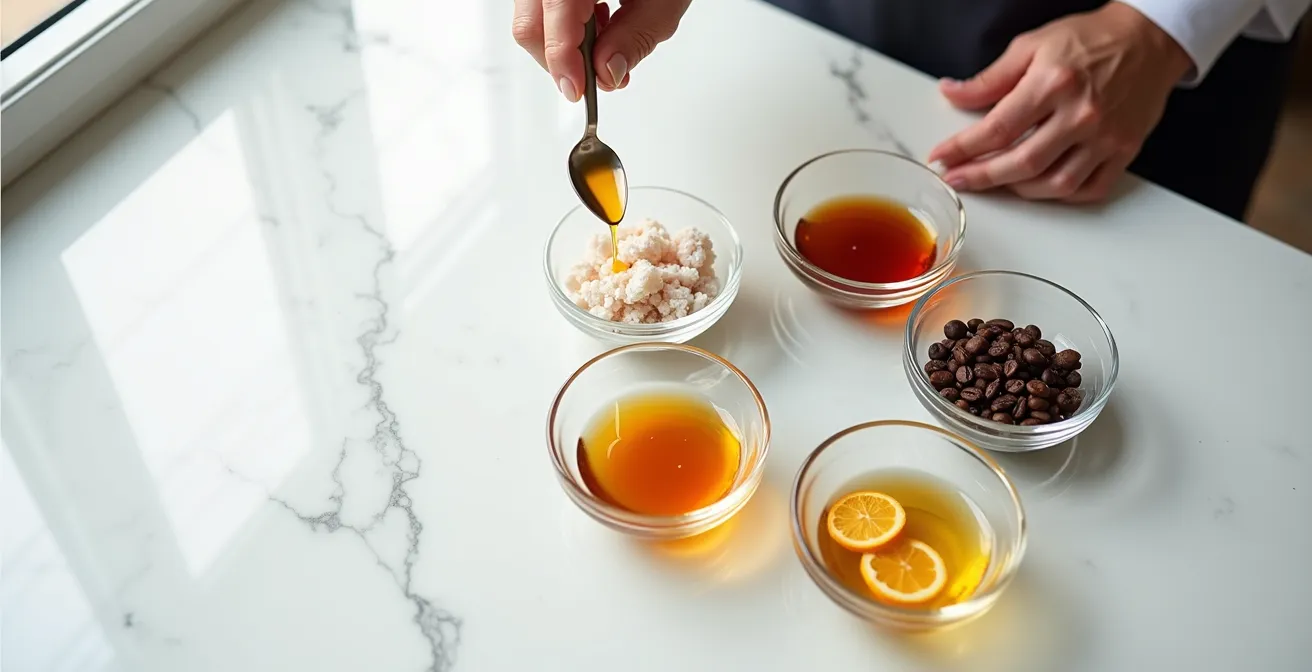
Developing a professional palate is not magic; it is the mastery of a rigorous diagnostic system for deconstructing flavor.
- A “flat” dish is a symptom of imbalance, typically a deficit in salt, acid, or fat—not a lack of ingredients.
- Flavor perception is a science: temperature, aroma, and ingredient interactions at the receptor level dictate what you taste.
Recommendation: Stop adding ingredients hoping for the best. Start tasting with intent, isolating variables to make precise, targeted corrections.
Every aspiring chef reaches a plateau. Your execution is clean, your recipes are sound, but the final dish lacks something you can’t quite name. It tastes “flat” or “muddy.” The common advice is to “learn the five tastes” or simply “taste as you go,” but this is insufficient. It is the equivalent of telling a mechanic to “listen to the engine” without teaching them what each sound means. True culinary intuition is not a gift; it is a discipline. It is the ability to move beyond simply following a recipe and to start commanding flavors based on a systematic understanding of how they interact.
This is where most cooks fail. They treat seasoning as an afterthought, a final sprinkle of salt and pepper. A professional, however, understands that balancing a dish is an active, continuous process of diagnosis and correction. It involves understanding not just what to add, but why. The key is not in a more complex recipe, but in a more refined sensory process. This guide is not a collection of cooking tips. It is a training manual for your palate. We will dismantle the core principles of flavor balance, debunk common myths, and provide a structured framework to help you taste, diagnose, and correct any dish with precision and confidence.
This article provides a structured curriculum for your palate. We will begin with the foundational diagnostic tool for correcting flatness, then move to debunking persistent myths that hinder progress. We will then dissect the environmental and biological factors that alter your perception, before concluding with the core techniques that form the basis of a professional’s sensory library.
Summary: The 5 Tastes: A Disciplined Approach to Identifying What’s Missing in Your Dish
- Fat, Acid, Salt, Heat: How to Correct a Dish That Tastes “Flat”?
- Potato Myth: Does Adding a Potato Actually Remove Salt from Soup?
- The Spoon Method: Why You Must Taste at Temperature, Not Boiling Hot?
- Nose Blindness: How Cooking Smells Prevent You From Tasting Your Own Food?
- Blocking Bitterness: Why Salt Suppresses Bitterness Better Than Sugar?
- Why Adding Flaky Salt to Caramel Enhances Sweetness Perception?
- Fat vs Acid: How to Balance Rich French Sauce with Sharp Asian Vinegar?
- Which 5 Essential Techniques Will Transform Your Home Cooking from Average to Restaurant Quality?
Fat, Acid, Salt, Heat: How to Correct a Dish That Tastes “Flat”?
A dish that tastes “flat” is a diagnostic problem, not an ingredient problem. The flavor is one-dimensional, lacking vibrancy and depth. Before you even consider adding another herb or spice, you must address the four foundational pillars of flavor: salt, fat, acid, and heat. These are not just ingredients; they are tools for manipulation. Salt is the primary flavor enhancer; it doesn’t just make food salty, it makes food taste more like itself by amplifying existing flavors. If a dish is bland, your first correction must always be salt.
If salt doesn’t solve the problem, the next variable is acid. A squeeze of lemon, a splash of vinegar, or a dollop of yogurt cuts through richness and brightens muted flavors. It provides a high note that lifts an otherwise heavy dish. If the dish tastes rich but still dull, it is crying out for acidity. Next, evaluate fat. Ingredients like butter, cream, or olive oil carry flavor and provide a satisfying mouthfeel. A lack of fat can make a dish feel thin and unsatisfying, causing flavors to dissipate too quickly on the palate.
Finally, consider heat—not spiciness, but the application of thermal energy. Searing, caramelization, and the Maillard reaction create complex, deep flavors that cannot be achieved by simply boiling or steaming. A lack of browning is a common cause of flatness in stews and roasts. Mastering this diagnostic sequence is the first step toward cooking by taste, not by recipe.
Your Action Plan: The 4-Step System to Fix Flat-Tasting Dishes
- Salt Adjustment: Taste the dish. Add a small amount of salt, stir, and taste again. Repeat until flavors become more pronounced and defined, not just “salty.”
- Acid Addition: If the dish is still flat after proper salting, add a small amount of acid (e.g., lemon juice for fish, red wine vinegar for a stew). Taste. The goal is brightness, not sourness.
- Fat Evaluation: Assess the mouthfeel. Is it thin or watery? A finishing drizzle of extra virgin olive oil or a knob of butter can add richness that helps carry the other flavors.
- Heat Application Review: Reflect on your cooking process. Did you achieve proper browning on your meat or vegetables? If not, remember that deep color equals deep flavor for your next attempt.
Potato Myth: Does Adding a Potato Actually Remove Salt from Soup?
One of the most persistent and incorrect pieces of culinary advice is to add a raw potato to an over-salted soup. The theory is that the potato acts like a sponge, soaking up the excess sodium. This is fundamentally wrong. A potato will absorb some of the salty liquid, but it absorbs the salt and water in the same proportion as the surrounding broth. It does not selectively target sodium ions. When you remove the potato, you are removing a small amount of salty soup, which has a negligible effect on the overall salinity of the pot. Relying on this myth is a mark of an amateur.
A professional chef addresses over-salting with precision, using one of three proven methods that tackle the root problem: concentration. These techniques are not magic; they are applied chemistry. The first and most direct method is dilution. By adding more unsalted liquid—be it water, stock, or wine—you increase the total volume, thereby lowering the salt concentration. This is the most effective way to correct the error. The key is to add the liquid slowly and taste frequently to avoid over-diluting the other flavors.
The other two methods work not by removing salt, but by altering its perception. Adding acid (like vinegar or citrus juice) can help balance the taste, making the saltiness less prominent by introducing a competing sour flavor. Similarly, adding fat (such as cream, butter, or olive oil) can mute the perception of salt by coating the tongue and providing a rich counterpoint. These methods require a more delicate touch, as you are adding flavor to mask an error, but they are infinitely more effective than the potato myth.
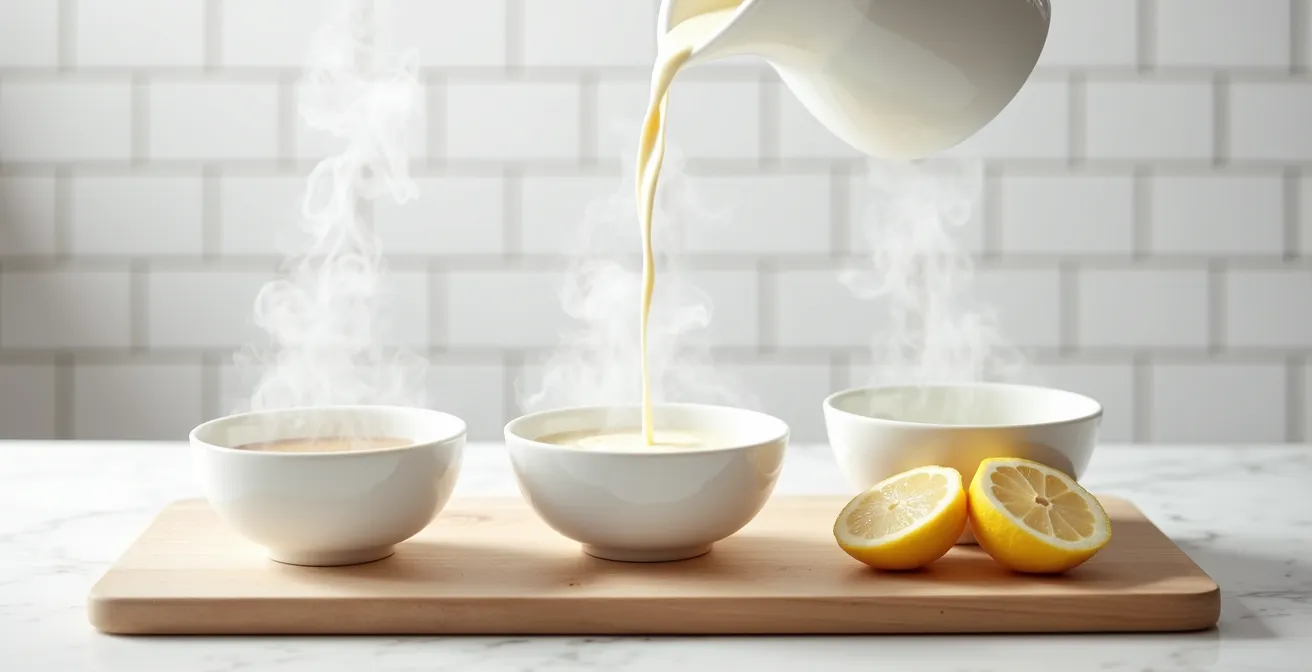
As the image demonstrates, the solutions are logical and direct. You either dilute the concentration or you balance it with a counter-flavor. There is no room for folklore in a disciplined kitchen. Understanding these principles separates those who follow recipes from those who command them.
The Spoon Method: Why You Must Taste at Temperature, Not Boiling Hot?
A critical error aspiring cooks make is tasting a sauce or soup directly from a boiling pot. Your palate is not a thermometer, and extreme temperatures completely distort your perception of flavor. Tasting scalding hot food is not just dangerous; it is counterproductive. Heat suppresses our ability to perceive certain tastes while amplifying others. Specifically, high temperatures make it difficult to detect bitterness and sourness, which can lead to over-seasoning. You might find a boiling-hot sauce perfectly balanced, only to discover it’s cloyingly sweet or acridly bitter once it cools to serving temperature.
The “Spoon Method” is a required discipline. You must take a small amount of the liquid onto a spoon and either blow on it or wait a few moments until it cools to a warm, not hot, temperature. This is the only way to get an accurate reading of the final flavor profile. Our taste buds are most receptive and provide the most accurate information in a specific temperature range. At this optimal warmth, you can properly gauge the interplay of all five tastes: sweet, salty, sour, bitter, and umami. Tasting at boiling point is tasting with incomplete data.
The following data illustrates precisely how temperature skews your sensory input. Notice how bitterness and sourness are suppressed when hot but become prominent as the food cools. Conversely, sweetness is enhanced by heat. This is not subjective; it’s a well-documented phenomenon of taste perception that every serious cook must understand and account for.
| Temperature | Sweet | Bitter | Sour | Salty | Umami |
|---|---|---|---|---|---|
| Hot (>140°F) | Enhanced | Suppressed | Suppressed | Moderate | Enhanced |
| Warm (100-140°F) | Optimal | Balanced | Balanced | Optimal | Optimal |
| Room Temp | Moderate | Enhanced | Enhanced | Balanced | Moderate |
| Cold (<70°F) | Suppressed | Strong | Strong | Suppressed | Weak |
This table isn’t just data; it’s an operational manual for your palate. A soup that tastes perfectly seasoned when hot will taste bland and under-salted when served cold, as our perception of saltiness is suppressed at low temperatures. As a breakdown of taste perception shows, this is why cold desserts require more sugar to taste as sweet as their warm counterparts. Always calibrate your seasoning at or near the intended serving temperature.
Nose Blindness: How Cooking Smells Prevent You From Tasting Your Own Food?
If you have been simmering a stew for hours, you are the least qualified person in the house to judge its final flavor. The reason is a phenomenon known as olfactory fatigue, or “nose blindness.” Your sense of smell and sense of taste are inextricably linked. In fact, culinary research suggests that as much as 80% of what we perceive as taste is actually smell, processed by our olfactory receptors. When you are exposed to a constant aroma for a prolonged period—like the smell of garlic and herbs from your simmering pot—your brain begins to register it as background noise and tunes it out to remain sensitive to new, potentially dangerous scents.
This sensory adaptation means you are no longer perceiving the full aromatic profile of your own dish. When you taste it, you are getting a muted, incomplete picture. This often leads to a classic error: over-seasoning. You might think the dish needs more cumin or more thyme, when in reality, the aroma is already powerful, but your own senses have become desensitized to it. Someone walking into the kitchen for the first time will experience the dish’s aroma in its full intensity.
A professional chef is acutely aware of this and actively works to combat it. You cannot trust a fatigued palate. To get an accurate taste, you must perform a sensory calibration. This involves deliberately resetting your olfactory receptors before you make a final seasoning decision. The simplest method is to leave the kitchen for at least five minutes. Go outside, breathe fresh air, and then return. The aromas of your dish will strike you with the same intensity as they would a guest. Other professional techniques include smelling something neutral, like coffee beans or the crook of your own arm, to provide a new baseline for your senses. Another method is to chew on a plain water cracker to cleanse the palate of lingering flavors. Only after such a reset can you trust your judgment.
Blocking Bitterness: Why Salt Suppresses Bitterness Better Than Sugar?
The instinctive reaction to a bitter flavor is to counteract it with sweetness. While sugar can mask bitterness, it often does so clumsily, creating a muddled flavor profile where two dominant sensations are fighting for attention. A far more elegant and effective tool for controlling bitterness is salt. This is not about masking; it is about chemical inhibition. Salt actively suppresses our perception of bitterness at the receptor level on our tongue. When sodium ions are present, they interfere with the signaling of bitter compounds, effectively turning down their volume.
This principle is a cornerstone of professional flavor balancing. It allows a chef to make bitter ingredients like radicchio, arugula, kale, or brussels sprouts more palatable without altering their fundamental character with sweetness. A pinch of salt on bitter greens in a salad doesn’t just season them; it chemically reduces their aggressive edge, allowing their more subtle, pleasant flavors to emerge. This is a technique of precision, not brute force.

This technique is especially crucial in applications where adding sugar would be inappropriate or destructive to the intended profile. A chef seeking to smooth out the bitter notes in a dark roast coffee or a high-cacao chocolate will use a few grains of salt, not a spoonful of sugar. As a case study from professional kitchens confirms, salt’s direct inhibition of bitter receptors is the preferred method for refining flavors in savory and even some sweet contexts. Understanding this allows you to wield salt as a tool for more than just salinity; you are using it as a flavor modulator.
Why Adding Flaky Salt to Caramel Enhances Sweetness Perception?
The rise of salted caramel is not a mere trend; it is the commercialization of a fundamental principle of sensory science: flavor contrast. Adding salt to a sweet substance like caramel does not make it less sweet. Instead, it enhances the perception of sweetness by creating a dynamic interplay on the palate. When our taste receptors are stimulated by two opposing tastes simultaneously—in this case, salty and sweet—our brain registers the experience with heightened intensity. The salt provides a sharp, savory counterpoint that prevents the sweetness from becoming monotonous or cloying.
This effect is twofold. First, as we learned, salt can suppress mild bitterness that is often present in deeply caramelized sugar, cleaning up the flavor profile and allowing the pure sweetness to shine. Second, the presence of a contrasting flavor simply makes the dominant one more interesting. A single, monolithic flavor leads to palate fatigue quickly. The jolt of saltiness resets the palate with each bite, allowing you to perceive the sweetness anew. It is the difference between a flat, one-note sound and a rich, harmonic chord.
The key to successful application is in the type of salt and the timing. You must use a finishing salt, such as Maldon or another flaky sea salt, and apply it after the caramel has cooled slightly. Using fine-grain table salt during cooking will simply dissolve, making the caramel taste uniformly salty. Flaky salt provides distinct, crunchy points of salinity that contrast texturally and flavorfully with the smooth, sweet caramel. This technique extends beyond caramel and applies to many other foods:
- A sprinkle of flaky salt on ripe watermelon or mango slices.
- A pinch of salt in cookie or cake batter.
- A salted rim on a sweet cocktail like a margarita.
- Finishing salt on chocolate mousse or brownies just before serving.
Fat vs Acid: How to Balance Rich French Sauce with Sharp Asian Vinegar?
Balancing fat and acid is one of the most crucial skills in cooking. Fat provides richness, mouthfeel, and carries flavor, while acid cuts through that richness, cleanses the palate, and adds brightness. When they are in harmony, a dish is vibrant and satisfying. When they are out of balance, it can be heavy and cloying or sharp and aggressive. The challenge intensifies when you cross culinary traditions, for example, by attempting to integrate a sharp, assertive Asian rice vinegar into a classic, fat-rich French butter sauce like a beurre blanc.
A common failure in this scenario is a “broken” sauce. The high acidity of the vinegar can cause the fat emulsion to separate, resulting in a greasy, watery mess. An amateur might discard it and start over. A professional understands the mechanics of emulsion and knows how to correct it. An emulsion is a suspension of fat molecules within water (or in this case, a water-based reduction of vinegar and wine). It is held together by emulsifying agents, typically proteins from the butter.
Case Study: The ‘Monter au Beurre’ Rescue Technique
When a sharp acid breaks a butter sauce, professionals immediately remove the pan from the heat to stop the cooking process. Then, they begin to whisk vigorously while adding one or two cubes of ice-cold butter. This technique, known as ‘monter au beurre’, forces the sauce to re-emulsify. The cold temperature of the new butter drops the overall temperature of the sauce, slowing the reaction, while the slow melting and constant whisking allow the fat globules and proteins to gradually re-bond with the liquid and acid molecules. As detailed in an analysis of the core elements of cooking, this creates a stable, creamy-acidic balance rather than a sharp separation. This is a technical save that turns a potential failure into a sophisticated, balanced sauce.
This technique demonstrates a deeper understanding of food science. It’s not just about adding ingredients; it’s about controlling their physical and chemical interactions. The ability to create and maintain an emulsion, especially in the face of a challenging component like strong vinegar, is a test of a chef’s technical proficiency. The goal is a perfect synthesis where the acid’s sharpness is tamed by the fat’s creaminess, and the fat’s heaviness is lifted by the acid’s brightness.
Key Takeaways
- Your palate is an instrument that must be calibrated; taste at serving temperature and reset your senses to fight olfactory fatigue.
- Flavor correction is a diagnostic process: always start with salt, then address acid, fat, and heat in a systematic order.
- Salt is a modulator, not just a seasoning. Use it to suppress bitterness and to create contrast that enhances sweetness.
Which 5 Essential Techniques Will Transform Your Home Cooking from Average to Restaurant Quality?
Moving from a home cook to a chef-level thinker requires a deliberate shift in mindset. You must stop seeing ingredients as a shopping list and start seeing them as data points for your senses. The preceding sections have laid the groundwork by explaining the *why* behind flavor interactions. Now, we codify this knowledge into five essential techniques. These are not recipes; they are training exercises for your palate. Practicing them diligently will build the sensory library and diagnostic skills necessary to cook with intuition and authority.
These techniques force you to be an active, analytical taster rather than a passive consumer. They are designed to break down the complex experience of flavor into its constituent parts so you can understand how each element contributes to the whole. This is how professional chefs develop their palate—not through magic, but through structured, repetitive, and mindful practice. Integrate these drills into your daily cooking until they become an unconscious part of your process. This is the path from average to exceptional.
This is your curriculum. Master these five techniques, and you will have built the foundation for a truly professional palate.
- Technique 1: Practice Taste Deconstruction. When you taste a dish, don’t just ask “is it good?”. Actively search for individual components in a specific order. First, identify the acid. Then, focus on the fat’s richness. Finally, detect the level of heat or spice. This trains your brain to isolate and analyze, rather than just experience.
- Technique 2: Build a Sensory Library. This is non-negotiable homework. Taste ingredients in isolation. Taste five different vinegars and write down specific words to describe each. Do the same with oils, salts, and chiles. You cannot identify what is missing in a dish if you don’t have a precise mental reference for what that element tastes like on its own.
- Technique 3: Implement Umami Synergy. Understand that umami is not a single flavor. It is created by combining ingredients rich in glutamates (like tomatoes, soy sauce, or parmesan cheese) with those rich in nucleotides (like mushrooms, anchovies, or cured meats). The combination creates an exponential, savory depth that neither ingredient could achieve alone. Practice this synergy.
- Technique 4: Use the Subtraction Method. When developing a new sauce or vinaigrette, taste it in stages. Taste the base liquid. Then, add only salt and taste again. Then, start over, and add only acid and taste. This method of subtraction teaches you the precise contribution of each core component, clarifying its role in the final balance.
- Technique 5: Apply Staged Seasoning. Never season a dish only at the end. Season at every major stage of cooking. Salting meat before searing, salting onions as they sweat, and salting a sauce as it simmers builds layers of flavor. Final seasoning should only be a minor adjustment, not the entire flavor foundation.
Stop hoping for good results and start engineering them. This systematic approach is the only path to true culinary mastery. Begin applying this diagnostic discipline to every dish you create, starting today.