
Feeling anxious about restaurant menus is the main obstacle to social dieting, but the solution isn’t restriction—it’s strategy.
- Mastering physiological levers like satiety (through healthy fats and fiber) and flavor puts you in control of your meal.
- Learning to navigate menus to spot hidden sugars and make smart substitutions transforms dining out from a threat into an opportunity.
Recommendation: Instead of avoiding social events, use them as a training ground to apply these strategies, building confidence with each successful, enjoyable meal.
The invitation arrives, and a familiar knot tightens in your stomach. Dinner with friends, a celebration, a business lunch—it should be a joy, but for many on a weight management journey, it feels like a test. You’re not alone in this feeling. The fear of derailing your progress, the anxiety of navigating a menu filled with tempting “traps,” and the social pressure can turn what should be a pleasant experience into a source of stress. Many dieters simply choose to opt out, missing valuable social connections for fear of the food.
The common advice often feels inadequate: “look at the menu beforehand” or “just order a salad.” These tips skim the surface and fail to address the core issue: a feeling of powerlessness. They frame the restaurant as a battlefield where you must constantly defend yourself. But what if we reframed the entire situation? What if, instead of viewing the menu as a minefield, you saw it as a map you knew how to read? The key isn’t to restrict yourself into a corner but to empower yourself with knowledge.
This is where the principles of the Mediterranean diet shine, not just as a list of foods, but as a strategic framework. This guide moves beyond the generic advice. We will delve into the “why” behind the “what”—understanding the physiological mechanisms of satiety, the science of flavor, and the psychology of mindful eating. By learning to engineer your meal for fullness and satisfaction, you can turn any Mediterranean restaurant into a powerful ally for your health goals.
This article will provide you with a set of actionable strategies, from estimating portions without a scale to understanding why a little olive oil is your best friend. We’ll equip you to enjoy the social connection of dining out, confident in your choices and in control of your journey. Let’s transform that anxiety into mastery.
Summary: How to Master Mediterranean Dining on a Diet
- The Hand Measure Method: How to Estimate Portions Without a Scale?
- Why Adding Olive Oil to Salad Keeps You Full Longer Than Fat-Free Dressing?
- Soluble vs Insoluble: Which Fiber Reduces Belly Bloat?
- “Light” Products: Why Low-Fat often Means High-Sugar?
- Wine on a Diet: How to Incorporate a Glass Without Stalling Weight Loss?
- How to Use Konjac Noodles Without the Rubber Band Texture?
- The 20-Minute Rule: How Long Does It Take for the Brain to Register Satiety?
- How to Make Healthy Meals Taste Rich and Decadent Without Excess Fat?
The Hand Measure Method: How to Estimate Portions Without a Scale?
One of the biggest anxieties in a restaurant is the sheer size of the portions. Without a food scale, it’s easy to feel lost. The hand measure method is your secret weapon for regaining control. It’s not about being perfectly precise; it’s about creating a reliable, personal, and discreet visual guide. This simple practice helps recalibrate your perception of a “normal” serving size, empowering you to make conscious decisions right at the table.
Think of your hand as a personalized set of measuring cups. A serving of protein, like grilled fish or chicken, should be about the size and thickness of your palm (excluding fingers). A serving of carbohydrates, such as a side of quinoa or a portion of potatoes, should be no larger than your clenched fist. For vegetables, be generous! Aim for two cupped hands’ worth—a portion that should fill at least half your plate. And for added fats like olive oil or a sprinkle of feta, a portion is about the size of your thumb.
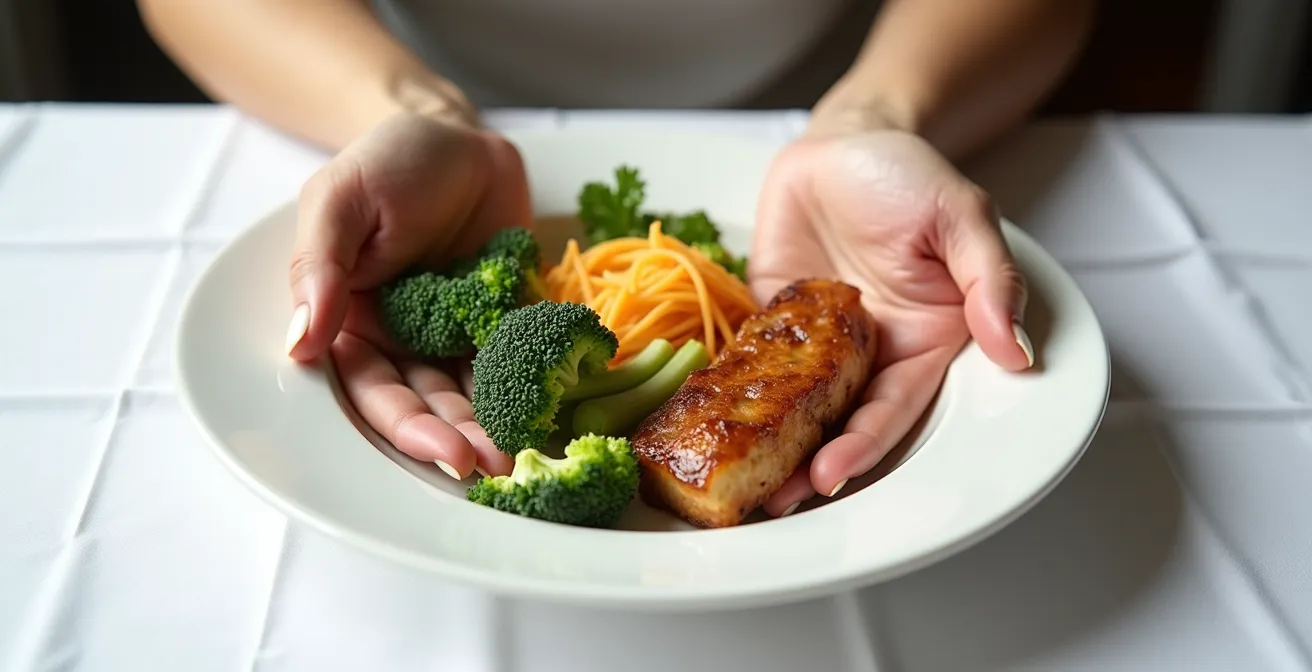
Visualizing these portions as you look at your plate is the first step. You don’t need to leave food behind; you can simply be mindful of these guidelines as you eat. Combining this with other strategies, like ordering a fiber-rich appetizer first and then waiting 10-15 minutes to gauge your true hunger, can dramatically prevent overeating. This isn’t about restriction; it’s about Satiety Engineering—actively building a meal that satisfies you with the right amount of food.
By using your hand as a guide, you’re not just controlling portions; you’re building a sustainable skill that works in any social dining situation, freeing you from the anxiety of the unknown.
Why Adding Olive Oil to Salad Keeps You Full Longer Than Fat-Free Dressing?
For decades, “low-fat” was synonymous with “healthy,” leading many dieters to religiously choose fat-free dressings. However, this approach often backfires, leaving you hungry an hour later and more likely to snack. The secret to lasting fullness lies in understanding the powerful role of healthy fats, with olive oil being the cornerstone of the Mediterranean diet. Fat is a crucial component of satiety signaling, the communication system between your stomach and your brain.
When you consume healthy fats like those in olive oil, it slows down gastric emptying. This means the food stays in your stomach longer, promoting a sustained feeling of fullness. Furthermore, fat triggers the release of hormones like cholecystokinin (CCK), which directly tells your brain you are satisfied. Fat-free dressings, on the other hand, are often loaded with sugar, salt, and thickeners to compensate for the lack of flavor and texture. This can lead to a quick blood sugar spike and a subsequent crash, triggering hunger and cravings shortly after your meal. Choosing olive oil isn’t just a “healthy” choice; it’s a strategic one for appetite control.
The comparison below clearly illustrates why a simple olive oil and vinegar dressing is a superior choice for anyone focused on weight management and overall health. It’s about nutrient quality, not just calorie quantity.
| Factor | Olive Oil Dressing | Fat-Free Dressing |
|---|---|---|
| Satiety Duration | 3-4 hours | 1-2 hours |
| Caloric Density | 120 cal/tbsp | 20-40 cal/tbsp |
| Nutrient Absorption | Enhances fat-soluble vitamins (A,D,E,K) | Limited absorption |
| Blood Sugar Impact | Stabilizes, slows digestion | May cause quicker spike |
| Common Hidden Ingredients | None (pure olive oil) | Added sugars, thickeners |
By embracing olive oil, you also enhance the absorption of fat-soluble vitamins (A, D, E, and K) from your vegetables, making your “healthy” salad genuinely more nutritious. So next time, confidently ask for simple olive oil and lemon or vinegar on the side.
Soluble vs Insoluble: Which Fiber Reduces Belly Bloat?
Fiber is another critical tool for satiety engineering, but not all fiber is created equal. Understanding the difference between soluble and insoluble fiber is key to managing not just fullness, but also digestive comfort—especially when dining out. Both are important, but choosing the right type at the right time can mean the difference between feeling comfortably full and feeling unpleasantly bloated. This knowledge is central to the Mediterranean diet’s effectiveness, which was ranked number one for gut health benefits by U.S. News & World Report.
Soluble fiber dissolves in water to form a gel-like substance in your digestive tract. This gel slows down digestion, which helps stabilize blood sugar and keeps you feeling full for longer. Excellent sources found on Mediterranean menus include lentils (in soups), beans (in hummus), oats, and fruits like apples and citrus. Starting your meal with a lentil soup or a side of hummus with a few veggie sticks is a brilliant strategy to curb your appetite before the main course arrives. This type of fiber is generally gentle on the stomach.
Insoluble fiber, on the other hand, does not dissolve in water. It adds bulk to your stool and helps food pass more quickly through the digestive system. It’s found in whole grains, nuts, and many vegetables like cauliflower, green beans, and leafy greens. While essential for regularity, large amounts of insoluble fiber, especially from raw vegetables (like in a huge raw kale salad), can sometimes cause gas and bloating for sensitive individuals. If bloating is a concern, opting for cooked vegetables like grilled asparagus or steamed green beans over a large raw salad can be a more comfortable choice.
The goal is a balanced intake. Prioritize soluble fiber at the start of your meal to manage hunger, and pair your main course with a sensible portion of cooked, insoluble-fiber-rich vegetables for a well-rounded, comfortable, and satisfying dining experience.
“Light” Products: Why Low-Fat often Means High-Sugar?
The word “light” or “low-fat” on a menu can feel like a safe harbor for a dieter. It’s a marketing term designed to signal a healthier choice. However, it’s often a Trojan horse. When manufacturers or chefs remove fat from a product, they remove a significant source of flavor and texture. To make the food palatable again, they often compensate by adding something else: sugar, sodium, and chemical additives. This is the fundamental trap of many so-called “healthy” options.
A “Light Asian Glazed Salmon” might sound like a perfect choice, but the glaze could be packed with 20-30 grams of sugar, equivalent to a can of soda. A “Fat-Free Vinaigrette” might be low in fat, but its primary ingredients could be water, corn syrup, and salt. These hidden sugars cause a rapid spike in blood glucose, followed by a crash that leaves you feeling hungry and craving more sugar soon after. This cycle sabotages your weight management efforts far more than a moderate amount of healthy fat would have. True “Menu Navigation” involves looking past these health halos and scrutinizing the preparation method.
The best defense is to learn how to spot these traps and build your own meal. Ask questions, request simple preparations, and be wary of anything described with sugary keywords. Your goal is to eat real, whole foods, not processed “diet” concoctions.
Action Plan: Identifying Hidden Sugars in Restaurant ‘Healthy’ Options
- Recognize sugar-laden keywords: Scrutinize menu items labeled ‘glazed,’ ‘honey-drizzled,’ ‘teriyaki,’ or ‘sweet-chili’.
- Ask clarifying questions: Politely ask your server, ‘Is the sauce for this dish sweet or savory?’ to uncover hidden sugars.
- Request simple preparations: Ask for proteins to be grilled or baked with only olive oil, lemon, and herbs.
- Scan for misleading ‘health halos’: Be skeptical of items that sound healthy but involve a sauce, like ‘BBQ Chicken Salad’ or ‘Healthy Teriyaki Bowl’.
- Build your own dish: Whenever possible, customize your order by combining simple items like grilled fish, steamed vegetables, and a side of olives to control all ingredients.
This proactive approach puts you back in the driver’s seat, ensuring that your healthy choice is genuinely healthy and supportive of your long-term goals.
Wine on a Diet: How to Incorporate a Glass Without Stalling Weight Loss?
For many, a glass of wine is an integral part of the social dining experience. The idea of giving it up completely can be a major deterrent to going out. The good news is, you don’t have to. The Mediterranean lifestyle famously includes moderate wine consumption, and with a strategic approach, you can enjoy a glass without sabotaging your progress. It’s not about prohibition, but about conscious and mindful inclusion. The key is to account for it and make smart choices around it.
First, understand the calories. A standard 5-ounce (150ml) glass of red or dry white wine contains approximately 125 calories. Think of it as part of your meal’s energy budget, not an “extra.” To accommodate it, you might make a small trade-off elsewhere, like asking for no bread at the start of the meal or opting for a fruit-based dessert. Second, timing is everything. Sip your wine with your meal, not on an empty stomach. Consuming it with food, particularly with protein and fat, slows the absorption of alcohol and helps mitigate its impact on blood sugar.
Furthermore, hydration is your ally. For every glass of wine, have a full glass of water. This not only keeps you hydrated but also naturally paces your drinking. Finally, stick to a single glass. The official Mediterranean diet guidelines are clear on this. Research shows that moderate wine intake, specifically one glass with a meal, is the accepted standard. By planning for it, sipping slowly, and staying hydrated, you can fully participate in the social ritual without the guilt or the fear of stalling your weight loss. It becomes a deliberate pleasure, not a dietary transgression.
This balanced mindset is the essence of a sustainable lifestyle change, allowing you to build healthy habits that last far beyond the initial phase of a diet.
How to Use Konjac Noodles Without the Rubber Band Texture?
While the title mentions konjac noodles—a popular low-carb swap known for its tricky texture—the underlying strategy is much broader: how to smartly substitute high-carb items at a restaurant. Navigating a menu often means dealing with dishes built around pasta, rice, or potatoes. Instead of seeing these as off-limits, view them as an opportunity to get creative with substitutions. This is a core skill for long-term success, allowing you to adapt almost any menu item to fit your needs.
The most universal and effective swap is simply asking for double vegetables or a side salad instead of the starch. Most restaurants are happy to accommodate this simple request. This not only cuts carbs but also boosts your intake of fiber and micronutrients. Increasingly, Mediterranean and health-focused restaurants are offering built-in low-carb bases. Look for menu items featuring zucchini noodles (“zoodles”), spaghetti squash, or cauliflower rice. These are excellent vehicles for flavorful sauces and proteins.
Don’t be afraid to think outside the box by building a meal from appetizers. A combination of hummus (with veggie sticks instead of pita), baba ganoush, grilled halloumi, and a plate of roasted vegetables can be a far more interesting and nutrient-dense meal than a standard main course. The table below offers a quick comparison of common low-carb alternatives you might find.
| Alternative Base | Carbs per Serving | Fiber Content | Restaurant Availability |
|---|---|---|---|
| Zucchini Noodles | 4g | 2g | Increasingly common |
| Cauliflower Rice | 5g | 3g | Widely available |
| Spaghetti Squash | 7g | 2.2g | Seasonal/limited |
| Lentil Puree | 20g | 8g | Mediterranean restaurants |
| Extra Vegetables | 6-10g | 3-4g | Universal |
It shifts your mindset from one of limitation to one of creative problem-solving, giving you the flexibility and confidence to eat well anywhere.
The 20-Minute Rule: How Long Does It Take for the Brain to Register Satiety?
Have you ever finished a meal so quickly that you felt stuffed moments later, even though you didn’t feel full while eating? This common experience is due to a communication delay between your stomach and your brain. It takes approximately 20 minutes for the satiety signals, triggered by stretching of the stomach and the release of hormones, to be fully registered by your brain. This “20-minute rule” is a fundamental principle of mindful eating and one of the most powerful tools for preventing overeating in a social setting.
The challenge in a restaurant is that the environment often encourages fast eating. To counter this, you need to practice “Physiological Pacing.” This means consciously slowing down to give your brain a chance to catch up. One of the most effective techniques is the “fork down” method: literally put your utensils down on the plate between bites. Take a sip of water, engage in conversation, and actually taste your food. This simple act breaks the rhythm of continuous eating and stretches the meal’s duration.
Mindful Eating Techniques in Social Settings
Restaurant dining strategies that incorporate the 20-minute rule are highly effective. For example, ordering an appetizer first and deliberately waiting 15 minutes before ordering a main course allows you to assess your true hunger level. Using conversation as a natural eating pace regulator is another key technique. By actively listening and speaking, you automatically slow down your consumption. These methods allow satiety signals to reach the brain, preventing overeating while simultaneously enhancing the social aspect of the dining experience, making it more enjoyable and less food-focused.
Implementing these techniques turns the 20-minute delay from a liability into a strategic advantage. It puts you back in sync with your body’s natural hunger and fullness cues. In the long run, consistent adherence to Mediterranean eating patterns that encourage mindful eating has profound benefits; a 2024 meta-analysis found a link between this diet and a significant reduction in the incidence of neurodegenerative diseases.
By respecting this biological timeline, you can enjoy your meal to the fullest, eat less without feeling deprived, and walk away feeling comfortably satisfied, not unpleasantly full.
Key Takeaways
- Empowerment over Restriction: The goal is not to avoid food, but to understand how to make it work for you through strategic choices.
- Satiety is Your Superpower: Leveraging healthy fats (olive oil) and the right kind of fiber (soluble vs. insoluble) is the key to feeling full and satisfied.
- Read Beyond the Headlines: Be skeptical of “light” or “low-fat” labels, as they often hide sugar, and learn to ask for simple, whole-food preparations.
How to Make Healthy Meals Taste Rich and Decadent Without Excess Fat?
A major fear for dieters is that “healthy” food will be bland and unsatisfying, leading to feelings of deprivation. This is where the Mediterranean diet truly excels. Its genius lies in “Flavor Hacking”—creating deep, rich, and decadent flavors not from excessive fat or cream, but from smart cooking techniques and an arsenal of powerful ingredients. You can absolutely have a meal that feels indulgent while being perfectly aligned with your health goals.
The first key is to look for flavor-boosting cooking methods on the menu. Words like ‘wood-fired,’ ‘char-grilled,’ ‘braised,’ or ‘smoked’ are your clues. These methods create complex, savory flavors through the Maillard reaction and caramelization, adding immense taste without adding calories. Roasted vegetables, for example, develop a sweetness and depth that steamed vegetables simply can’t match. Second, seek out ingredients that are naturally rich in umami, the fifth taste associated with savoriness. Mushrooms, sun-dried tomatoes, aged cheeses like Parmesan or feta (in moderation), and olives are all umami powerhouses that can make a simple dish taste incredibly complex.

Finally, don’t underestimate the power of free flavor enhancers. Always feel free to ask for extra lemon wedges, fresh herbs (like parsley or oregano), or chili flakes on the side. A squeeze of fresh lemon juice can brighten up an entire dish, while fresh herbs add a vibrant aroma and taste. This approach not only satisfies your palate but also nourishes your brain. In fact, a November 2024 Harvard study revealed that adherence to a Mediterranean diet is linked to less age-related brain shrinkage in regions crucial for cognitive function.
This strategy is the final piece of the puzzle, proving that you never have to choose between food that is good for you and food that you genuinely love to eat.