In Summary:
- The Scoville number is only half the story; true heat control comes from understanding the *dynamics* of capsaicin.
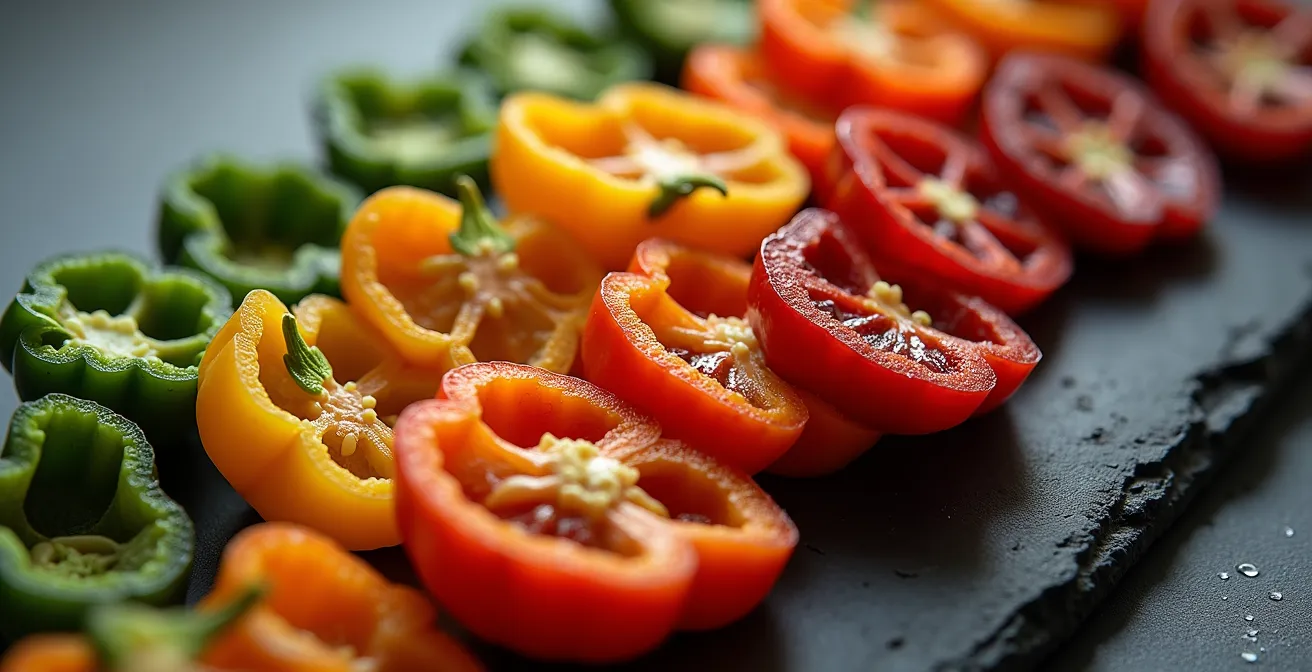
- Heat isn’t in the seeds. It’s concentrated in the white pith (placental tissue), which you can remove for precise heat management.
- Toasting dried chilis is non-negotiable; it awakens complex flavors through chemical reactions that raw chilis don’t have.
- Fat (like dairy or oil) is a capsaicin solvent that mellows heat, while acid (like vinegar or lime) sharpens and brightens its sensation.
- The right antidote to excessive heat is full-fat dairy, as its casein protein acts like a detergent to wash away the spicy oils.
You stand in the market, a vibrant tapestry of dried chilis before you. You’re here for flavor—the smoky, fruity, complex notes that promise to elevate your cooking from simple to sublime. But there’s a whisper of fear. You remember the last time you gambled on a chili, a dish hijacked by a searing heat that obliterated every other taste. The Scoville scale, with its dizzying numbers, feels more like a warning label than a helpful guide. It tells you the potential for fire, but not how to harness its warmth.
Many guides will simply list peppers and their Scoville Heat Units (SHU), creating a catalogue of pain potential. They tell you to “drink milk” if you go too far, or that “seeds are hot.” But these are platitudes, surface-level truths that don’t empower you in the kitchen. What if the real secret to mastering chili heat wasn’t about avoiding it, but about understanding its very nature? What if you could manipulate the heat, dial it up or down, and shape its character to fit your exact desires?
This is where we move beyond the numbers. The true reality of the Scoville scale is that it’s a static measurement in a dynamic world. This guide is your entry into the world of heat dynamics. We will deconstruct the chili, exploring how toasting transforms its soul and how drying creates entirely new flavor profiles. You will learn to control heat at its source, understand the science of cooling the burn, and discover how fat, acid, and sweetness can become your greatest allies in crafting dishes that are deeply flavorful, perfectly balanced, and exactly as spicy as you want them to be. This is not about fear; it’s about flavor, and you are about to take control.
To navigate this journey from heat-fear to flavor-confidence, we’ve structured this guide to build your skills layer by layer. Explore the key principles that will transform the way you cook with chilis.
Summary: Scoville Scale Reality: How to Choose the Right Chili for Your Tolerance Level?
- Why You Must Toast Dried Chilis Before Blending Them?
- Ancho vs Poblano: How Drying Changes the Flavor Profile Completely?
- Seeds or Veins: Which Part of the Chili Actually Holds the Heat?
- Milk vs Water: What Actually Stops the Burning Sensation in Your Mouth?
- Mango and Chili: Why Sweet and Spicy Work So Well Together?
- Adobo Sauce: How to Control the Heat While Getting the Smoke?
- Fat vs Acid: How to Balance Rich French Sauce with Sharp Asian Vinegar?
- Mole Sauce Demystified: Why It Needs 20 Ingredients and Is Chocolate Just a Gimmick?
Why You Must Toast Dried Chilis Before Blending Them?
To use a dried chili without toasting it first is like listening to an orchestra with earplugs in. You get the basic idea, but you miss all the nuance and richness. Toasting is not an optional step; it is the act of awakening the chili’s soul. When you apply dry heat, you’re initiating a cascade of chemical transformations that unlock a spectrum of flavors completely absent in the raw, leathery pod. This isn’t about cooking the chili, but about coaxing its dormant essential oils and sugars to life.
The primary magic at play is the Maillard reaction, the same process that gives seared steak and toasted bread their complex, savory depth. This reaction begins to occur in the critical temperature range of 280°F to 300°F, transforming the chili’s natural sugars and amino acids into hundreds of new aromatic compounds. A raw guajillo might taste of dusty red pepper, but a toasted one sings with notes of cherry, green tea, and pine. This process also makes the chilis pliable and easier to blend, ensuring a smoother final sauce.
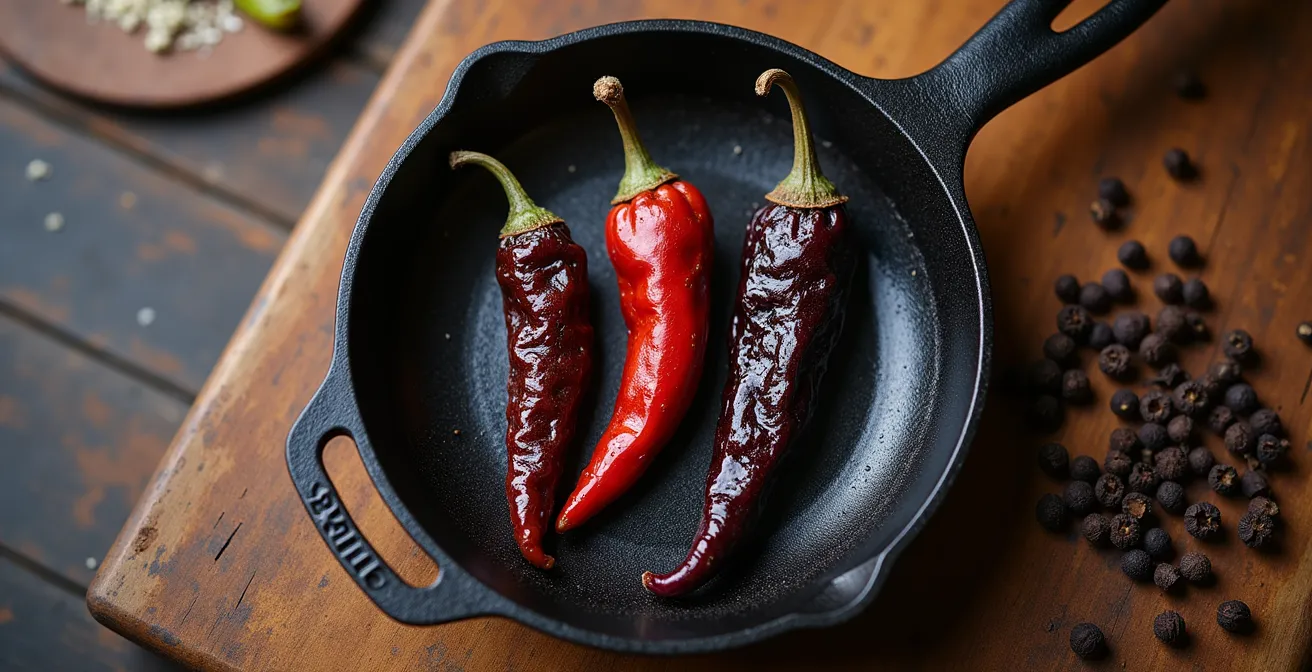
Control is everything. A few seconds too long and these beautiful new flavors can turn acrid and bitter. The goal is to heat the chili on a dry skillet or comal just until it becomes fragrant and slightly changes color, a matter of 30 to 60 seconds per side. You’ll physically feel it soften as the oils are released. This simple, quick step is the single most important technique for moving beyond one-dimensional heat and into the world of profound, layered chili flavor.
Ancho vs Poblano: How Drying Changes the Flavor Profile Completely?
To understand the profound impact of drying, one need look no further than the relationship between the fresh poblano and the dried ancho. They are the same pepper, yet they occupy entirely different culinary worlds. This isn’t just a matter of water removal; it’s a complete metamorphosis of flavor, texture, and even the perception of heat. While they share the same DNA and a similar, mild Scoville rating (1,000-1,500 SHU), their applications are distinct, all thanks to the slow, transformative power of dehydration.
The journey begins when a green poblano is left on the vine to ripen to a deep red. During this ripening, its flavor profile shifts away from green and vegetal, and its sugar content begins to climb. The subsequent drying process concentrates these sugars intensely. According to a case study on the chemical transformation during this conversion, the sugar content can increase by as much as 60-80%. This concentrated sweetness, combined with the slow oxidation, creates the ancho’s signature notes of raisin, plum, and bitter chocolate—a profile completely alien to the fresh, bell pepper-like poblano.
This table illustrates the dramatic divergence between the fresh and dried forms:
| Characteristic | Fresh Poblano | Dried Ancho |
|---|---|---|
| Scoville Heat Units | 1,000-1,500 SHU | 1,000-1,500 SHU |
| Heat Profile | Sharp, vegetal, upfront | Warm, rounded, slow-building |
| Primary Flavors | Green bell pepper, grass | Raisin, prune, chocolate |
| Sugar Content | 3-4% when green | 15-20% concentrated |
| Best Application | Stuffing (chiles rellenos) | Sauces, moles, marinades |
Notice how the heat profile changes from “sharp” to “warm” and “slow-building.” Even with the same capsaicin level, the high concentration of sugars and complex oils in the ancho acts as a buffer, changing how our palate perceives the heat. This demonstrates a key principle: the Scoville number is a constant, but the sensory experience is entirely variable.
Seeds or Veins: Which Part of the Chili Actually Holds the Heat?
Here lies the single most persistent and misunderstood myth in the world of chilis. For generations, cooks have painstakingly removed seeds, believing them to be the fiery culprits responsible for overwhelming heat. While the intention is correct, the target is wrong. The seeds are not the source of the fire; they are merely bystanders caught in the crossfire. The real power, the true heart of the heat, lies in the pale, spongy membrane to which the seeds are attached.
This part of the chili is properly known as the placental tissue, or more simply, the pith. This is the capsaicin factory. It is here that the glands produce and store the vast majority of the chili’s heat-producing oils. The seeds only become hot through their direct proximity to this tissue. Dr. Paul Bosland, a leading figure at the Chile Pepper Institute, clarifies this with the concept of “contact contamination.” As he notes, “It’s not the ‘veins,’ but the ‘placental tissue’ or ‘pith’ that produces and stores the capsaicin. The seeds are only hot due to their direct contact with this tissue.”
It’s not the ‘veins,’ but the ‘placental tissue’ or ‘pith’ that produces and stores the capsaicin. The seeds are only hot due to their direct contact with this tissue, a concept called ‘contact contamination’
– Dr. Paul Bosland, Chile Pepper Institute, New Mexico State University
The numbers are staggering. A scientific analysis of capsaicin distribution reveals that nearly 90% of a chili’s capsaicin is concentrated in this placental tissue, with only about 6% found in the seeds and the rest in the flesh. This knowledge is not just trivia; it is the key to absolute heat control. By scraping away this white pith with the back of a knife or a spoon, you can radically reduce a chili’s heat while preserving the unique flavor of its flesh. This technique allows you to use even famously hot peppers like habaneros for their fruity, floral notes, with only a fraction of their fire.
Milk vs Water: What Actually Stops the Burning Sensation in Your Mouth?
It’s a moment of pure panic: the chili was hotter than you expected, and a five-alarm fire is raging in your mouth. Your first instinct is to grab the nearest glass of water. It’s a logical reaction, but a futile one. Gulping down water will only spread the fire, turning a localized burn into a full-blown inferno. The reason for this failure lies in the chemical nature of the enemy: capsaicin is an oil-based compound, and as we all know, oil and water do not mix.
Drinking water simply sloshes the capsaicin oils around your mouth, coating new and previously unaffected taste receptors. To extinguish the flame, you need a solvent, not a rinser. This is where dairy products, particularly full-fat versions, prove their legendary effectiveness. The relief they provide comes from a protein called casein. Casein is a lipophilic (fat-loving) protein that actively surrounds the capsaicin molecules, acting like a detergent to lift them off your pain receptors and wash them away. Think of it as a microscopic soap for your mouth.
The ultimate antidote combines multiple mechanisms of relief. An illuminating case study on “The Ice Cream Solution” shows it provides a triple-action effect. First, the casein washes away capsaicin. Second, the high milk fat content helps to dissolve the oil-based compound. Third, the cold temperature physically numbs the TRPV1 pain receptors, providing immediate, albeit temporary, relief. In one trial, vanilla ice cream was found to reduce perceived heat by an astonishing 95% within 30 seconds. Starchy foods like rice or bread also work by physically absorbing the oils, while sugar can help by overwhelming the pain signals with a competing sweet sensation.
Mango and Chili: Why Sweet and Spicy Work So Well Together?
The pairing of sweet and spicy is a cornerstone of cuisines around the globe, from Thai sweet chili sauce to Mexican mango con chile. This combination is so successful because it’s not just a pleasing contrast of tastes; it’s a fascinating neurological and chemical dance that plays with our perception of pain and pleasure. When you taste the vibrant sweetness of a mango alongside the sharp heat of a habanero, your brain is engaged in a delightful battle for attention.
This phenomenon can be explained by the “Gate Control Theory” of pain. Your brain has a limited bandwidth for processing strong sensory inputs. As Dr. Barry Green of the Yale School of Medicine’s Taste Lab explains, “The intense sweetness of mango sends a powerful ‘pleasure’ signal that competes with the ‘pain’ signal from capsaicin, effectively ‘closing the gate’ on heat perception.” The sweetness doesn’t eliminate the heat, but it distracts the brain, making the heat feel less aggressive and more like a pleasant warmth. It tames the chili’s bite, allowing its more subtle fruity and floral notes to come forward.
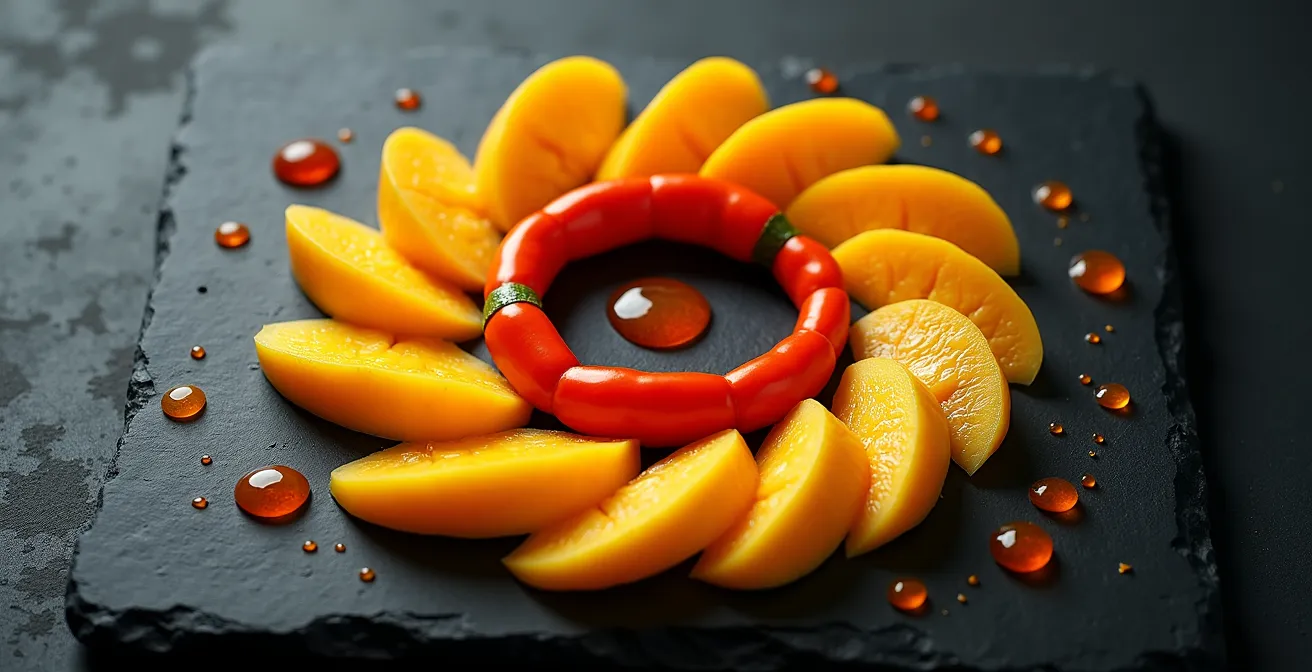
But the synergy goes deeper. Beyond the neurological distraction, there is a chemical harmony. Rich, sweet fruits like mango also bring their own balancing elements to the table. For instance, a typical mango contains natural acids like citric and malic acid, which act as a palate cleanser, cutting through the lingering oils of the capsaicin and refreshing your mouth between bites. This creates a dynamic experience where waves of sweet, heat, and tangy acidity wash over the palate, each one enhancing the others. This is not just masking heat; it’s creating sensory harmony.
Adobo Sauce: How to Control the Heat While Getting the Smoke?
The small can of chipotles in adobo sauce is one of the most potent weapons in a flavor-seeker’s arsenal. It delivers a trifecta of taste: the deep, smoky flavor of the dried and smoked jalapeños (chipotles), the tangy, spiced tomato-vinegar sauce (adobo), and a significant, often unpredictable, level of heat. For a cook wary of spice, this unpredictability can be terrifying. One brand might be pleasantly warm, while another can be ferocious, as commercial chipotles in adobo can vary dramatically in heat from 2,500 to over 8,000 SHU.
The solution is not to avoid this incredible ingredient, but to deconstruct it. By separating the components, you can precisely control the heat while maximizing the smoky flavor you desire. The key is to understand that the heat is primarily in the chipotle peppers themselves (specifically, their placental tissue), while much of the iconic smoky flavor is infused into the surrounding adobo sauce. By treating them as two separate ingredients, you gain complete authority over the final dish.
This “deconstruction and reconstruction” method allows you to build the flavor profile you want, piece by piece, without risking a spicy catastrophe. It turns a volatile ingredient into a reliable tool.
Action Plan: The Adobo Deconstruction Method
- Separate Components: Use a fine-mesh strainer to separate the chipotle peppers from their adobo sauce. Reserve both.
- Disarm the Chilis: For maximum heat reduction, slice open the reserved chipotles. Use a small spoon to scrape out and discard the seeds and, most importantly, all the white placental tissue. This can reduce their heat by over 70%.
- Bloom the Smoke: Heat a small amount of oil in your pan and add the reserved adobo sauce. Fry it for 30-60 seconds until it darkens slightly and becomes intensely fragrant. This “blooming” step amplifies its smoky compounds.
- Reconstruct and Taste: Add your de-heated, processed chipotle flesh back into the bloomed sauce. Start with half, stir, and taste. Add more until you reach your desired balance of smoke and gentle warmth.
- Balance the Flavor: If the final flavor is too sharp from the vinegar, balance it with a small amount of a dark sugar like piloncillo or brown sugar to round out the edges.
By following this process, you are no longer a victim of the can’s contents. You are the architect of the flavor, using the smoke, tang, and heat as individual building blocks to construct the perfect taste.
Fat vs Acid: How to Balance Rich French Sauce with Sharp Asian Vinegar?
The Scoville number of a chili pepper is a fixed, scientific value, but the way we experience its heat is anything but. Two of the most powerful agents that modify our perception of heat are fat and acid. They act as “delivery systems” for capsaicin, fundamentally changing its sensation on the palate. Understanding this dichotomy is like a painter learning the difference between oil and watercolor; both can use the same pigment, but the end result is dramatically different. Fat coats and mellows, creating a slow, blooming warmth. Acid cuts and cleanses, delivering a sharp, immediate, and vibrant heat.
A real-world example perfectly illustrates this principle. Consider a Thai coconut curry and a Vietnamese nuoc cham dipping sauce, both made with fiery bird’s eye chilis. In the curry, the high fat content of the coconut milk (often over 20%) encapsulates the capsaicin molecules. The heat doesn’t hit you upfront; it blooms slowly across your entire palate, a gentle, prolonged warmth that builds with each bite. In contrast, the nuoc cham, with its base of acidic lime juice and rice vinegar, delivers the chili’s heat as a sharp, piercing, and almost electric sensation that is intense but fades relatively quickly. The acid cleanses the palate, making each new dip feel just as bright as the first.
This table breaks down how these two powerful components shape the spicy experience:
| Component | Fat-Based Delivery | Acid-Based Delivery |
|---|---|---|
| Heat Sensation | Slow, gentle, prolonged warmth | Sharp, immediate, intense burn |
| Mechanism | Coats palate, dissolves capsaicin | Cleanses palate, brightens heat |
| Duration | Extended, gradual fade | Quick peak, faster dissipation |
| Example Dishes | Beurre monté with chilies | Spicy mignonette sauce |
| Ideal Use | For deep, integrated warmth | For bright, clean spice notes |
This knowledge allows for incredible precision. If you want the fruity notes of a habanero with a manageable, gentle heat, infuse it into a butter or oil-based sauce (a French beurre monté, for example). If you want that same habanero to provide a shocking, bright-hot accent to fresh oysters, deploy it in an acidic mignonette. You are not just choosing a chili; you are choosing how its heat will perform on stage.
Key Takeaways
- True chili mastery is about managing heat dynamics—how capsaicin interacts with other elements—not just knowing Scoville numbers.
- The vast majority of a chili’s heat is in the white placental tissue (pith), not the seeds. Removing it is the most effective way to control spice at the source.
- Fat and acid are opposing forces: fat (dairy, oil) creates a slow, blooming, and mellow warmth, while acid (vinegar, citrus) delivers a sharp, bright, and immediate heat.
Mole Sauce Demystified: Why It Needs 20 Ingredients and Is Chocolate Just a Gimmick?
Mole poblano, with its legendary list of 20, 30, or even more ingredients, can seem like the pinnacle of culinary intimidation. To the uninitiated, the inclusion of chocolate often feels like a novelty, a bizarre gimmick. But to dismiss it as such is to misunderstand the very soul of mole. Mole is not a recipe; it is a philosophy. It represents the ultimate expression of balance and complexity, where every single ingredient has a structural role in building a harmonious “sensory architecture.” And in this architecture, chocolate is a foundational pillar, not a decorative flourish.
Celebrated Chef Enrique Olvera of Pujol, a global authority on Mexican cuisine, puts it best. He explains that traditional mole uses unsweetened chocolate for critical functions that have little to do with overt sweetness. First, it provides a complex bitterness that masterfully balances the intense sweetness from dried fruits like raisins and prunes. Second, its natural cocoa butter adds a crucial layer of fat to mellow and round out the combined heat of multiple chilis. Finally, it contributes to the sauce’s iconic deep color and luxurious, velvety texture.
Traditional mole uses unsweetened chocolate not as a gimmick but for three critical functions: providing complex bitterness to balance sweet fruits, adding cocoa butter fat to mellow heat, and contributing to the sauce’s velvety texture
– Chef Enrique Olvera, Pujol Restaurant Mexico City
The complexity of mole comes from layering different chilis, each chosen for its unique contribution. A common foundation is the “holy trinity” of anchos, pasillas, and guajillos. The ancho provides a sweet, fruity body. The pasilla adds deep, almost bitter, cocoa-like notes. The guajillo contributes a bright, tangy heat that cuts through the richness. These are supported by a cast of other ingredients: nuts and seeds (almonds, sesame) add more fat and texture; spices (cinnamon, clove) create aromatic “false heat”; and fruits provide the sweet counterpoint. Each ingredient is a solution to a potential imbalance, meticulously layered to create a final sauce that is simultaneously smoky, sweet, spicy, bitter, and savory—a complete and profound flavor experience.
By understanding these dynamics, you’ve moved beyond the simple fear of the Scoville scale. You are now equipped not just to choose a chili, but to conduct it, composing dishes of incredible depth and flavor, all perfectly tuned to your personal palate. To continue your journey, the next logical step is to explore specific regional chili varieties and put these principles into practice.