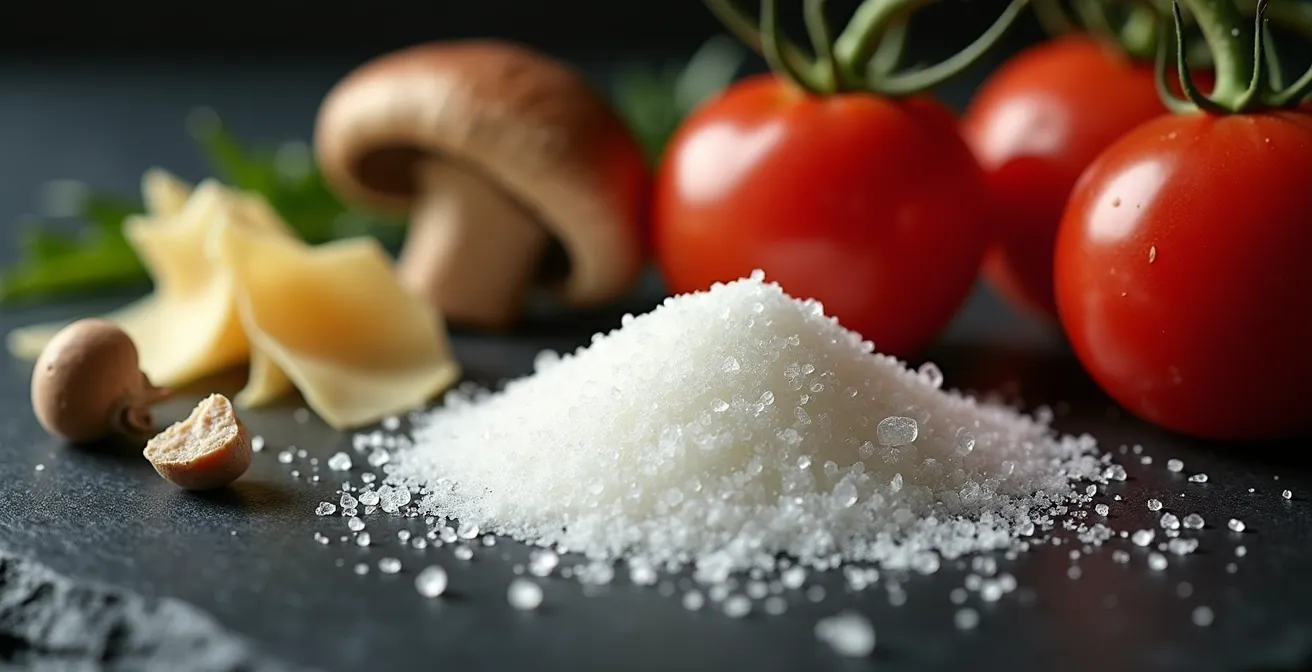
In summary:
- The “secret” to restaurant-quality flavor isn’t just MSG; it’s the scientific principle of umami synergy.
- True flavor depth comes from layering ingredients rich in glutamates (like tomatoes, soy sauce) with those rich in nucleotides (like dried mushrooms, anchovies).
- This combination can amplify savory taste by up to eight times more than using one ingredient alone.
- You can easily apply this principle at home using common pantry items to fix “flat” tasting dishes.
Every passionate home cook has faced the same frustrating moment: you follow a recipe for your favorite Asian takeout dish to the letter, yet the final result tastes disappointingly “flat.” It lacks the deep, mouth-filling savory quality that makes restaurant food so addictive. The common assumption is that the missing link is Monosodium Glutamate (MSG), a controversial ingredient often seen as a culinary shortcut or a well-guarded secret. While it’s true that chefs use MSG, a singular focus on it misses the bigger, more fascinating picture.
Many will advise you to simply add more salt, use fresh herbs, or get a better sear on your ingredients. These are good practices, but they don’t address the fundamental lack of complexity. The truth lies not in a single “magic” powder, but in a core principle of food science that professional chefs master and home cooks often overlook. It’s a concept that elevates cooking from simply combining ingredients to architecting flavor on a molecular level.
But what if the real key wasn’t about adding one thing, but about creating a reaction between two? The secret to that craveable, restaurant-quality taste is a phenomenon called umami synergy. This is the art of strategically combining different types of savory compounds to create a flavor explosion that is far greater than the sum of its parts. This guide will demystify the science behind umami, moving beyond the MSG debate to give you a practical, scientific framework for building profound flavor depth in your own kitchen, using ingredients you likely already have.
This article will break down the science of savory flavor into actionable steps. We will explore the specific ingredients that create umami synergy, explain how to combine them, and provide clear techniques to transform your cooking from flat to full-bodied.
Summary: Unlocking the Science of Savory: A Guide to Umami and Flavor Depth
- Mushroom Powder: How to Add Depth Without Changing the Flavor Profile?
- Kombu Soaking Time: Why Boiling Kelp Makes the Broth Bitter?
- When to Add Fish Sauce: Beginning for Depth or End for Punch?
- Glutamates and Nucleotides: Why Mixing Tomato Paste and Soy Sauce Explodes Flavor?
- Dissolving Anchovies: How to Use Them as a Secret Weapon in Stir-Fries?
- Mushrooms and Tomatoes: How to Create “Meaty” Depth in Vegetable Stews?
- Fat, Acid, Salt, Heat: How to Correct a Dish That Tastes “Flat”?
- Miso Paste Varieties: Which Color Should You Buy for Soup vs Marinades?
Mushroom Powder: How to Add Depth Without Changing the Flavor Profile?
One of the most effective tools in the umami-building arsenal is mushroom powder. Unlike fresh mushrooms, which contribute significant texture and their own distinct taste, dried and powdered mushrooms act as a pure flavor enhancer. The secret lies in their chemical composition. Dried mushrooms, especially shiitake, are a potent source of a nucleotide called guanylate. This compound works on a different set of taste receptors than glutamates but signals the brain with the same “savory” message, effectively amplifying any existing umami in a dish.
This allows you to add a significant layer of savory depth without altering the primary flavor profile of your dish. A teaspoon of shiitake powder can make a vegetable broth taste richer and more “meaty” without making it taste like mushrooms. It dissolves easily and integrates invisibly, making it a stealthy way to boost flavor in everything from soups and stews to spice rubs and sauces. The key is choosing the right mushroom for the job: shiitake offers a smoky intensity perfect for Asian-inspired dishes, while porcini provides a deep, earthy note ideal for Western cuisine like pasta sauces or risottos.
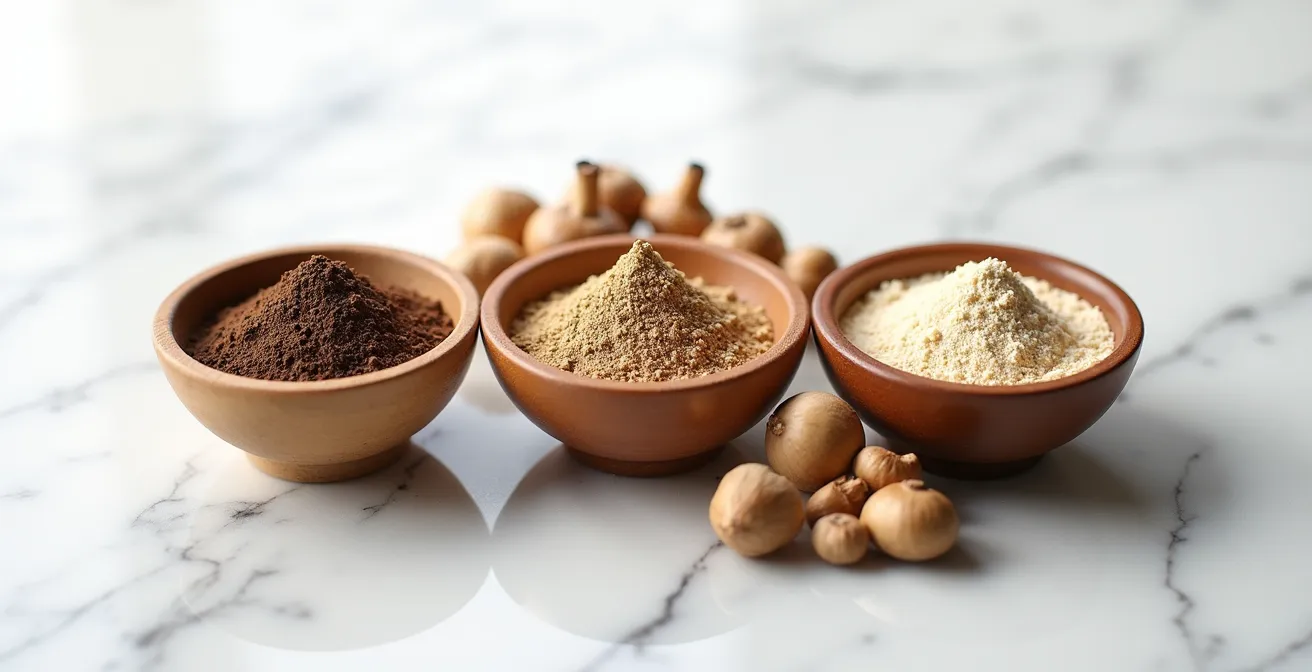
The visual difference between powders—from dark brown shiitake to light beige cremini—often corresponds to their flavor intensity. By keeping a small jar of homemade or store-bought mushroom powder in your pantry, you gain the ability to add a foundational layer of umami to any savory dish, correcting flatness at its source before it even becomes an issue. This is a perfect example of applying flavor layering in its most subtle form.
Kombu Soaking Time: Why Boiling Kelp Makes the Broth Bitter?
Kombu, a type of dried kelp, is the cornerstone of Japanese dashi and one of the world’s most concentrated natural sources of free-form glutamate. According to the Umami Information Center, kombu is the richest source of glutamate among all foods, making it indispensable in cuisines that rely on savory depth without meat. However, extracting this flavor is a delicate process where temperature and time are critical. The common mistake that leads to a bitter broth is boiling the kombu.
Glutamate is highly water-soluble and extracts beautifully at temperatures well below boiling, ideally between 60-80°C (140-176°F). When kombu is subjected to boiling temperatures (100°C or 212°F), two undesirable things happen. First, it begins to release alginic acid, which contributes a bitter, astringent taste. Second, the high heat can damage the delicate glutamate molecules, resulting in a less clean and impactful umami flavor. The broth also becomes viscous and slimy, which is unpleasant in clear soups.
The best methods for kombu extraction respect this temperature sensitivity. For the cleanest, most delicate flavor, a cold brew (mizudashi) over several hours in the refrigerator is ideal. For a quicker, all-purpose dashi, a warm steep for 30-60 minutes is the classic approach. This careful temperature control is the difference between a refined, savory broth and a harsh, bitter one.
The following table, based on traditional dashi-making principles, compares the three primary methods for kombu extraction.
| Method | Temperature | Time | Best For | Flavor Profile |
|---|---|---|---|---|
| Cold-Brew (Mizudashi) | Room temp/Fridge | 3-12 hours | Clear soups | Cleanest, most delicate |
| Warm-Steep Classic | 60-80°C (140-176°F) | 30 minutes | All-purpose dashi | Balanced, traditional |
| Simmering (Niban) | 85-95°C | 10-15 minutes | Miso soups, stews | Robust, slightly bitter |
When to Add Fish Sauce: Beginning for Depth or End for Punch?
Fish sauce is a powerhouse of umami, derived from the long-term fermentation of anchovies. This process breaks down proteins into free amino acids, primarily glutamic acid, resulting in a deeply savory, salty liquid. However, its potent, “funky” aroma can be intimidating. The key to harnessing its power lies entirely in timing: when you add it to the cooking process dictates its final contribution to the dish.
Adding fish sauce at the beginning of cooking, along with aromatics like garlic and onions, is a technique called “front-loading.” The initial heat cooks off the most volatile, fishy aromas, leaving behind a deep, integrated, and almost meaty savoriness. The flavor becomes a seamless part of the background, providing depth without an overt fishy taste. This is the best method for stews, braises, and pasta sauces where you want foundational complexity.
Conversely, adding fish sauce at the very end of cooking, or “back-loading,” preserves its bright, pungent character. Added off-heat to a stir-fry, a soup, or a dipping sauce, it delivers a sharp, salty, and funky punch that lifts and brightens the entire dish. This is not about creating background depth but about adding a high note that makes the flavors pop. Both techniques are valid; they just serve entirely different purposes. Mastering the timing of fish sauce is like having two different ingredients in one bottle: one for building deep, savory foundations and one for adding a final, vibrant exclamation point.
Glutamates and Nucleotides: Why Mixing Tomato Paste and Soy Sauce Explodes Flavor?
This is where we get to the heart of umami science. The reason your home cooking might taste “flat” is often because it contains only one type of umami-producing compound. True, explosive, restaurant-quality flavor is rarely achieved with a single ingredient, but through the powerful phenomenon of umami synergy. This occurs when you combine an ingredient rich in glutamates with one rich in specific nucleotides (inosinate or guanylate).
Think of them as two different keys that unlock flavor. Glutamates (found in tomatoes, soy sauce, parmesan cheese, and kombu) are the primary source of umami. Nucleotides (found in dried mushrooms, anchovies, and cured meats) are umami “boosters.” When present together, they don’t just add their flavors together—they multiply the perceived savory taste. In fact, scientific research published in Nature demonstrates that glutamate-nucleotide combinations can increase perceived umami by up to eight times the sum of their individual components. This “1+1=8” effect is the engine of deep flavor.
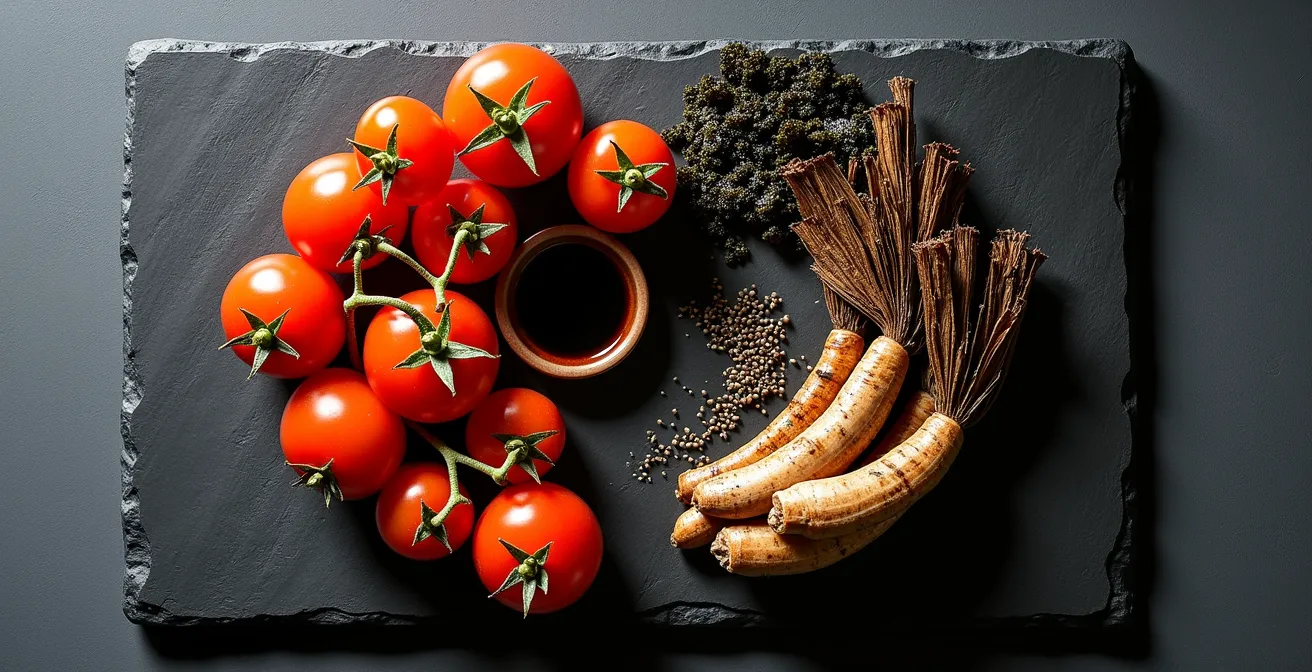
This explains why classic food pairings are so satisfying. A bolognese sauce (tomatoes/glutamate) with anchovies (inosinate/nucleotide) is profoundly more savory than one with tomatoes alone. Japanese dashi combines kombu (glutamate) with bonito flakes (inosinate). A simple stir-fry becomes transcendent when you use both soy sauce (glutamate) and shiitake mushroom powder (guanylate). Understanding this synergistic principle is the single most impactful shift a home cook can make. It’s not about adding more salt; it’s about building a smarter, more complex savory foundation.
Dissolving Anchovies: How to Use Them as a Secret Weapon in Stir-Fries?
Anchovies are perhaps the most misunderstood ingredient in the Western pantry, often dismissed for their “fishy” taste. In reality, they are a concentrated source of umami-boosting nucleotides, specifically inosinate. When used correctly, they can provide an incredible savory depth to dishes without tasting of fish at all. The secret is to not treat them as a solid ingredient but as a dissolvable flavor base, particularly effective in stir-fries.
The technique, often used by professional chefs, involves “melting” the anchovy fillets in hot oil at the very beginning of the cooking process. By mashing one or two fillets into medium-hot oil along with your initial aromatics (like garlic or ginger), the anchovy breaks down completely, dissolving into the fat. The fishy smell dissipates within a minute, leaving behind a pure, savory foundation. This umami-infused oil then becomes the base for your entire stir-fry, coating every vegetable and piece of protein with an invisible layer of complex flavor.
This method is a game-changer because it builds depth from the ground up. The vegetables will not taste fishy; they will simply taste more intensely of themselves, with a richer, more rounded flavor profile. It is the ultimate secret weapon for elevating a simple vegetable stir-fry or adding a “meaty” backbone to a dish without adding meat. This technique perfectly embodies the principle of using nucleotides to create a savory base that enhances all other ingredients.
Action Plan: The Anchovy Melting Technique
- Heat oil to a medium temperature (not smoking) in a wok or large pan.
- Add 1-2 anchovy fillets to the oil along with your initial aromatics like minced garlic and ginger.
- Use the back of a wooden spoon or spatula to mash the anchovies against the pan for 30-60 seconds.
- Continue mashing until the fillets have completely dissolved and “disappeared” into the oil.
- Proceed with your stir-fry recipe as normal, adding vegetables and proteins to the now umami-infused oil.
Mushrooms and Tomatoes: How to Create “Meaty” Depth in Vegetable Stews?
Creating a rich, “meaty” vegetarian stew that satisfies even devout carnivores is a classic culinary challenge. The solution, once again, lies in the principle of umami synergy. By pairing two plant-based umami powerhouses—mushrooms and tomatoes—you can build layers of savory complexity that mimic the depth of a meat-based braise. This pairing is a perfect example of combining glutamates and nucleotides from non-animal sources.
Tomatoes, especially when cooked down into a paste or roasted, are a prime source of glutamate. The cooking process concentrates their natural sugars and glutamic acid, creating a sweet and deeply savory base. Mushrooms, particularly dried or well-browned fresh varieties, are a key source of the nucleotide guanylate. In fact, food science research shows that the drying process significantly increases the concentration of flavor-enhancing compounds in mushrooms, making them even more potent.
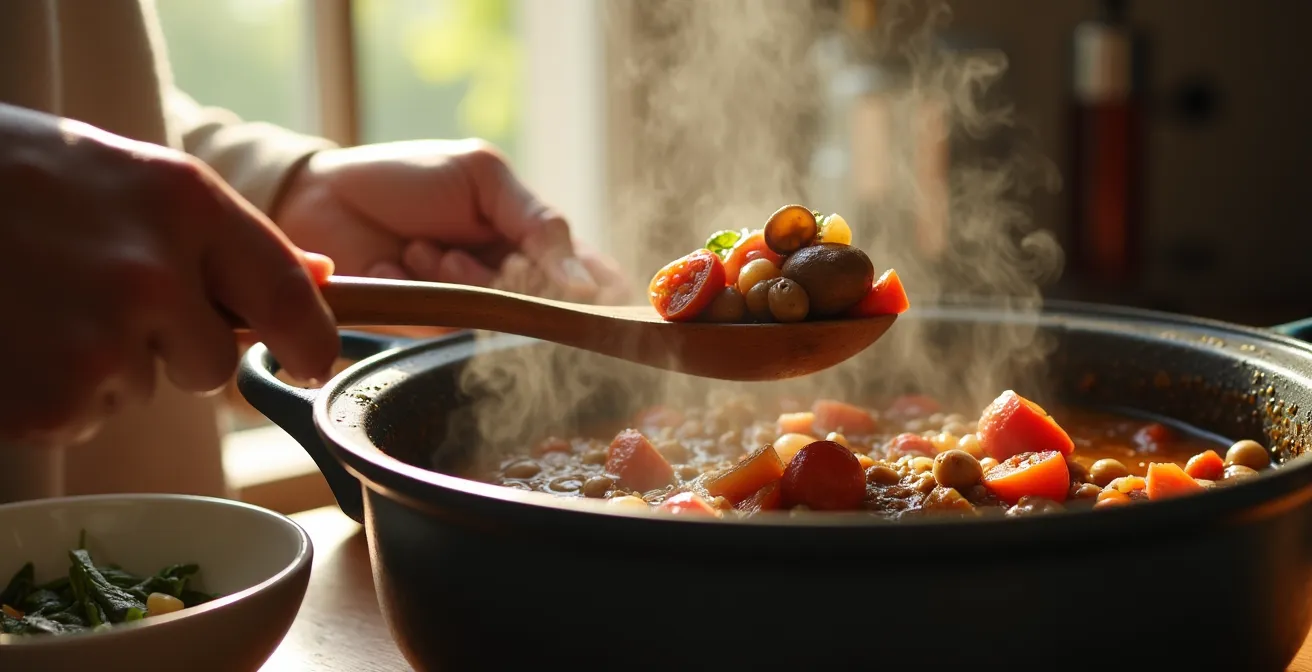
When used together in a stew, the glutamate from the tomatoes and the guanylate from the mushrooms trigger the “1+1=8” synergy effect. To maximize this, start by deeply browning your mushrooms to develop their flavor through the Maillard reaction. Then, add tomato paste and cook it for a few minutes until it darkens in color before adding your other liquids. This combination creates a robust, multi-layered savory flavor that provides the satisfying, long-lasting taste often described as “meaty.” It’s a foundational technique for any cook looking to create deeply flavorful vegetarian and vegan dishes.
Fat, Acid, Salt, Heat: How to Correct a Dish That Tastes “Flat”?
The feeling of a dish tasting “flat” is a common frustration, and the instinct is often to just add more salt. However, saltiness and flavor depth are two different things. A dish can be perfectly salted but still feel one-dimensional. When a dish lacks vibrancy, it’s usually missing one of four key elements: fat, acid, salt, or heat. But there is a fifth, crucial dimension: umami. Correcting a flat dish is a process of diagnosis—identifying which of these elements is out of balance.
First, taste critically. If the dish tastes bland but is salty enough, the problem is almost certainly a lack of umami or acid. A squeeze of lemon juice or a dash of vinegar can often “wake up” the flavors by providing contrast. If that doesn’t work, the dish needs a direct umami boost. This is where your arsenal of umami-rich ingredients comes in. A spoonful of miso paste, a splash of soy sauce or fish sauce, or a sprinkle of mushroom powder can provide the missing savory foundation.
As the research team at FiveThirtyEight notes, umami is best described as a “full-bodied taste.” A study they cite explains that umami translates from Japanese as “tasty,” “scrumptiousness,” or “savory” and is the foundational flavor in ingredients like parmesan and meat. When your dish is flat, it’s this very sensation that’s missing. Rather than blindly adding more of everything, learn to diagnose the specific deficiency. Often, a tiny amount of a glutamate or nucleotide-rich ingredient can round out the flavor profile and transform a flat dish into a dynamic one, proving that complexity, not just salt, is the key to deliciousness.
Key Takeaways
- Flavor depth comes from umami synergy, the combination of glutamates (e.g., soy sauce, tomato) and nucleotides (e.g., dried mushrooms, anchovies).
- The timing of adding ingredients like fish sauce is critical: add at the beginning for deep, integrated savoriness, or at the end for a bright, pungent finish.
- Temperature control is essential for ingredients like kombu; gentle steeping extracts clean umami, while boiling creates bitterness.
Miso Paste Varieties: Which Color Should You Buy for Soup vs Marinades?
Miso paste is a fermented soybean paste and another cornerstone of Japanese cuisine, delivering a complex blend of salty and savory flavors thanks to its high concentration of glutamates. However, walking into a store and seeing a range of colors—from pale white to deep reddish-brown—can be confusing. Choosing the right miso is essential, as each type has a distinct flavor profile and best use case, determined primarily by its fermentation time.
White Miso (Shiro Miso) is fermented for the shortest period, typically just a few months. It has a higher ratio of rice koji to soybeans, resulting in a mild, delicate, and slightly sweet flavor. This makes it ideal for applications where you don’t want to overpower other ingredients, such as in light salad dressings, glazes for fish, and classic, simple miso soups. Red Miso (Aka Miso) is fermented for much longer, sometimes up to three years. It has a higher soybean content and a robust, intensely salty, and pungent flavor. Its strength holds up well in hearty dishes, making it perfect for rich stews, bold marinades for red meat, and braises.
The most versatile option is Awase Miso, which is simply a mix of red and white varieties. It offers a perfect balance of sweet and savory notes, making it an excellent all-purpose choice for a home cook who wants one go-to miso for both soups and other general cooking. Understanding these categories allows you to use miso not just as an ingredient, but as a strategic tool to control the precise level and character of umami in your dishes.
This table breaks down the main types of miso and their ideal applications to help you make the right choice for your pantry.
| Miso Type | Color | Fermentation Time | Best Uses | Flavor Profile |
|---|---|---|---|---|
| White (Shiro) | Pale beige | 1-3 months | Dressings, light soups, glazes | Sweet, mild, delicate |
| Red (Aka) | Dark brown | 1-3 years | Hearty stews, marinades, braises | Intense, salty, robust |
| Mixed (Awase) | Medium brown | 6-12 months | All-purpose, versatile | Balanced sweet-savory |
With a deeper understanding of food science, you can move beyond simply following recipes and begin to build flavor with intention. By mastering the art of layering glutamates and nucleotides, you are no longer at the mercy of “flat” dishes. The next step is to put this knowledge into practice. Start by choosing one synergistic pairing from this guide and consciously apply it to your next meal. You’ll be amazed at the depth you can create.
Frequently Asked Questions About Building Savory Flavor
What should I add if my dish is salty enough but still tastes bland?
If a dish is salty but bland, it lacks umami depth. This is the perfect time to add a pure umami source. When dissolved, an ingredient like MSG separates into glutamate and sodium, and the glutamate binds to taste receptors to create that “savory” sensation without adding excessive saltiness. Alternatively, a salt-free mushroom powder or a splash of unsalted tomato paste can achieve a similar effect.
Which umami booster works fastest for emergency fixes?
For a quick, last-minute fix, pure MSG is the fastest actor as it dissolves and integrates almost instantly. Other liquid sources like fish sauce or soy sauce are also quick, typically needing only 2-3 minutes of gentle heat to meld with the dish and lose any harsh notes.
Can I combine multiple umami sources without overdoing it?
Yes, absolutely. Layering multiple umami sources is the secret to profound complexity. Combining a glutamate source (like miso) with a nucleotide source (like mushroom powder) creates synergy and depth, not an overwhelming flavor. The key is to use each in small amounts, tasting as you go, to build a balanced and multi-dimensional taste profile.