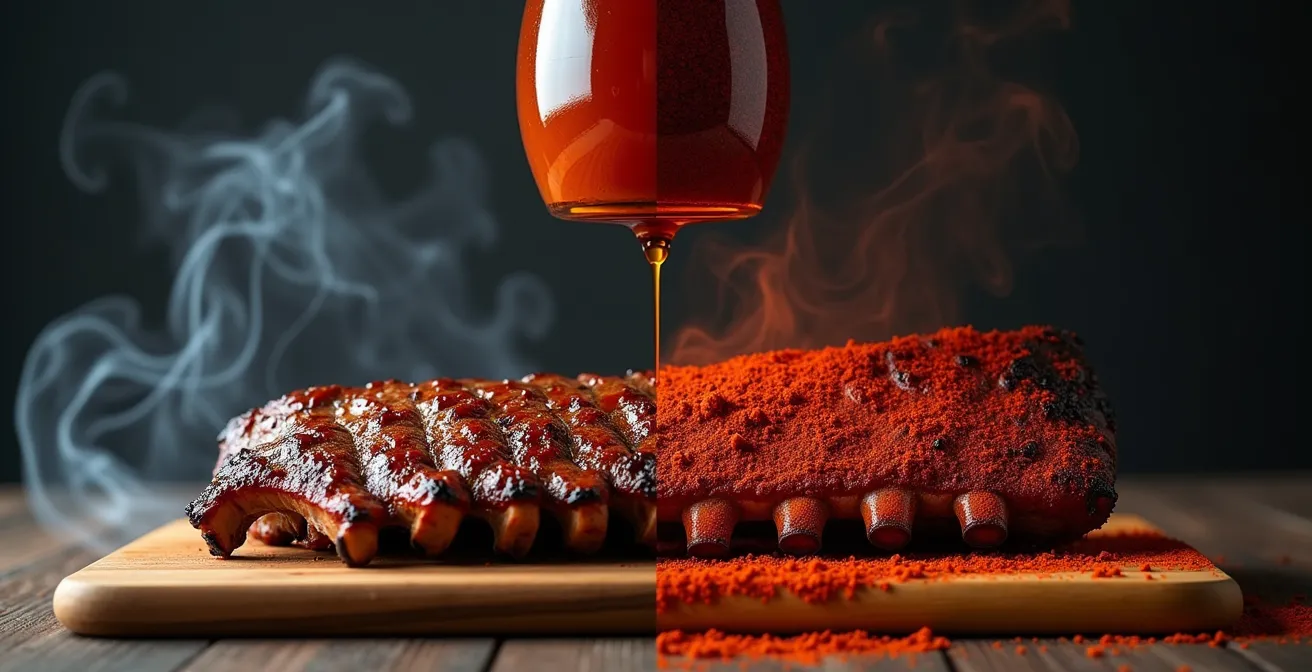
Achieving authentic indoor BBQ flavor is less about choosing between liquid smoke and paprika, and more about mastering a diverse toolkit of smoke-infusion techniques.
- Explore the science of the “smoke ring” and how to replicate it without charcoal.
- Learn specialized methods like wok smoking, oven charring, and using cedar planks safely indoors.
Recommendation: Start by identifying the flavor profile you want to achieve, then select the right technique from your new arsenal—not just the easiest ingredient.
For the city dweller with a craving for the deep, complex taste of barbecue, the options can feel frustratingly limited. Without a garden or balcony for a proper smoker, the culinary world often points you toward two simple solutions: a dash of liquid smoke or a spoonful of smoked paprika. While these are valid starting points, they barely scratch the surface of what’s possible. They are the equivalent of a single paint color when you have a whole spectrum of aromatic possibilities at your disposal.
The truth is, infusing authentic smoke flavor indoors is not about a single magic ingredient; it’s about understanding the craft and science of smoke itself. It’s about building a flavor architecture where smoke is a structural element, not just a decorative finish. Many cooks stop at paprika, but what about the smoky depth of adobo, the fruity notes of dried ancho chilies, or the fragrant whispers of tea-smoked duck? These are the tools of the resourceful indoor BBQ specialist.
This guide moves beyond the simple A-vs-B debate. We will deconstruct the very essence of smoke flavor and equip you with a range of techniques to master it in your own kitchen. From modern gadgets to ancient methods, and from understanding the chemistry of a smoke ring to managing the heat of chilies, you’ll learn how to create layers of smoky flavor that rival anything from an outdoor grill.
To guide you through this journey of indoor smoke mastery, we’ve structured this article to cover a wide array of tools, techniques, and foundational knowledge. The following sections will provide you with a comprehensive toolkit for bringing authentic BBQ flavor into your home.
Summary: A Guide to Mastering Indoor Smoke Flavor
- Is a Handheld Smoking Gun Worth the Investment for Home Cocktails and Cheese?
- Wok Smoking: How to Smoke Duck Breast Using Rice and Tea Leaves?
- Adobo Sauce: How to Control the Heat While Getting the Smoke?
- Oven Charring: How to Mimic the “Bark” of Brisket in a Conventional Oven?
- Cedar Planks in the Oven: Does It Work or Just Make a Mess?
- Why Charcoal Grilling Provides a Smoke Ring That Gas Cannot Replicate?
- Ancho vs Poblano: How Drying Changes the Flavor Profile Completely?
- Scoville Scale Reality: How to Choose the Right Chili for Your Tolerance Level?
Is a Handheld Smoking Gun Worth the Investment for Home Cocktails and Cheese?
For those looking to add a touch of theatricality and precise smoke flavor, the handheld smoking gun presents an intriguing option. Unlike ingredients that are cooked into a dish, a smoking gun allows you to finish foods with a delicate, aromatic layer of cold smoke. This makes it ideal for items that you wouldn’t typically “cook,” like a finished cocktail, a slice of aged cheddar, or even butter. The investment is primarily one of control; you can choose your wood chips (applewood, hickory, mesquite) and apply smoke for as little as a few seconds or up to several minutes for a deeper infusion.
The key advantage is precision. You can add a whisper of hickory to an Old Fashioned in 30 seconds or give a block of cheddar a balanced smokiness in just 2 minutes. This method is about surface-level flavor and aroma, not deep penetration. While it won’t replace low-and-slow cooking, it’s a powerful tool for adding a final, sophisticated layer to your culinary creations. It’s less about creating a BBQ meal and more about using smoke as a final seasoning or aromatic garnish.
The decision to invest hinges on your culinary habits. If you enjoy craft cocktails, host cheese tastings, or love experimenting with subtle flavor enhancements, a smoking gun offers a unique capability. For a city dweller, it’s a compact, low-mess way to bring the essence of a smokehouse into the apartment for specific, high-impact applications. However, if your goal is a smoky brisket, other techniques will be more effective.
Wok Smoking: How to Smoke Duck Breast Using Rice and Tea Leaves?
Long before modern gadgets, resourceful cooks used a simple wok to achieve incredible smoky flavors. Wok smoking is a traditional Chinese technique that uses a combination of dry rice, tea leaves, and sugar as the smoking fuel. It’s a brilliant indoor solution because it produces a fragrant, controlled smoke that infuses food quickly. The setup is simple: a layer of foil protects the bottom of the wok, the smoking mixture is heated until it smolders, and the food is placed on a rack above, all enclosed by a tight-fitting lid.

This technique is perfect for delicate items like duck breast, fish fillets, or chicken. The tea leaves (like Lapsang Souchong or jasmine) contribute complex aromatics, the rice helps regulate the burn, and the sugar aids in caramelization and color. An important principle to remember is that wood smoke affects foods best when they are raw. As food cooks, its surface dries and smoke penetration diminishes. Therefore, the initial phase of wok smoking is crucial for infusing that signature flavor into the raw duck breast before it fully cooks.
This method demonstrates a core concept of indoor smoking: it’s not always about replicating a Texas BBQ. It’s about using smoke as a distinct flavor element within a different culinary context. The result is not a heavily smoked piece of meat, but a perfectly cooked duck breast with an ethereal, tea-scented smokiness that is both subtle and profound. It’s an elegant and highly effective technique that requires no special equipment beyond a wok and a lid.
Adobo Sauce: How to Control the Heat While Getting the Smoke?
Moving from tools to ingredients, we find that some of the best sources of indoor smoke flavor come from chilies. Canned chipotles in adobo sauce are a perfect example. A chipotle is simply a smoked and dried jalapeño, and the adobo sauce it’s packed in is a rich, tangy, and smoky marinade. This single ingredient provides a trifecta of flavor: heat, smoke, and acidity. The challenge for many cooks, however, is managing the intensity of the heat while maximizing that coveted smoky taste.
The secret lies in deconstruction and dilution. Instead of adding whole chipotles, separate the chilies from the sauce. The sauce itself is less spicy and carries a significant amount of the smoky flavor. You can use the adobo sauce liberally in marinades, soups, or glazes to build a smoky base without overwhelming heat. For a milder, more controlled approach, consider using powders made from other smoked chilies. For instance, ancho powder provides a mild heat of 1,000-1,500 SHU with deep, fruity smoke notes, making it an excellent alternative for building smoky flavor with minimal burn.
Another technique is to balance the heat with other ingredients. Dairy products like sour cream or yogurt, fats like mayonnaise, and sweeteners like honey can all temper the capsaicin (the compound responsible for heat) while allowing the smoke flavor to shine. By using just the sauce, incorporating other smoked chili powders, or balancing with cooling ingredients, you can precisely control the heat-to-smoke ratio and customize it for any dish or palate.
Oven Charring: How to Mimic the “Bark” of Brisket in a Conventional Oven?
One of the most sought-after elements of true barbecue is the “bark”—the dark, flavorful, and delightfully crusty exterior that forms on slow-smoked meats like brisket. Many believe this is impossible to achieve without a dedicated smoker, but with the right technique, your conventional oven can produce a remarkably similar result. The process, known as oven charring, is a multi-step method focused on building layers of flavor and texture.
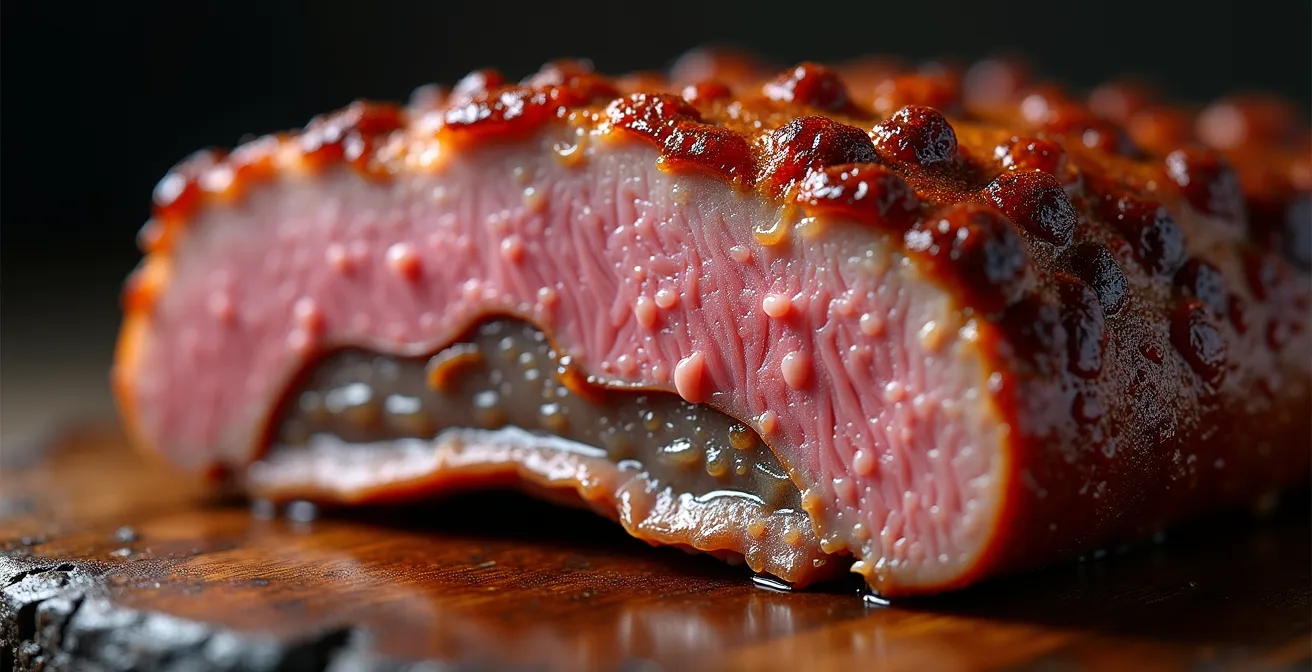
The foundation of a great bark is the rub. A mix containing smoked paprika and a small amount of sugar (around 1-2%) is essential. The paprika provides the base smoke flavor, while the sugar is crucial for the Maillard reaction and caramelization that creates the dark crust. The process starts with a high-heat blast to set the crust, followed by a long, low-and-slow cooking phase. Consistent moisture is key to attracting smoke particles (even in an oven environment), so spritzing the meat hourly with a liquid like apple cider vinegar—spiked with a touch of liquid smoke—helps build that authentic flavor layer by layer.
For those truly dedicated to authenticity, the appearance of the pink “smoke ring” can also be mimicked. This ring is a chemical reaction, not a flavor, and can be recreated with a tiny amount of curing salt (Prague Powder #1) in the rub. This combination of a specific rub, precise temperature control, and strategic moisture management allows the home cook to build a complex, delicious bark that offers the texture and deep flavor of traditionally smoked meat.
Action Plan: Building Authentic BBQ Bark in Your Oven
- Apply rub with smoked paprika and 1-2% sugar for Maillard reaction.
- Start with an initial high-heat blast at 450°F (232°C) for 15 minutes to set the crust.
- Reduce oven temperature to 225-250°F (107-121°C) for the low-and-slow cooking phase.
- Spritz the meat every hour with a mixture of apple cider vinegar and liquid smoke to build flavor and moisture.
- Optional: Include 0.25% Prague Powder #1 in the rub for an authentic smoke ring appearance.
Cedar Planks in the Oven: Does It Work or Just Make a Mess?
Cedar plank grilling is a classic method for infusing salmon and other foods with a gentle, woodsy smoke. The common wisdom is to use it on a grill, but can it work in an oven? The answer is yes, but with a critical adjustment. Simply placing a soaked plank in an oven will result in steaming, not smoking, imparting a woody taste but no true smoke flavor. The key is to generate actual smoke, which requires a pre-charring step.
Before placing the food on it, the soaked plank must be heated in the oven at a high temperature until it begins to char and actively smolder. This is what generates the smoke. Once it’s smoking, you can reduce the oven temperature, place your seasoned food (like a salmon fillet) on the plank, and continue cooking. This allows the food to cook in a self-contained smoky environment. It’s a contained and relatively clean way to create real wood smoke indoors. The process relies on the scientific principle of combustion. As the Napoleon Grills Technical Team explains:
The smoke from burning hardwood breaks down cellulose into sugar which caramelizes. Lignin changes into aromatics, lending smoky flavor and creating a preservative coating.
– Napoleon Grills Technical Team, Master BBQ Smoking: Science & Techniques
This method works best for relatively quick-cooking items. A common professional technique involves a three-stage process: an initial period of heavy smoke infusion, followed by covering the food with foil to cook it through without burning, and finally, uncovering it to crisp the exterior. While it requires more attention than just using smoked paprika, oven-planking is a highly effective way to get authentic wood smoke flavor in a standard kitchen.
Why Charcoal Grilling Provides a Smoke Ring That Gas Cannot Replicate?
The “smoke ring”—that coveted pinkish layer just beneath the crust of perfectly smoked meat—is often seen as the hallmark of authentic barbecue. It’s a visual cue that screams “low-and-slow.” But what is it, and why is it so closely associated with charcoal and wood, but not gas grills? The answer lies in pure chemistry, not cooking magic. The ring isn’t actually a “smoke” flavor itself, but a color reaction between the meat’s myoglobin (a protein) and specific gases produced during combustion.
When wood or charcoal burns, it releases a cocktail of gases, including nitrogen dioxide (NO₂) and carbon monoxide (CO). These gases permeate the surface of the raw meat and bind with the myoglobin, “fixing” its natural pink color and preventing it from turning gray as it cooks. This is the exact same chemical process that gives cured meats like corned beef or hot dogs their pink hue. BBQ science research confirms that wood combustion produces hundreds of compounds, with NO and CO gases creating the pink smoke ring. Gas grills, conversely, burn very cleanly and produce high levels of water vapor but negligible amounts of these specific gases. Without NO₂ and CO, the myoglobin simply denatures and turns gray, resulting in no smoke ring.
Understanding this science is empowering for the indoor cook. It clarifies that the smoke ring is a cosmetic effect, not a flavor indicator. And because it’s a chemical reaction, it can be replicated indoors without a charcoal grill. As mentioned in the oven-charring section, a tiny amount of sodium nitrite (Prague Powder #1) in a rub will produce the same myoglobin-fixing reaction, giving your oven-cooked brisket or pork shoulder that authentic, smokehouse look.
Ancho vs Poblano: How Drying Changes the Flavor Profile Completely?
Exploring the world of chilies is a cornerstone of advanced flavor building, especially when it comes to smoke. A fantastic case study is the relationship between the fresh poblano pepper and its dried form, the ancho pepper. They are the same fruit, yet the transformation through drying and smoking creates two dramatically different ingredients. Understanding this change is key to choosing the right chili for your desired flavor profile.
The fresh poblano is bright, vegetal, and has a mild, grassy flavor. It’s fantastic for stuffing or in fresh salsas where you want a gentle heat and a green, crisp taste. The ancho, on the other hand, undergoes a profound change. As the pepper dries, its sugars concentrate, and it develops deep, complex flavors. The taste shifts from vegetal to sweet, fruity, and raisin-like, with mild tobacco and smoke undertones from the slow-drying process. As a comparative analysis shows, the flavor profiles are worlds apart even though the heat level remains similar.
| Characteristic | Fresh Poblano | Dried Ancho |
|---|---|---|
| Flavor Profile | Bright, vegetal, grassy | Sweet, fruity, raisin-like |
| Heat Level (SHU) | 1,000-1,500 | 1,000-1,500 |
| Best Uses | Rajas, fresh salsas, stuffing | Moles, dark sauces, rubs |
| Sugar Content | Low (4-5%) | Concentrated (15-20%) |
| Smoke Notes | None | Mild tobacco undertones |
This transformation is why ancho is a powerhouse ingredient for dark, rich sauces like mole, or as the base for a complex BBQ rub. It provides not just heat, but also sweetness, fruitiness, and an earthy depth that a fresh pepper cannot. For the indoor cook, using ancho powder or rehydrated anchos is a direct route to adding a layer of non-wood smoke flavor that is complex and satisfying. It’s a lesson in how processing can completely redefine an ingredient’s role in the kitchen.
Key Takeaways
- Smoke is a spectrum of flavors, not a single note; choose your method (wood, tea, chili) based on the desired aromatic profile.
- Technique matters as much as the ingredient. Mastering heat, moisture, and timing is essential for building authentic flavor indoors.
- Balancing smoke and spice is crucial. Understanding the Scoville scale and how to manage capsaicin allows you to create complex, not just fiery, dishes.
Scoville Scale Reality: How to Choose the Right Chili for Your Tolerance Level?
The Scoville Scale is the standard measure of a chili pepper’s heat, but relying on its numbers alone can be misleading. The “Scoville Scale Reality” for a cook is that perceived heat is dramatically affected by what it’s paired with. A chili’s burn is not an absolute value; it’s a dynamic experience. Understanding this allows you to wield heat like a precision tool, ensuring it complements, rather than overwhelms, the other flavors in your dish, including smoke.
The active compound, capsaicin, is fat-soluble. This means that when a chili is used in a creamy or fatty medium, its heat is dispersed and feels much milder. For example, heat perception studies show that a chili rated at 5,000 SHU in a creamy sauce can feel 50% milder than one rated at just 2,000 SHU in a vinegar-based liquid. This is why a spicy curry with coconut milk is often more palatable than a spicy vinaigrette with the same chili. Dairy, fats, and sugars all act as buffers, taming the fire and allowing the chili’s fruitier, smokier, or earthier notes to emerge.
To choose the right chili, start by considering the base of your dish. For a lean marinade or a clear soup, select a chili with a lower SHU rating than you think you need. For a rich, creamy sauce or a fatty piece of meat, you can be bolder. You can also actively reduce a chili’s heat by removing the seeds and the white pithy veins, which contain the highest concentration of capsaicin. By combining knowledge of the Scoville scale with an understanding of how ingredients interact, you gain true control over the final flavor profile, creating dishes that are balanced, complex, and perfectly suited to your tolerance.
Now that you’re armed with this diverse toolkit of techniques and knowledge, the next step is to start experimenting. Begin by crafting your own unique spice rubs and marinades, using these principles to build layers of authentic smoky flavor right in your own kitchen.