In summary:
- True decadence in healthy food comes from mastering culinary science, not just swapping ingredients.
- Build deep, “meaty” flavor by strategically layering umami sources like browned tomato paste and dried mushrooms.
- Mimic the luxurious mouthfeel of fat by creating smart emulsions with ingredients like cashews or cauliflower.
- Control flavor intensity by understanding when to add dried vs. fresh herbs during the cooking process.
For the health-conscious foodie, the greatest challenge is the perceived sacrifice. You want the benefits of a clean diet, but the thought of another plate of steamed vegetables and bland chicken breast feels like a culinary punishment. The common belief is that richness, depth, and decadence are the exclusive domain of butter, cream, and fat. This forces a frustrating choice between pleasure and well-being, a choice that ultimately makes healthy eating unsustainable for anyone who truly loves food.
The standard advice often falls short. You’re told to “use more herbs” or “roast your vegetables,” which are valid starting points but barely scratch the surface of flavor creation. These tips often lead to food that is merely seasoned, not profoundly satisfying. The missing piece isn’t a magical low-calorie ingredient; it’s a fundamental shift in approach. It’s about moving from simple substitution to active flavor construction.
What if the secret to decadent healthy meals wasn’t in what you remove, but in the techniques you add? The key is to think like a gastronomic nutritionist, using culinary science to build layers of flavor, create luxurious textures, and enhance sensory satisfaction without relying on excessive fat and calories. This is not about restriction; it is about empowerment in the kitchen.
This guide will walk you through eight foundational strategies to achieve this. We will deconstruct the science of flavor, from unlocking umami to mimicking the mouthfeel of fat. By mastering these principles, you will learn to create dishes that are not just “healthy for you” but are genuinely, deeply delicious in their own right.
To help you navigate these culinary strategies, this guide breaks down the essential techniques for building rich, satisfying flavor into your healthy cooking. Explore the sections below to master each concept.
Summary: 8 Culinary Secrets for Healthy Food That Tastes Rich
- Mushrooms and Tomatoes: How to Create “Meaty” Depth in Vegetable Stews?
- Cashew vs Cauliflower Cream: Which Thickener Best Mimics Alfredo Sauce?
- Fresh vs Dried Herbs: When to Add Each for Maximum Flavor Impact?
- Why Eating Slowly Increases Satisfaction with Smaller Portions?
- Confit vs Braising: How to Retain Moisture While Reducing Oil by 50%?
- Wet Brine vs Dry Brine: Which is Faster for Weeknight Pork Chops?
- Fat, Acid, Salt, Heat: How to Correct a Dish That Tastes “Flat”?
- The 5 “Hidden” Additives in Your Pantry That Sabotage Clean Cooking
Mushrooms and Tomatoes: How to Create “Meaty” Depth in Vegetable Stews?
The perception that vegetable dishes lack the satisfying, savory depth of meat-based stews stems from a misunderstanding of one key flavor component: umami. Often called the fifth taste, umami provides a long-lasting, mouth-watering sensation that makes food feel substantial and deeply flavorful. Meat is naturally high in umami, but you can build an equally powerful foundation in vegetarian cooking by strategically using ingredients like mushrooms and tomatoes.
The secret lies in concentrating their natural glutamates. For tomatoes, this means going beyond simply adding them from a can. The technique of browning tomato paste is transformative. When you caramelize the paste in a little oil before adding liquids, you initiate a chemical reaction. According to culinary research, this simple step can result in reducing acidity by up to 30% while intensifying umami, creating a rich, complex, and almost sweet base flavor that mimics the slow-cooked depth of a meat ragu.
Mushrooms are another umami powerhouse, but not all are created equal. Dried shiitake mushrooms contain significantly more umami-producing compounds than their fresh counterparts. Rehydrating them in warm water creates a twofold benefit: the mushrooms themselves become tender and flavorful, and the soaking liquid transforms into a potent, savory broth. This “mushroom tea” can be used as the liquid base for your stew, infusing the entire dish with a profound, “meaty” character from the very beginning. This technique is a cornerstone of creating umami synergy, where different umami sources amplify each other.
By combining the caramelized sweetness of browned tomato paste with the earthy depth of a dried shiitake broth, you create a complex, layered flavor profile that completely satisfies the craving for richness, proving that “meaty” is a flavor you can build, not just one you have to buy.
Cashew vs Cauliflower Cream: Which Thickener Best Mimics Alfredo Sauce?
One of the biggest hurdles in healthy cooking is replicating the luxurious, velvety mouthfeel of high-fat sauces like Alfredo. Traditional dairy-free alternatives can often taste thin or have a tell-tale vegetal aftertaste. The solution lies in textural mimicry—choosing an ingredient that can be processed to create a stable emulsion that coats the palate in a similar way to fat. The two leading contenders for this are cashew cream and cauliflower cream.
Cashew cream is the go-to for many chefs seeking richness. When raw cashews are soaked and blended with water, their high fat content creates a naturally thick and stable emulsion. The resulting cream is incredibly smooth, with a subtle nutty sweetness that works well in many dishes. It coats pasta beautifully and rarely separates when heated, making it a reliable choice for achieving a decadent texture.
Cauliflower cream, on the other hand, is the lean champion. Steamed and blended until perfectly smooth, it creates a surprisingly creamy texture with a fraction of the fat and calories. Its flavor is more neutral, which can be an advantage as it won’t compete with other ingredients. However, its lower fat content means it is less stable and can sometimes have a slightly grainy texture or separate if not blended with a high-powered machine. It excels in providing body without richness.
Ultimately, the best choice depends on your goal. For pure, uncompromising richness that most closely mimics a classic Alfredo, cashews win. For a lighter, everyday sauce where volume and creaminess are more important than fatty mouthfeel, cauliflower is an excellent choice. Many chefs find the perfect balance by blending the two—using cauliflower for the body and a smaller amount of cashews for the richness and stability, creating a sauce that is both satisfying and sensible.
This comparative analysis shows how each option delivers different results in terms of fat content, texture, and flavor, allowing for a tailored approach to healthy indulgence. The 80/20 blend often provides the best of both worlds, as detailed in a comparative analysis of plant-based fats.
| Property | Cashew Cream | Cauliflower Cream | 80/20 Blend |
|---|---|---|---|
| Fat Content | 12g per 1/4 cup | 0.5g per 1/4 cup | 2.5g per 1/4 cup |
| Texture | Velvety, rich | Light, can separate | Balanced body |
| Emulsification | Natural emulsifiers | Requires stabilizer | Moderate stability |
| Flavor Profile | Nutty, sweet | Neutral, vegetal | Mild, creamy |
By understanding the properties of each, you can move beyond simple substitution and start making strategic choices to build the exact texture you crave, whether it’s for a special occasion indulgence or a weeknight healthy comfort food.
Fresh vs Dried Herbs: When to Add Each for Maximum Flavor Impact?
Saying “add more herbs” is common advice for bland food, but it lacks the crucial detail of timing. Fresh and dried herbs are not interchangeable; they contain different flavor compounds and release them under different conditions. Mastering the when and how of adding herbs is a simple technique that yields a dramatically more complex and aromatic dish. The key is to treat them as two distinct tools for flavor layering.
Dried herbs, like oregano, thyme, and rosemary, have had their water content removed, concentrating their deeper, earthier flavors. Their robust, oil-soluble compounds need heat and time to be fully released. For this reason, hardy dried herbs should be added at the beginning of the cooking process, often bloomed in oil along with onions and garlic. This process infuses the entire dish with a foundational layer of aromatic flavor that deepens over time.
Fresh herbs, such as basil, cilantro, parsley, and mint, are prized for their bright, volatile, and delicate aromas. These compounds are water-soluble and heat-sensitive. If added too early, their vibrant flavor will cook off, leaving behind a dull, vegetal taste. Therefore, soft fresh herbs should be added at the very end of cooking—often in the last 30 seconds—or used as a garnish. This preserves their fresh, zesty character, adding a final, high-note burst of flavor that lifts the entire dish.
Your Action Plan: The Flavor Booking Herb Technique
- Preparation: Toast hardy, dried herbs (like oregano, thyme) in a dry pan for 30 seconds to awaken their essential oils before adding them to your dish.
- Foundation: Add these toasted dried herbs at the beginning of the cooking process to build a deep, foundational flavor base.
- Finishing: Reserve delicate, fresh herbs (like basil, cilantro, parsley) for the final minute of cooking, or as a garnish, to preserve their bright, volatile aromas.
- Synergy: Apply the “flavor booking” principle by using the same herb in both its dried form (early) and fresh form (late) to create a complex, multi-layered flavor profile.
- Audit: Before serving, taste the dish. If it needs a final lift, add another sprinkle of the fresh herb to brighten the overall taste.
This strategic use of both dried and fresh herbs, known as “flavor booking,” is a hallmark of professional cooking. It ensures your dishes are never one-dimensional, but instead offer a journey of flavor from the deep, roasted base notes to the bright, fresh top notes.
Why Eating Slowly Increases Satisfaction with Smaller Portions?
The quest for decadent flavor isn’t just about what’s on the plate; it’s also about how your brain and body perceive the meal. You can have the most delicious, healthy dish, but if you eat it quickly while distracted, you’re unlikely to feel fully satisfied. This is where the science of sensory satiety comes into play. Eating slowly is a powerful tool to increase satisfaction, allowing you to feel full and content with smaller, more appropriate portions.
The connection is biological. It takes approximately 20 minutes for your stomach to send signals to your brain that you are full. When you eat quickly, you can easily consume more calories than your body needs before this signal arrives. Eating slowly gives your gut time to release satiety hormones like CCK and GLP-1. These hormones tell your brain you’re full while simultaneously suppressing ghrelin, the “hunger hormone.” This hormonal response is the biological mechanism behind feeling satisfied with less food.
Beyond hormones, there’s a psychological component known as “sensory-specific satiety.” This is the tendency to get tired of a flavor the more you eat of it. When you eat fast, your palate becomes fatigued quickly. By eating slowly and mindfully, you allow your brain to register the complex nuances of taste and texture in each bite. This delays sensory fatigue, making each mouthful remain interesting and enjoyable for longer. This heightened engagement with your food leads to greater psychological satisfaction from the meal.
Taking control of your meals by cooking at home sets the stage for these benefits. Home cooking gives you complete control over ingredients and portions, and as research from Johns Hopkins University shows, people who cook most of their meals at home tend to consume fewer carbs, less sugar, and less fat. Pairing this control with mindful eating techniques creates a powerful combination for achieving both health goals and deep meal satisfaction.
Ultimately, slowing down is one of the easiest, no-cost ways to make healthy food feel more decadent. It shifts the focus from quantity to quality, ensuring that you not only taste your food but truly experience and enjoy it, leading to a more profound sense of contentment.
Confit vs Braising: How to Retain Moisture While Reducing Oil by 50%?
Confit, the classic French technique of slowly poaching something in its own fat, is the epitome of decadence. It yields incredibly moist and tender results, but it requires a large amount of fat, making it a no-go for everyday healthy eating. However, the principle behind confit—low, slow cooking in a liquid to prevent moisture loss—can be adapted. By understanding the techniques of moisture retention, you can achieve similar results with significantly less oil.
The key is to recognize that water can be as effective as oil for conducting heat and protecting food from drying out. This is the science behind braising, where food is partially submerged in a flavorful liquid (like broth or wine) and cooked slowly in a covered pot. The liquid creates a steamy, humid environment that gently cooks the food while preventing it from losing its own internal moisture. This is the foundation of the “Faux Confit” technique.
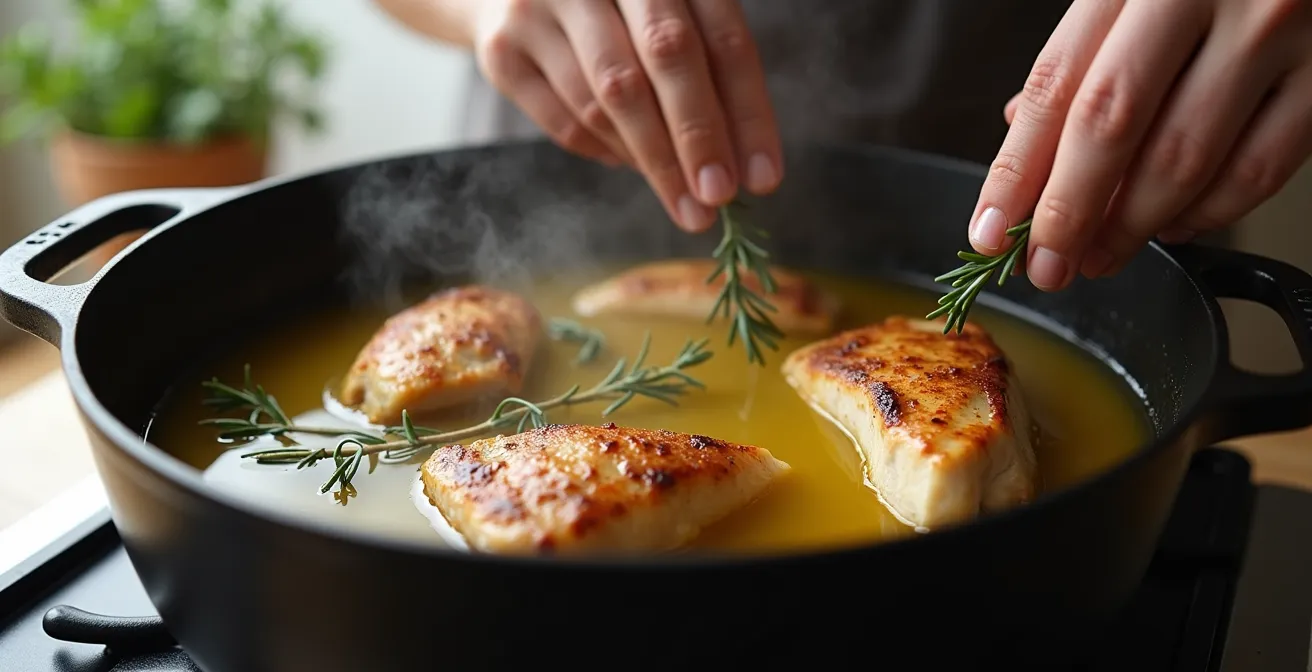
To perform a “faux confit,” you place your ingredient (like chicken thighs or firm vegetables) in a pot and add just enough flavorful broth to come halfway up the sides. Then, you drizzle a small amount of high-quality oil over the top. As the dish cooks slowly, the submerged portion braises in the broth while the exposed portion gently fries in the thin layer of oil, creating a variety of textures. You get the moist tenderness of braising combined with some of the richness of confit, all while using up to 90% less oil than the traditional method.
Other methods offer even more efficiency. Pressure cooker braising can achieve tender results in under an hour with minimal oil. The “en papillote” method—sealing food in a parchment paper packet with herbs and a splash of liquid—essentially steams the food in its own juices, yielding maximum moisture retention with almost no added fat. These techniques demonstrate that the goal is not to submerge food in fat, but to cook it in an environment that prevents its natural moisture from escaping.
By shifting your focus from fat as the medium to moisture retention as the goal, you unlock a world of techniques that deliver tender, succulent results without the heavy caloric load of traditional indulgent cooking.
Wet Brine vs Dry Brine: Which is Faster for Weeknight Pork Chops?
A common complaint about healthy protein like pork chops or chicken breasts is that they easily become dry and tough. Brining is the professional solution to this problem, guaranteeing juicy, flavorful meat every time. A brine works through osmosis, where salt draws moisture into the meat while also denaturing proteins so they can’t contract and squeeze out moisture during cooking. While a traditional wet brine (soaking in salt water) is effective, it’s also messy and time-consuming. For a busy weeknight, the dry brine is both faster and superior.
A dry brine is simply salting the meat and letting it rest. Initially, the salt draws moisture out of the pork chop onto the surface. This moisture dissolves the salt, creating a concentrated wet brine that is then reabsorbed back into the meat, taking the salt with it. This process seasons the meat more deeply than a wet brine and doesn’t introduce excess water, which can dilute the natural flavor of the pork.
The primary advantage of dry brining for weeknight cooking is speed and efficiency. A large container of salt water takes time to chill and requires the meat to be submerged for several hours. A dry brine is much quicker. For a thin cut like a standard weeknight pork chop (about 1-inch thick), research shows that 45-60 minutes is all that’s needed for the process of osmosis to be effective. You can salt the chops the moment you get home from work, and they’ll be perfectly brined and ready to cook by the time you’ve prepared your side dishes.
Furthermore, a dry brine results in a drier surface on the meat. After brining, you simply pat the chops dry. This lack of surface moisture is crucial for achieving a deep, golden-brown crust when searing, a process known as the Maillard reaction. A wet-brined chop, laden with water, will often steam in the pan, resulting in a pale, grey exterior. A dry brine gives you the best of both worlds: a juicy, seasoned interior and a perfectly seared, flavor-packed crust.
For any foodie looking to elevate their everyday healthy cooking, mastering the quick dry brine is a non-negotiable technique. It’s a small investment of time that pays massive dividends in flavor and texture.
Fat, Acid, Salt, Heat: How to Correct a Dish That Tastes “Flat”?
Every cook has been there: you’ve followed a recipe, but the final dish tastes flat, boring, and one-dimensional. It’s missing… something. That “something” can almost always be identified and corrected using the foundational framework of Fat, Acid, Salt, and Heat. Understanding how to diagnose and balance these four elements is the single most important skill for transforming a bland meal into a vibrant one.
This framework acts as a diagnostic tool. When a dish tastes flat, ask yourself which element is missing:
- Salt: If the dish tastes bland and the flavors feel muted, it almost always needs more salt. Salt doesn’t just make things “salty”; it amplifies all the other flavors present.
- Acid: If the dish feels heavy, rich, or dull, it needs acid. A squeeze of lemon juice or a dash of vinegar can cut through richness and “brighten” the entire dish, making the flavors feel lighter and more distinct.
- Fat: If the dish tastes thin, austere, or unsatisfying, it may need fat. Fat carries flavor and provides a pleasing mouthfeel. A finishing drizzle of high-quality olive oil or a few slices of avocado can add richness and a sense of luxury.
- Heat: This refers not just to temperature, but to aromatic heat. If a dish is balanced but still boring, it might need a touch of heat from black pepper, chili flakes, or fresh ginger to add a layer of exciting complexity.
Often, the missing element is a combination of these, or even the fifth taste, umami. As culinary experts point out, umami plays a unique role in this balancing act. Stephanie Lim of Epicurus Culinary Science explains how cooking methods themselves contribute:
Roasting, caramelizing, browning and grilling all boost umami because they free glutamate from proteins.
– Stephanie Lim, Epicurus Culinary Science
This highlights that heat is not just about spice, but about using cooking methods that develop deep, savory notes. When you have all the other elements but the dish still feels incomplete, an umami-rich ingredient like a splash of soy sauce or a sprinkle of nutritional yeast can be the final piece of the puzzle, tying all the other flavors together.
Instead of blindly following a recipe, learn to taste and adjust using this framework. It empowers you to take control of your cooking, turning you from a recipe-follower into a true cook who can create delicious, balanced meals from scratch.
Key Takeaways
- Decadent flavor is built with technique, not just ingredients. Mastering umami, texture, and aromatics is key.
- Low-fat doesn’t mean low-flavor. Methods like “faux confit” and dry brining deliver succulent results with minimal oil.
- Mindful eating and understanding satiety hormones can make smaller, healthier portions feel more satisfying.
The 5 “Hidden” Additives in Your Pantry That Sabotage Clean Cooking
You can spend hours crafting the perfect healthy meal from fresh ingredients, only to have your efforts sabotaged by a single spoonful from a jar in your pantry. Many common condiments, broths, and spice blends are marketed as convenient, but they often contain hidden additives that can deaden flavor, add empty calories, and undermine your “clean cooking” goals. Being a vigilant label-reader is as important as any cooking technique.
Some of the most common culprits include spice blends filled with anti-caking agents (like silicon dioxide) and cheap fillers like flour, which can mute the vibrancy of the spices. Store-bought vegetable broths and bouillon cubes are frequently loaded with MSG, yeast extract, and maltodextrin—all shortcuts to create a superficial umami flavor without the complexity of real ingredients. Even “healthy” nut milks can contain carrageenan and various gums, which are used to create a creamy texture but can cause digestive issues for some people.
Case Study: The “Healthy” Balsamic Glaze
A classic example is the flavored balsamic glaze. A true aged balsamic vinegar is naturally sweet and rich with umami. However, many commercial glazes are made from cheap, young vinegar and are packed with added sugars, corn syrup, and caramel coloring to mimic the flavor and consistency of the real thing. A consumer might think they’re adding a healthy, flavorful drizzle to their salad, but they are actually pouring on a significant amount of hidden sugar.
The solution is to build a pantry based on whole, single-ingredient products. Instead of a pre-made garlic-herb blend, stock high-quality garlic powder, dried oregano, and dried thyme. Instead of store-bought broth, make your own (it can be frozen in batches) or choose a low-sodium version with a minimal ingredient list. By taking control of these building blocks, you ensure that every component in your dish is contributing pure, clean flavor.
Swapping out processed pantry staples for cleaner alternatives is a critical step in ensuring your healthy cooking efforts are not unintentionally undermined. This table provides a clear guide for making smarter choices.
| Product Type | Clean Alternative | Hidden Additives to Avoid |
|---|---|---|
| Spice Blends | Single spices, DIY blends | Silicon dioxide, flour fillers, excess salt |
| Vegetable Broth | Homemade or low-sodium | Yeast extract, MSG, maltodextrin |
| Nut Milks | Homemade or minimal ingredients | Carrageenan, gums, added sugars |
| Salad Dressings | Oil & vinegar based | Xanthan gum, corn syrup, stabilizers |
Building a “clean” pantry takes a little more effort upfront, but it pays off in every single dish you make. It guarantees that the flavors you taste are authentic and vibrant, and that your healthy meal is truly as wholesome as you intend it to be.
Frequently Asked Questions on Healthy, Flavorful Cooking
How does eating slowly affect satiety hormones?
Eating slowly allows time for the gut to release satiety hormones like CCK and GLP-1, which signal fullness to the brain. This process simultaneously suppresses ghrelin, the primary hunger hormone, making you feel full and satisfied with less food.
What is Sensory Specific Satiety?
Sensory Specific Satiety is the principle that our enjoyment of a food decreases as we eat more of it. When we eat fast, our palate becomes fatigued with a single flavor profile. Slow, mindful eating allows the brain to register the nuances in each bite, which delays this sensory fatigue and keeps the food enjoyable for longer.
What is the Three-Bite Rule?
The “Three-Bite Rule” is a mindful eating technique designed to force deeper engagement with your food. The first bite is for analysis (what am I tasting?). The second bite is for pure enjoyment. The third bite is for confirmation and satisfaction. It slows you down and enhances your appreciation of the food’s texture and taste.