The solution to cooking fatigue isn’t finding more recipes; it’s building a creative system that eliminates decision-making and unlocks the potential already in your pantry.
- Your brain is hardwired to reject complex new tasks like recipes after a long day of making thousands of other choices.
- Structured systems, like theme nights and ingredient formulas, are more effective at sparking creativity than the infinite scroll of a recipe app.
Recommendation: Before seeking new inspiration, start by mastering the versatility of a few “powerhouse” staples you already own, like miso or a high-quality vinegar.
The feeling is all too familiar. You open the fridge, a landscape of possibilities, and yet feel a profound sense of emptiness. It’s not a lack of food, but a lack of will. You’re bored with your standard rotation of meals, but the thought of tackling a new, complex recipe feels more exhausting than exciting. The common advice—to browse endless food blogs or buy another specialty cookbook—often just adds to the overwhelm. This cycle of “cooking burnout” is a common struggle for home cooks who genuinely love food but are drained by the daily demands of deciding “what’s for dinner?”
This feeling isn’t a personal failing; it’s a symptom of a larger issue: decision fatigue. We’ve been taught that inspiration is something you go out and find, an external spark from a vibrant farmer’s market or a glossy magazine. But what if the real key to reigniting your culinary passion wasn’t about adding more, but about creating a better system with what you already have? What if inspiration could be cultivated from within, by changing your mindset and approach rather than your shopping list?
This guide offers a different path. We’ll explore the psychology behind why your brain fights new recipes and how to build a framework for creativity that reduces mental load. We will deconstruct the myth of the “exotic ingredient” and show you how to transform a handful of basic staples into a world of flavors. By the end, you’ll have a practical toolkit to move beyond the recipe rut and rediscover the joy of cooking, turning your kitchen from a place of chore into a space of endless, sustainable inspiration.
To help you navigate this journey, we’ve structured this guide to tackle each aspect of culinary fatigue. The following sections will provide you with a clear roadmap to rebuild your cooking habits from the ground up.
Summary: Finding Endless Culinary Inspiration
- Why Your Brain Rejects New Recipes After a Long Work Day?
- How to Build a “Theme Night” Schedule That Reduces Decision Fatigue?
- Recipe Apps vs Vintage Cookbooks: Which Source Better Sparks Creativity?
- The “Exotic Ingredient” Trap That Wastes Money and Pantry Space
- How to Transform 5 Basic Pantry Staples into 3 Different Cuisines?
- Why You Think Cooking Takes an Hour When It Can Take 15 Minutes?
- Gochujang and Miso: Which Panty Staples Offer the Most Versatility?
- How to Plan Healthy Daily Meals for a Family of 4 Under $150 a Week?
Why Your Brain Rejects New Recipes After a Long Work Day?
That resistance you feel when looking at a new recipe after 6 PM isn’t laziness; it’s a cognitive-load crisis. Your brain is a finite resource, and by the end of the day, its capacity for complex decision-making is severely depleted. This phenomenon, known as decision fatigue, is the primary culprit behind your lack of culinary motivation. When you’ve already made countless choices from what to wear to how to respond to an email, asking your brain to now decode a new ingredient list, learn a new technique, and manage timing for an unfamiliar dish is often one ask too many.
The numbers are staggering; research shows that the average person makes about 35,000 remotely conscious decisions each day, with over 200 of them being just about food. Each choice, no matter how small, chips away at your executive function. A new recipe isn’t just one decision; it’s a cascade of them: Do I have all the ingredients? Is this substitution okay? What pan should I use? Which step do I do first? Your brain, seeking the path of least resistance, defaults to the familiar—the same three to five meals you can cook on autopilot. It’s not a rejection of novelty, but a protective mechanism against further mental exhaustion.
To overcome this, the solution isn’t to force more inspiration but to create a system that drastically reduces the number of choices required at dinnertime. By pre-deciding certain elements, like a cooking theme or a meal formula, you conserve precious mental energy. This frees up your cognitive resources not for arduous execution, but for what you actually want: a little creative flair. Understanding that this is a battle of brain chemistry, not willpower, is the first step toward building a more sustainable and enjoyable cooking habit.
How to Build a “Theme Night” Schedule That Reduces Decision Fatigue?
A “theme night” schedule is one of the most powerful tools for combatting decision fatigue, but its effectiveness depends on the right kind of structure. The common approach of “Taco Tuesday” or “Pasta Night” is a good start, but it can quickly lead to the same recipe rut. A more creatively stimulating method is to build themes around techniques or flavor profiles rather than specific cuisines. This creates a framework that guides you without overly restricting you, leaving room for improvisation and discovery within your pantry.
Instead of “Italian Night,” consider “One-Pot Wednesday” or “Sheet-Pan Thursday.” This shifts the focus from a specific recipe to a method. On “One-Pot Wednesday,” you know your cleanup will be minimal, and your only real decision is what combination of protein, starch, and vegetables to toss into that single vessel. Similarly, a theme built around a flavor profile, like “Smoky & Spicy Night,” gives you a clear direction. You might use smoked paprika and chipotles on chicken one week, and gochujang-glazed tofu the next. The theme provides the guardrails, but your creativity drives the meal.
To keep things fresh, develop a rotational system. Create a master list of 12-16 themes you enjoy and rotate through 4-5 of them each week. Another highly effective strategy is the “formula approach,” where your theme is simply a blueprint: protein + complex carb + two vegetables + healthy fat. This abstract structure completely liberates you from the tyranny of a specific recipe, encouraging you to “shop your pantry” and build a balanced, satisfying meal with what you already have. This systematic approach turns the dreaded “what’s for dinner?” question into a simple, creative puzzle.
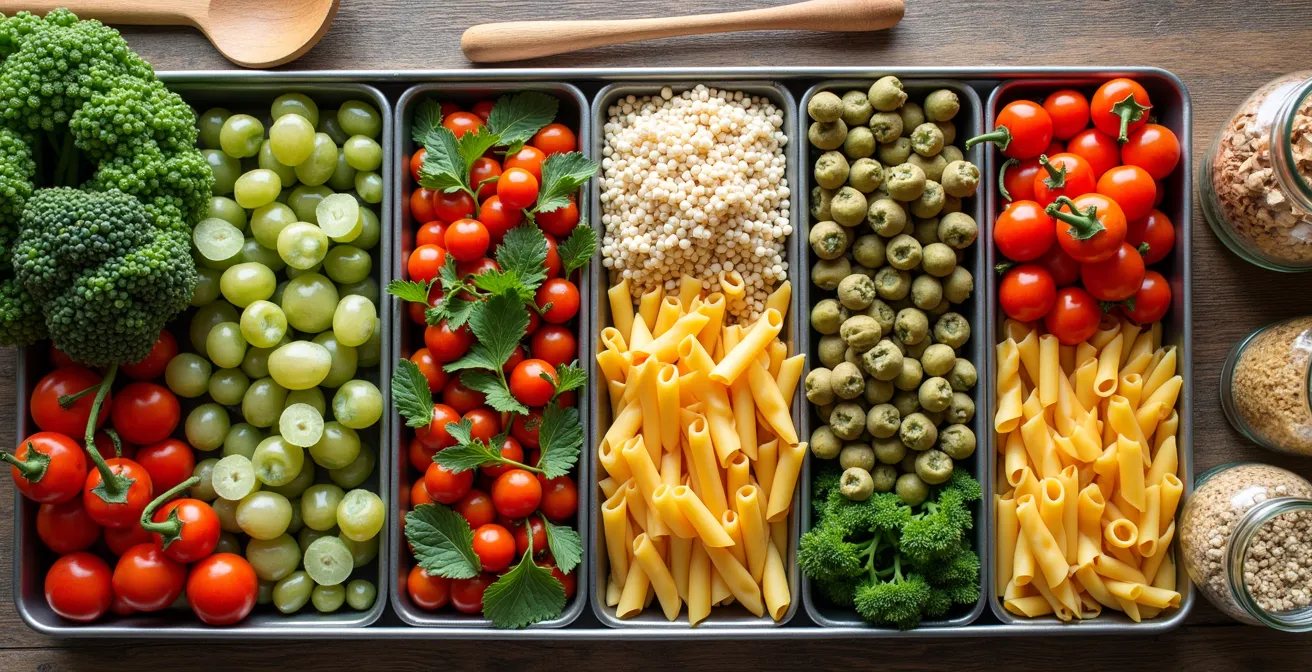
As you can see, organizing your thoughts visually with ingredients grouped by cooking method or flavor can make the planning process feel less like a chore and more like a creative session. This approach transforms meal prep from a list of recipes to a palette of possibilities.
Recipe Apps vs Vintage Cookbooks: Which Source Better Sparks Creativity?
In the quest for inspiration, we often turn to two main sources: modern recipe apps and traditional cookbooks. While both have their place, they engage our brains in fundamentally different ways, with one being far more conducive to sparking genuine, lasting creativity. Recipe apps, with their infinite scroll, algorithmic suggestions, and user ratings, are masters of convergent thinking. They are designed to give you a specific, optimized answer to a query like “quick chicken breast recipe.” They excel at technical execution but can paradoxically stifle creativity by overwhelming you with choice.
Vintage or well-curated cookbooks, on the other hand, foster divergent thinking. Their finite, carefully selected collection of recipes, often accompanied by stories and evocative photography, encourages exploration rather than just execution. As culinary writer Casey Barber notes, “The finite, curated nature of a good cookbook is less overwhelming and therefore more creatively stimulating than the infinite, algorithm-driven feed of an app.” Flipping through a physical book allows for serendipitous discovery; a photo might catch your eye, or an author’s note on an ingredient might send your mind in a new direction. This sensory experience is less about finding a single “best” recipe and more about absorbing a point of view.
The key difference lies in the decision load. An app presents thousands of options, forcing your brain back into the evaluative, fatiguing mindset you’re trying to escape. A good cookbook has already done the heavy lifting of curation for you. This distinction is crucial for understanding how to use each tool effectively.
This table breaks down how each source impacts your creative process:
| Aspect | Recipe Apps | Vintage Cookbooks |
|---|---|---|
| Thinking Style | Convergent (specific answers) | Divergent (exploration-based) |
| Decision Load | High (infinite choices) | Low (curated selection) |
| Inspiration Type | Data-driven (ratings, times) | Sensory (photography, stories) |
| Best Use | Technical execution | Conceptual inspiration |
Ultimately, for reigniting a passion for cooking, cookbooks often have the edge. Use apps when you need a quick, reliable recipe for a specific ingredient you have on hand. But for true inspiration—for developing your own culinary voice—turn to the curated, story-rich world of a physical cookbook.
The “Exotic Ingredient” Trap That Wastes Money and Pantry Space
One of the biggest pitfalls on the path to culinary inspiration is the “exotic ingredient” trap. A captivating recipe calls for a teaspoon of black garlic powder or a tablespoon of rose harissa. You buy the expensive jar, use it once, and it gets pushed to the back of the pantry, destined to expire. This not only wastes money but also creates clutter, which contributes to the feeling of being overwhelmed in your own kitchen. For a family, this habit can be costly; the average U.S. family of four wastes approximately $1,500 per year on unused food, with specialty ingredients being a significant contributor.
The solution is to adopt a “Pantry-First Philosophy” and develop a strict vetting system for any new ingredient. Instead of buying for a single recipe, you should prioritize “powerhouse staples”—versatile ingredients that can bridge multiple cuisines and applications. Think of high-quality soy sauce, white miso, sherry vinegar, or Dijon mustard. These ingredients provide a massive return on investment in flavor and flexibility, unlike that one-hit-wonder bottle of truffle-infused oil.
Before committing to a purchase, apply the “Rule of Three”: can you immediately name three other distinct dishes you are genuinely excited to make with this ingredient? If not, it’s probably not worth the investment. Another helpful technique is to think in “flavor families.” Instead of buying Gochugaru, Aleppo pepper, and Maras pepper, recognize them as part of the “sweet-spicy chili flake” family and choose one to master. This mindset shift from collecting ingredients to building a versatile flavor toolkit is fundamental to sustainable creativity.
Your Action Plan: The Smart Ingredient Vetting System
- Apply the ‘Rule of Three’: Never buy a niche ingredient unless you can immediately name three distinct and appealing dishes you’ll make with it.
- Identify ‘Flavor Families’: Group similar ingredients (e.g., different types of chili flakes or vinegars) and choose one versatile representative rather than collecting them all.
- Prioritize ‘Powerhouse Staples’: Focus your budget on high-quality, versatile workhorses like excellent olive oil, soy sauce, or miso that offer broad utility.
- Check for Versatility: Before buying, ask if the ingredient works in both sweet and savory dishes, or across multiple cooking methods (raw, cooked, as a finishing touch).
- Assess its Function: Does this new ingredient add a truly unique function to your pantry, or does it merely duplicate something you already own?
By implementing this system, you not only save money and space but also force yourself to become more creative with the tools you already possess, which is the true mark of an inspired home cook.
How to Transform 5 Basic Pantry Staples into 3 Different Cuisines?
The true test of a creative cook isn’t a pantry full of exotic ingredients, but the ability to transform a few humble staples into a variety of exciting dishes. This is the core of the “Pantry-First Philosophy.” By understanding how a handful of “flavor-building” additions can completely pivot a simple base, you unlock endless possibilities. Let’s take five incredibly common, affordable staples: canned tomatoes, lentils, onions, garlic, and olive oil. On their own, they are simple. But with the right supporting cast, they can transport you across the globe.
This core combination provides a foundation of savory depth, texture, and acidity. The magic happens when you introduce a “flavor trio” from a specific cuisine. Think of these trios as your culinary levers, each one pulling the base ingredients in a completely new direction. You don’t need a dozen spices for each; often, three well-chosen ones are enough to create a distinct and authentic-tasting profile.
Here’s how you can transform that simple base into three completely different meals:
- Mediterranean-Style Lentil Stew: To your base of sautéed onion, garlic, tomatoes, and lentils, add the classic trio of oregano, basil, and a splash of red wine vinegar at the end. The herbaceous, bright notes instantly evoke the flavors of Italy or Greece. Serve with a final drizzle of good olive oil and perhaps some feta cheese if you have it.
- Mexican-Inspired Lentil Chili: Using the same base, introduce a trio of cumin, chili powder, and a pinch of smoked paprika. These earthy, smoky, and warm spices completely change the dish’s character. A squeeze of lime juice at the end will brighten it up, creating a simple, hearty chili.
- Indian-Flavored Dal: Again, start with the same five staples. Now, add the Indian flavor trio of turmeric, ground coriander, and garam masala. The turmeric provides a vibrant color and earthy flavor, the coriander adds citrusy notes, and the garam masala brings a complex warmth. A dollop of yogurt on top would complete the transformation.
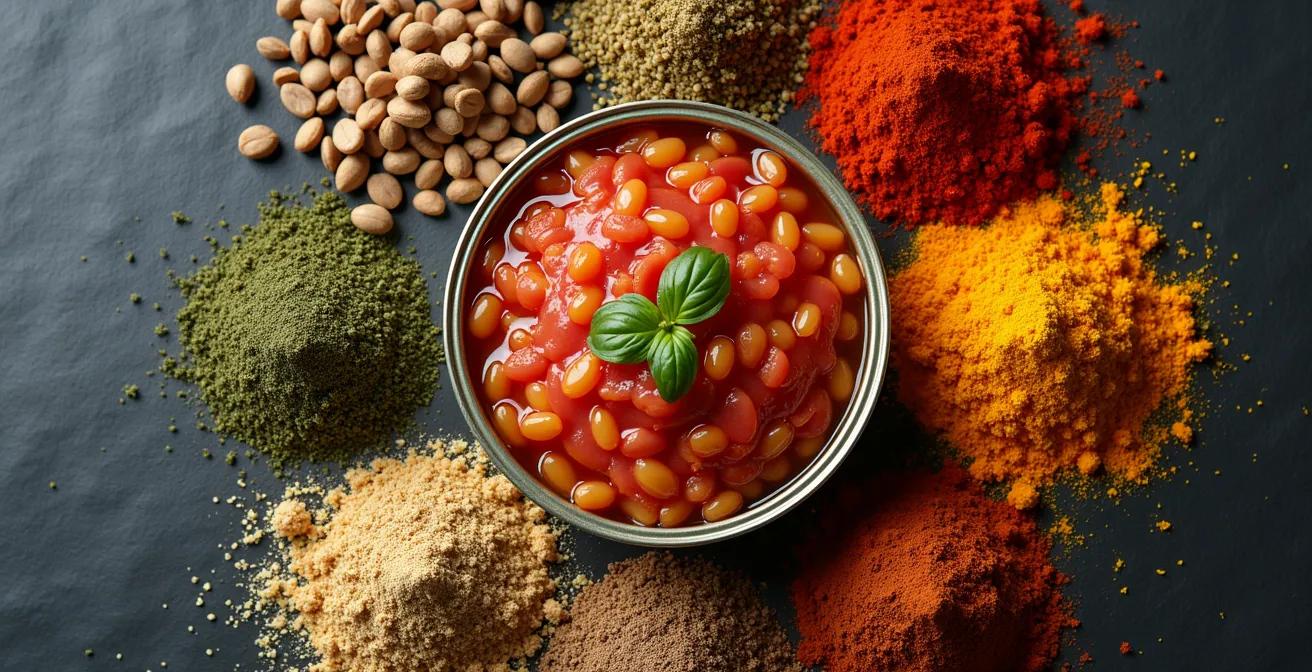
This exercise demonstrates that versatility isn’t in the number of base ingredients you have, but in your understanding of how to manipulate them with flavor. Mastering just a few of these “flavor trios” is far more powerful than owning fifty different spices you barely use. It’s about creative constraint, not endless acquisition.
Why You Think Cooking Takes an Hour When It Can Take 15 Minutes?
Our perception of how long a task takes is often skewed by a psychological bias called “anchoring.” We anchor our expectations to our most frequent experiences. If your most-cooked meals are time-consuming, multi-step recipes, your brain starts to believe that all cooking is an hour-long commitment. This creates a significant mental barrier to starting, especially on a busy weeknight. You don’t even attempt to cook because the perceived effort—the “activation energy”—is just too high.
We anchor our perception of cooking time to our most-cooked, often inefficient recipes. The solution is to consciously cook a few ultra-fast meals to ‘re-anchor’ our perception.
– Grant Pignatiello et al., Decision fatigue: A conceptual analysis
The key to breaking this cycle is to perform a “cognitive re-anchoring.” You must consciously and intentionally cook a few delicious, satisfying meals that take 15 minutes or less from start to finish. This isn’t just about finding quick recipes; it’s about proving to your own brain that cooking can be fast. After you successfully make a flavorful stir-fry in 12 minutes or a hearty pasta dish in 15, your mental anchor starts to shift. The next time you’re tired, the thought of cooking won’t automatically trigger the “hour-long project” alarm. Instead, your brain will have a new, more accessible reference point: “I could make something great in just 15 minutes.”
Excellent candidates for re-anchoring include dishes like a simple cacio e pepe, a broiled piece of fish with a quick lemon-herb sauce, a high-powered blender soup, or a stir-fry with pre-chopped vegetables. The goal is to experience a high ratio of flavor-to-effort. By recalibrating your internal clock, you dismantle one of the biggest psychological hurdles to daily cooking and make the kitchen a far more approachable place.
Gochujang and Miso: Which Panty Staples Offer the Most Versatility?
When building a “powerhouse pantry,” few ingredients offer more versatility and depth than Gochujang and Miso. Both are fermented pastes that deliver a massive punch of flavor, but they serve different primary functions and unlock different creative avenues. Understanding their unique strengths allows you to use them as incredible shortcuts to complexity in your cooking, far beyond their traditional Asian contexts. They are the epitome of smart, versatile staples that work hard for their space in your fridge.
Miso, a fermented soybean paste, is a master of umami. Its primary role is to add a salty, funky, deeply savory background note to dishes. While essential in Japanese cuisine for soups and glazes, its true power is revealed in non-Asian applications. A spoonful of white miso whisked into a tomato sauce adds a layer of complexity no one can quite place. It can make a vinaigrette more interesting, add depth to caramel sauces, or even be used to create a savory “cacio e pepe” style pasta sauce. Its best partners are often butter, citrus, and vinegar, which help balance its salty intensity.
Gochujang, a Korean fermented chili paste, is a more complex, multi-layered condiment. It brings sweetness, spiciness, and a savory funk all in one. Its primary role is as a bold, forward flavor. Outside of Korean cooking, it is incredibly adaptable. Whisk it into mayonnaise for a spicy sandwich spread, blend it with honey or maple syrup for a spectacular glaze on roasted vegetables or chicken, or use it to spike a classic American BBQ sauce. It pairs beautifully with garlic, sesame oil, and sweeteners like honey that tame its heat and amplify its flavor.
Here is a breakdown of their functions to help you decide which one best suits your cooking style:
| Function | Miso | Gochujang |
|---|---|---|
| Primary Role | Salty/Funky/Umami Enhancer | Sweet/Spicy/Funky Fermented Paste |
| Non-Asian Uses | Cacio e Pepe, caramel sauces, salad dressings | BBQ sauces, spicy mayo, vegetable glazes |
| Best Pairings | Butter, vinegar, citrus | Honey, sesame, garlic |
| Shelf Life | 1+ years refrigerated | 1+ years refrigerated |
While both are excellent, if you are looking for a subtle background enhancer to add depth, start with white miso. If you want a bold, all-in-one flavor bomb to create sauces and glazes, go with gochujang. Mastering either will dramatically expand your culinary toolkit.
Key Takeaways
- The primary obstacle to cooking is not a lack of recipes but cognitive decision fatigue; reducing choices is the most effective strategy.
- Creative constraints, such as a limited pantry or a technique-based theme night, are more effective at sparking inspiration than endless options.
- Investing in a few “powerhouse” staples that are versatile across multiple cuisines provides a greater return on flavor than collecting single-use exotic ingredients.
How to Plan Healthy Daily Meals for a Family of 4 Under $150 a Week?
Feeding a family of four healthy meals on a tight budget of $150 a week is a significant challenge, but it is achievable with a strategic, system-based approach. For context, according to USDA data, the average weekly grocery bill for a family of four ranges from $150 on the “thrifty” plan to over $300, so hitting this target requires discipline and planning. It moves meal planning from a simple-to-do list to a crucial financial and creative exercise. The key is to abandon recipe-led shopping and embrace cost-led menu creation.
The most effective strategy is ‘Reverse Meal Planning.’ Instead of deciding what you want to eat and then creating a shopping list, you start with the weekly sales flyers from your local grocery stores. See that pork shoulder is half-price? That becomes the anchor for two or three meals this week. Are bell peppers and onions on deep discount? That will form the base of your stir-fries or fajitas. This approach forces you to be flexible and creative, building your menu around the most affordable items available.
Another powerful framework is “Cook Once, Eat Thrice.” This involves cooking a large-format protein at the beginning of the week and transforming the leftovers. For example, a Sunday roast chicken becomes Monday’s chicken salad sandwiches and Wednesday’s chicken and vegetable soup. To further manage costs, practice “protein stretching” by adding inexpensive, nutritious fillers like lentils or beans to ground meat dishes, or bulking up stir-fries with extra vegetables like cabbage and carrots. Finally, “Component Cooking”—pre-cooking large batches of versatile grains (rice, quinoa), proteins, and roasted vegetables—allows family members to build their own bowls, reducing waste and catering to individual preferences without extra effort.
By shifting your mindset from finding the perfect recipe to building a resilient and creative system, you can transform your relationship with cooking. The ultimate goal is to make your kitchen a place of joy and discovery again, not a source of daily stress. Begin by implementing one or two of these strategies and see how it frees up your mental energy for what truly matters: enjoying the process of making and sharing good food.