
The secret to great fusion cooking isn’t mixing, it’s architectural design: one cuisine provides the structure, the other provides a deliberate accent.
- Successful fusion relies on a clear “Flavor Hierarchy” to prevent ingredients from competing.
- Choosing the right “Structural Canvas” (like a taco or rice bowl) is essential for a coherent dish.
Recommendation: Instead of adding more ingredients, first define your dish’s foundational cuisine and its primary flavor profile.
For the creative home cook, the allure of fusion is irresistible. The thought of weaving the fiery punch of gochujang into a classic taco or brightening a rich French cream sauce with a splash of yuzu is the kind of experimentation that makes cooking an art. Yet, this ambition is often shadowed by a legitimate fear: the risk of creating a “confused dish,” a culinary mess where distinct, beautiful flavors are lost in a chaotic muddle. You have the right ingredients, you understand the basics of balancing sweet and sour, but the bridge between a Japanese pantry and a Mexican recipe book can feel treacherous.
Many will advise you to simply “be bold” or “start with a familiar format like pizza,” but this advice often misses the core issue. The problem isn’t a lack of creativity, but the absence of a disciplined framework. True mastery in fusion cooking doesn’t come from random combinations; it comes from understanding the principles of structure and hierarchy. It’s about learning to think like an architect, not just a painter throwing colors at a canvas. The key isn’t about whether you can mix cuisines, but *how* you establish a clear relationship between them.
This guide moves beyond generic tips. We will establish a clear philosophy for building successful fusion dishes. We’ll explore how to balance core elements like fat and acid from different culinary worlds, how to navigate the line between appreciation and appropriation with respect, and why simplifying your concept is often the most brilliant move. By treating one cuisine as the solid foundation and the other as a thoughtful, respectful accent, you will gain the confidence to innovate without creating confusion.
To guide you through this culinary philosophy, this article breaks down the essential principles of disciplined fusion. We will cover everything from foundational techniques to the creative formats that best support your experiments, providing a clear roadmap to elevate your cooking.
Summary: A Chef’s Guide to Building Harmonious Fusion Dishes
- Fat vs Acid: How to Balance Rich French Sauce with Sharp Asian Vinegar?
- Appropriation or Appreciation: How to Respect Culture While Innovating?
- Gochujang and Miso: Which Panty Staples Offer the Most Versatility?
- Over-Complication: Why Adding Too Many Regions to One Bowl Fails?
- Tacos or Pizza: Which Formats Are Best for Flavor Experimentation?
- How to Transform 5 Basic Pantry Staples into 3 Different Cuisines?
- Mango and Chili: Why Sweet and Spicy Work So Well Together?
- MSG Myths vs Reality: Is It the Secret to Restaurant-Quality Asian Dishes?
Fat vs Acid: How to Balance Rich French Sauce with Sharp Asian Vinegar?
The first rule of any great dish, fusion or not, lies in balance. When combining cuisines as distinct as French and Asian, this principle is tested at a chemical level, most notably in the interplay between fat and acid. A classic French sauce, rich with butter or cream, provides a luxurious, mouth-coating base. An Asian vinegar, whether it’s a sharp rice vinegar or a complex black vinegar, brings a bright, cutting quality. The goal is not for one to dominate the other, but to create a perfectly emulsified harmony.
To achieve this, you need a “bridge ingredient”—an element that shares common ground with both profiles. Ginger, with its sharp, aromatic warmth, can seamlessly connect a buttery French sauce with rice vinegar. Similarly, a touch of honey can temper the aggressive tang of lime juice when paired with rich duck fat, creating a cohesive whole rather than a jarring contrast. The key is to see these pairings not as a clash, but as a conversation where each element enhances the other. This creates a sauce with both the satisfying weight of a classic European preparation and the vibrant, clean finish characteristic of many Asian dishes.

As seen in this close-up, a successful fusion sauce isn’t a simple mix; it’s an emulsion where fat and acid are bonded. You can often see tiny droplets of oil suspended within the vinegar, held together by the force of whisking and the right bridge ingredients. The texture becomes glossy and slightly thickened, a visual cue that the flavors have truly married. Here are some proven pairings to start with:
- Butter-based French sauces with rice vinegar: Use ginger as your bridge ingredient to add aromatic warmth.
- Duck fat with lime juice: A small amount of honey will balance the sharpness and harmonize the flavors.
- Coconut cream with tamarind: Incorporate finely chopped shallots for a savory depth that connects the two.
- Cream sauces with yuzu: Add a teaspoon of white miso to introduce an umami complexity that grounds the bright citrus.
- Olive oil with Chinese black vinegar: Use fresh garlic as the connector, providing a pungent link between Mediterranean and Asian profiles.
Appropriation or Appreciation: How to Respect Culture While Innovating?
As you step into the world of fusion, you are not just mixing ingredients; you are engaging with cultures, histories, and traditions. This carries a responsibility to innovate with respect. The line between appreciation and appropriation can seem blurry, but it is navigated with one guiding principle: seek to understand before you seek to change. Appreciation involves learning the “why” behind a dish—understanding the traditional techniques, the cultural significance of its ingredients, and the flavor profile it’s meant to achieve. Appropriation, in contrast, often involves taking surface-level elements without context, which can lead to a shallow or disrespectful interpretation.
Respectful innovation means honoring the essence of a cuisine even while you adapt it. If you’re making Korean-inspired tacos, take the time to learn how to properly make a real *gochujang* marinade. Understand the balance of sweet, savory, and spicy that is central to Korean BBQ. Only then can you thoughtfully place it within a new format, like a tortilla. The goal is to create a dish where both cuisines are celebrated, not where one is diminished or turned into a caricature. This approach isn’t new; as Wikipedia contributors note in an article on Fusion cuisine, some of the most celebrated culinary movements were born from this cross-cultural dialogue, such as when Japanese cooking techniques were combined with French in the 1970s to create nouvelle cuisine.
Case Study: Roy Choi’s Korean-Mexican Fusion Success
Korean BBQ in taco form is a flavor mashup that might seem obvious in hindsight, but it was revolutionary when Roy Choi started the Kogi truck in 2008. The success of the Kogi short rib taco lies in its respect for both culinary traditions. The dish features classic BBQ *kalbi*, marinated and grilled to perfection, tucked into a simple tortilla. The fusion brilliance comes from the accompaniments: a zesty salsa and a crisp slaw that bridge the gap between a Korean side dish (*banchan*) and a Mexican condiment. It’s a harmonious dish that highlights the best of both worlds without losing their identities.
Ultimately, a respectful fusion dish should taste like a delicious conversation between two cultures, where both are speaking their truth. It should make someone familiar with the original cuisine smile in recognition, while delighting someone new with an exciting, coherent combination.
Gochujang and Miso: Which Panty Staples Offer the Most Versatility?
A successful fusion kitchen is built on a smart pantry. Instead of hoarding dozens of single-use ingredients, the disciplined chef curates a small collection of powerful, versatile staples that can cross culinary borders. These are your “power tools”—ingredients so fundamental in their flavor function that they can provide depth, complexity, or brightness to almost any dish. Two of the most valuable are gochujang and miso paste.
Gochujang, a Korean fermented chili paste, is more than just heat; it’s a complex blend of spicy, sweet, and savory notes. A spoonful can transform a simple tomato sauce, add a surprising kick to a marinade for grilled chicken, or be whisked into mayonnaise for an instant, dynamic sandwich spread. Miso, a Japanese fermented soybean paste, is a pure umami bomb. It provides a deep, savory richness that can elevate everything from salad dressings to mashed potatoes. As fusion pioneer Peter Gordon notes, miso is a true workhorse.
Miso paste creates a richness and has a little sweetness. The umami characteristics make foods taste even more fabulous. You can use it in anything from porridge to salad dressing to meats to mashed potatoes.
– Peter Gordon, Esquire
To build your fusion pantry, think in terms of function, not just cuisine. You need ingredients that can perform specific jobs—adding umami, providing acid, building aromatic foundations, or introducing heat. Here are five essential categories for your pantry:
- Umami Bombs: Miso paste, fish sauce, parmesan cheese. Use these for adding savory depth to any sauce, broth, or marinade.
- Fermented Funks: Gochujang, fermented black beans. These add a layer of deep complexity that can make simple dishes taste like they’ve been simmering for hours.
- Aromatic Foundations: Lemongrass, ginger, garlic. This trio can build the flavor base for countless Southeast Asian, East Asian, and even Latin American dishes.
- Acid Brighteners: Rice vinegar, lime juice, tamarind paste. Essential for cutting through richness and balancing your final dish.
- Sweet Heat: Chili-honey combinations, sweet soy sauce (kecap manis). These create the addictive, layered flavor profiles found in many global cuisines.
Over-Complication: Why Adding Too Many Regions to One Bowl Fails?
The most common mistake for an enthusiastic home cook is over-complication. It’s the temptation to create a “world tour in a bowl,” mixing Thai green curry with Mexican salsa, Italian pesto, and a sprinkle of Japanese furikake. While the intention comes from a place of creativity, the result is almost always a confused, muddy-tasting dish. The reason this fails is the violation of a core principle in fusion cooking: Flavor Hierarchy.
A successful fusion dish is not a democracy; it’s a well-structured composition with a clear leader. You must decide which cuisine will form the “base” or “foundation” of your dish and which will act as the “accent.” The foundational cuisine should define the primary flavor profile and structure, while the accent cuisine should introduce a specific, complementary element—a surprising texture, a pop of acidity, or an unexpected aromatic note. For example, in a bowl of Italian risotto (the foundation), a swirl of Korean gochujang-infused butter (the accent) adds a delightful, smoky heat without disrupting the creamy integrity of the dish. You are still eating risotto, but a new and exciting version of it.
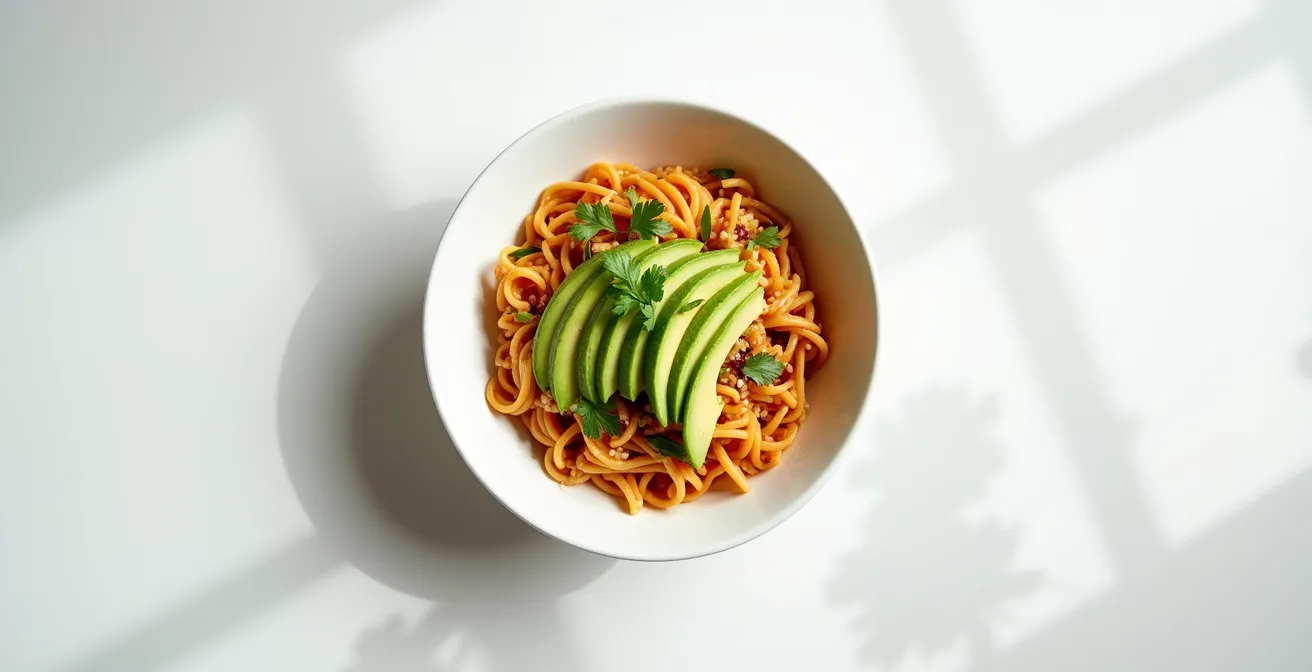
This bowl exemplifies clarity. The noodles and broth clearly establish an Asian foundation. The accents—perfectly sliced avocado and fresh cilantro—are recognizably from a different culinary world, but they are used with restraint. They add creaminess and a fresh, herbal note without trying to take over. This is synergy, not chaos. The smoky essence of Korean BBQ can be delightful with the spicy complexity of Mexican salsa, but only when one is the star and the other is the supporting act. When both try to shout at the same time, the diner hears nothing but noise.
Before you start cooking, ask yourself: what is the main story I want this dish to tell? Is it a story about a perfectly seared steak with a surprising twist, or a vibrant noodle salad with a creamy, unexpected dressing? Once you have your answer, every other ingredient you add should serve that primary narrative.
Tacos or Pizza: Which Formats Are Best for Flavor Experimentation?
Not all dishes are created equal when it comes to fusion. Some formats are like a blank canvas, offering a neutral, structurally sound base for experimentation. Others have strong personalities that can clash with new flavors. The key is to choose a “Structural Canvas” that supports your creative vision without competing with it. Tacos, rice bowls, and flatbreads are fantastic starting points because they are structurally simple and have a relatively neutral flavor profile, allowing your fusion ingredients to shine.
A tortilla, for example, is a wonderfully flexible and forgiving container. It can happily hold the juicy, marinated fillings of Korean bulgogi or the crispy, spicy chicken of a Thai *larb* salad. A pizza, on the other hand, is a more complex canvas. Its dough has its own fermented flavor, and the traditional combination of tomato sauce and melted cheese creates a powerful acidic and fatty profile that must be carefully considered. You can absolutely make a Thai green curry pizza, but you must be mindful of how the coconut milk will interact with the mozzarella and how the lemongrass will pair with the yeasty crust. It requires more careful engineering.
To help you choose the right format, this table from a comparative analysis on Masterclass breaks down the pros and cons of several universal canvases. It’s a great tool for planning your next experiment.
| Format | Structural Integrity | Flavor Neutrality | Customization Ease | Best For |
|---|---|---|---|---|
| Tacos | High – flexible tortilla | High – corn or flour base | Very High | Quick fusion experiments |
| Pizza | Medium – needs balance | Medium – dough has flavor | High | Cheese-based fusions |
| Rice Bowls | Very High | Very High | Very High | Complex layered dishes |
| Dumplings | High when steamed | High | Medium | Enclosed flavor bombs |
| Flatbreads | High | High | High | Open-faced combinations |
Ultimately, the best format is one that provides a stable, coherent base. Think of the South American arepa, a griddled corn cake, used as a pocket for a Greek-inspired tabbouleh salad. The arepa provides the structure, while the tabbouleh provides the fresh, herby filling. It works because the canvas is strong enough to support the new idea. Choose your canvas wisely, and you’ve already won half the battle.
How to Transform 5 Basic Pantry Staples into 3 Different Cuisines?
The magic of fusion cooking—and indeed, all cooking—is understanding that a cuisine’s identity is often defined by a handful of key ingredients and techniques. A chicken breast, an onion, garlic, rice, and cooking oil are a neutral starting point. But by simply swapping out a “Transformative Trio” of flavorings, you can transport that same set of base ingredients to entirely different parts of the world. This is the most practical and efficient way to practice your fusion skills: master the core flavor profiles of a few cuisines.
This exercise demonstrates the power of a disciplined pantry and the concept of flavor hierarchy. The chicken and rice act as your canvas, while the transformative trio becomes the defining “accent” that tells the culinary story. An Italian profile is built on the foundation of olive oil, garlic, and basil. Switch to coconut milk, lemongrass, and lime, and you are instantly in Thailand. This isn’t just about adding flavor; it’s about fundamentally changing the dish’s character through a few strategic choices. This approach removes the fear of the “confused dish” because you are committing to a single, coherent flavor profile for each iteration.
By mastering these fundamental combinations, you’ll develop an intuitive sense of how flavors work together. This will give you the confidence to start mixing and matching elements in a more thoughtful way, such as using a Thai-inspired marinade on a chicken that will be served with an Italian-style risotto. You’ll know it works because you understand the core of each profile.
Your Action Plan: The Transformative Trio Technique
- For an Italian Profile: Sauté your chicken and onions in olive oil, using plenty of garlic and finishing with fresh basil. Turn the rice into a simple risotto with parmesan.
- For a Thai Profile: Poach the chicken in a broth of coconut milk, lemongrass, and lime leaves. Cook the rice separately with a splash of the coconut milk.
- For a Mexican Profile: Cook the chicken and onions in vegetable oil with a generous amount of cumin and chili powder, finishing with fresh cilantro and a squeeze of lime. Cook the rice with tomatoes and a pinch of cumin.
- For a Chinese Profile: Stir-fry the chicken and onions with sesame oil, ginger, and soy sauce. This quick, high-heat method completely changes the texture and flavor.
- For an Indian Profile: Sauté the onions in ghee (clarified butter), bloom spices like garam masala and turmeric, then cook the chicken. Toast the rice in the same pan before adding water to create a fragrant pilaf.
Mango and Chili: Why Sweet and Spicy Work So Well Together?
The combination of sweet and spicy is one of the most beloved and universal pairings in global cuisine, from Thai mango salads to Mexican mole sauces. But why is this combination so compelling? The answer lies in how these two sensations interact with our brain chemistry. It’s a culinary push-and-pull that creates a uniquely satisfying and almost addictive experience.
The heat from chili peppers comes from a compound called capsaicin. When capsaicin hits the receptors on your tongue, your brain registers it as a sensation of pain or burning. In response, your body releases endorphins, which are natural painkillers that create a feeling of mild euphoria or a “chili high.” This is where the “sweet” element comes in. Sugar, scientifically, does two things. First, it provides an immediate, pleasurable taste that our brains are hardwired to enjoy. Second, it can physically help soothe the burning sensation of capsaicin by absorbing it and washing it away from the tongue’s pain receptors, especially when dissolved in a liquid.
This creates a perfect loop: the spice provides a thrilling “danger” signal and an endorphin rush, while the sweetness provides immediate pleasure and relief. This dynamic makes you want to go back for another bite, chasing the cycle of heat and sweet. A perfect example is a dressing made with fresh mango, lime juice, a hot chili, and a touch of fish sauce. The sweetness of the mango tempers the fire of the chili, the lime juice adds a necessary acidic brightness, and the fish sauce provides a savory, umami depth. It’s a four-way conversation where every flavor has a crucial role, resulting in a combination far more complex and interesting than any single element on its own.
Understanding this chemical and psychological dance allows you to create your own sweet and spicy pairings with confidence. You’re not just throwing ingredients together; you’re intentionally creating a layered, dynamic flavor experience that keeps the palate engaged and excited.
Key Takeaways
- True fusion cooking requires a clear flavor hierarchy; decide which cuisine is the foundation and which is the accent.
- Choose a structural canvas (like a taco or rice bowl) that is neutral and strong enough to support your creative flavors.
- Master the core flavor profiles of a few cuisines by learning their “transformative trio” of key ingredients.
MSG Myths vs Reality: Is It the Secret to Restaurant-Quality Asian Dishes?
For decades, Monosodium Glutamate (MSG) has been a controversial ingredient, often blamed for a variety of ailments under the now-debunked “Chinese Restaurant Syndrome.” The reality is that MSG is simply a purified form of glutamate, an amino acid that is the source of the fifth taste, umami. It’s naturally present in countless foods we love, including tomatoes, parmesan cheese, mushrooms, and soy sauce. The “secret” to restaurant-quality flavor isn’t necessarily a shaker of MSG, but a deep understanding of how to build this savory, mouth-watering umami taste using natural ingredients.
Instead of thinking of MSG as a shortcut, a skilled chef thinks about building layers of umami. As chef Peter Gordon explains, this principle is universal: “Fish sauce adds a soft, savory character that’s similar to how Italians use anchovies.” Both are umami-rich ingredients used to add an invisible layer of complexity and depth that you can’t quite put your finger on but would miss if it were gone. This is the true secret: enriching your dishes with ingredients that are naturally high in glutamate.
You can create incredibly profound, savory flavors without ever reaching for purified MSG. A broth fortified with dried shiitake mushrooms and a strip of kombu seaweed will have a deep, clean umami flavor. A tomato sauce becomes infinitely more complex with the addition of a parmesan rind or a single anchovy fillet. A simple stir-fry is elevated by a splash of high-quality soy sauce. Building an “Umami Toolkit” from these natural sources is essential for any fusion cook.
- Fish sauce: Adds savory depth, especially in Southeast Asian-inspired dishes.
- Miso paste: Creates richness with a natural sweetness and powerful umami.
- Dried mushrooms: Provides an earthy umami; can be ground into a powder for rubs and sauces.
- Kombu seaweed: Infuse broths, stews, or even cooking water for grains with a clean, oceanic umami.
- Soy sauce: Acts like a liquid stock cube for instant depth and savory flavor.
By applying these principles of hierarchy, structure, and respectful innovation, you can begin your own fusion experiments with the discipline and confidence of a professional chef. Start simple, focus on one clear idea, and build from there.