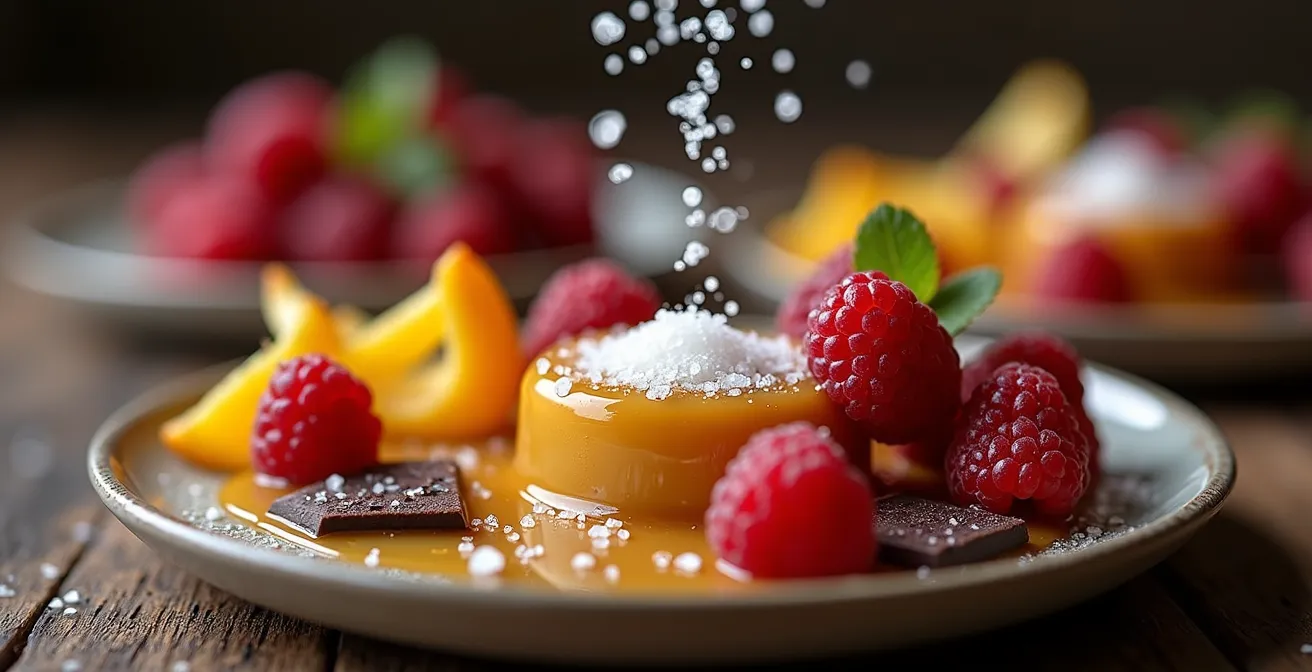
The secret to elevating a simple sweet dessert into a sophisticated experience lies not in reducing sugar, but in constructing a multi-layered “flavor architecture” using strategic counterpoints.
- Salt doesn’t just fight sweetness; at a chemical level, it can actually enhance the perception of sugar while adding complexity.
- Acid acts as a spotlight, cutting through richness to make other flavors brighter and more distinct, preventing palate fatigue.
- Textural variety is non-negotiable; a dessert with dynamic contrast between creamy, crunchy, and chewy elements is inherently more engaging.
Recommendation: Stop thinking like a baker who follows recipes and start thinking like a flavor architect who designs sensory experiences. Begin by actively training your palate to identify what’s missing.
There is a unique frustration known to every aspiring pastry chef. It’s the moment you taste your own creation—a silky panna cotta, a rich chocolate tart—and a quiet disappointment sets in. It’s technically perfect, yet it tastes only of one thing: sweet. The advice you’ve heard is always the same: “add a pinch of salt” or “a squeeze of lemon.” This is sound advice, but it’s the “what,” not the “why.” It treats flavor like a simple seesaw, when in reality, it’s a complex, three-dimensional structure.
To move beyond boringly sweet desserts is to stop thinking about balancing and start thinking about building. This is the realm of flavor architecture, where salt, acid, fat, and even temperature are not just ingredients but structural materials. The goal is no longer to simply “cut the sweetness,” but to construct a deliberate sensory journey for the palate, one with an introduction, a climax, and a lingering, memorable finish. This is the difference between a dessert that is eaten and one that is experienced.
This guide will deconstruct the science and art behind these sophisticated pairings. We will explore the chemical dialogue between salt and sugar, understand how acid can act as a spotlight on flavor, analyze why textural monotony leads to boredom, and ultimately, provide a clear protocol to calibrate your own palate. It’s time to transform your desserts from a singular, sweet note into a complex and satisfying chord.
Summary: A Guide to Building Sophisticated Dessert Flavors
- Why Adding Flaky Salt to Caramel Enhances Sweetness Perception?
- Lemon Zest or Citric Acid: How to Cut Through Heavy Creams?
- Dark Chocolate vs Milk: Which Pairs Better with Sweet Raspberries?
- Crunch vs Creamy: Why Monotextural Desserts Feel Boring?
- How to Infuse Basil into Strawberry Desserts Without It Tasting Like Pesto?
- Fat vs Acid: How to Balance Rich French Sauce with Sharp Asian Vinegar?
- Mango and Chili: Why Sweet and Spicy Work So Well Together?
- The 5 Tastes: How to Train Your Palate to Identify Missing Elements in a Dish?
Why Adding Flaky Salt to Caramel Enhances Sweetness Perception?
The common wisdom to “add salt to cut sweetness” is a fundamental misunderstanding of the sophisticated dialogue between salt and sugar on the palate. Salt, especially at low concentrations, doesn’t just suppress sweetness; it can actually amplify it and introduce complexity. This is not just culinary magic, but a specific neurological phenomenon. In fact, research from Okayama University reveals that a low concentration of salt is often perceived by our taste receptors as sweet, creating a richer, more rounded flavor profile rather than a simple counter-balance.
The key lies in understanding that salt plays two distinct roles: internal balance and external contrast. When fine salt is dissolved *into* a caramel sauce, its ions interact directly with our taste receptors. As one group of researchers found, this is a deep chemical interaction.
Chloride ions evoke taste sensations by binding to the extracellular ligand-binding domain of sweet/umami taste receptors.
– Atsuko Yamashita et al., eLife journal
Conversely, when a flaky finishing salt is sprinkled *on top* of the finished caramel, it provides a powerful sensory counterpoint. Each crystal delivers a concentrated burst of salinity and a delicate crunch, momentarily cleansing the palate from the overwhelming sweetness and making the next spoonful just as interesting as the first. This dual approach—dissolving salt for integrated depth and finishing with it for textural and flavor contrast—is a cornerstone of advanced dessert construction.
Lemon Zest or Citric Acid: How to Cut Through Heavy Creams?
When faced with the palate-coating richness of heavy creams, custards, or a dense cheesecake, acid is not merely an ingredient; it is a necessary tool for illumination. Acid acts like a spotlight, cutting through the heavy fog of fat and sugar to allow other, more subtle flavors to become visible. Without it, a rich dessert is a monolithic experience. With it, the same dessert becomes a dynamic landscape of taste. The question for the flavor architect is not *if* acid is needed, but *which form* of acid will best serve the final composition.
This is brilliantly demonstrated in Samin Nosrat’s “Salt Fat Acid Heat” methodology. Her work shows how acid provides critical contrast to fat and sugar, elevating pleasure. For instance, in Mexican cuisine, the bright citrus acids in salsas and lime wedges are essential to balance the richness of fatty meats, a principle that applies directly to cream-based desserts. The acid cleanses the palate, preventing the feeling of heaviness and inviting the next bite.

The choice between lemon zest and pure citric acid is a strategic one. Lemon zest offers a twofold benefit: it provides citric acid for brightness and aromatic oils for a floral, complex fragrance. It’s ideal when you want the *flavor of lemon* to be a distinct note in the dessert. Citric acid, on the other hand, is pure, unadulterated sourness. It is a precision tool used when you need to increase acidity and cut through richness without introducing any additional flavor or aroma that might conflict with other delicate elements like vanilla or white chocolate.
Dark Chocolate vs Milk: Which Pairs Better with Sweet Raspberries?
The classic pairing of chocolate and raspberry is not a matter of chance, but of chemical compatibility. Beyond taste, their connection is rooted in shared aromatic molecules. In fact, food pairing science reveals 73 shared flavor compounds between chocolate and berries like strawberries and raspberries. This deep-seated affinity gives chefs a solid foundation, but the choice between dark and milk chocolate fundamentally alters the dessert’s narrative and purpose.
The decision is not about which is “better,” but about the desired outcome. Do you want to create a high-contrast, sophisticated profile, or a unified, comforting one? Dark chocolate, with its high cacao content and inherent bitterness, creates contrast. Its tannins and bitter notes stand opposite the raspberry’s sweet tartness, making the fruit seem even brighter and more vibrant. It’s a pairing that challenges and excites the palate. Milk chocolate, with its higher sugar and fat content, aims for harmony. It mellows the raspberry’s sharp edges, and its creamy texture blends with the fruit to create a single, comforting, and unified flavor experience.
This strategic choice is best summarized by comparing their goals and applications, as this analysis from a professional chocolate pairing guide illustrates.
| Aspect | Dark Chocolate | Milk Chocolate |
|---|---|---|
| Flavor Goal | Contrast & highlight tartness | Mellow & unify flavors |
| Bitterness Level | High tannins balance fruit sweetness | Low, creates comfort profile |
| Fat Content | Lower, allows raspberry to shine | Higher, creates creamy blend |
Ultimately, choosing dark chocolate is a statement of intent for an adult, complex dessert profile, where the raspberry is the star against a dramatic backdrop. Choosing milk chocolate is to create an integrated, smooth, and approachable dessert where both elements merge into a familiar, beloved whole.
Crunch vs Creamy: Why Monotextural Desserts Feel Boring?
A dessert that offers only a single, uniform texture—no matter how delicious—is a missed opportunity. Palate fatigue sets in quickly not just from repetitive flavor, but from repetitive mouthfeel. A continuous, creamy sensation without a crunchy or chewy interruption becomes monotonous and, frankly, boring. This is because our enjoyment of food is profoundly tied to sensory variation. In fact, a Taste Tomorrow global survey shows that 72% of consumers actively seek out foods with diverse and interesting textures.
For the aspiring pastry chef, this means texture cannot be an afterthought or a mere garnish; it is a fundamental pillar of the dessert’s architecture. Textural dynamics—the interplay between smooth, creamy, crunchy, chewy, and even spongy elements—create rhythm and excitement in a dish. A smooth panna cotta is pleasant, but a panna cotta with a brittle, shattered caramel top and a chewy fruit compote at the bottom is an experience. Each spoonful offers a new combination, keeping the palate engaged and curious.

Think of it as musical composition. The creamy base is the sustained bass note, providing a foundation. A crumble or nut brittle is the sharp percussion, a sudden, exciting beat. A soft-baked cookie piece or a chewy caramel is the syncopated rhythm that adds complexity. As Pastry Arts Magazine notes, these elements are a vocabulary in themselves, creating a sensory story on the plate. The goal is to create a dessert where the textures are as intentionally composed as the flavors.
How to Infuse Basil into Strawberry Desserts Without It Tasting Like Pesto?
Incorporating savory herbs like basil into sweet applications is a hallmark of a confident chef, but it’s a path fraught with peril. The most common mistake is treating the herb as you would in a savory dish, often resulting in a muddled, grassy, or pesto-like flavor that clashes with the delicate sweetness of fruit. The secret to a successful infusion lies in understanding that an herb like basil contains a spectrum of oils and compounds, some savory and some sweet, and your extraction method determines which ones you get.
The enemy of a delicate, floral basil infusion is heat. Heat aggressively extracts chlorophyll and the more savory, bitter compounds from the basil leaves. The solution is a cold infusion. By steeping bruised basil leaves in a simple syrup, cream, or even a fruit purée in a cold environment for 24 to 48 hours, you gently coax out the sweet, floral, and anise-like aromatic oils while leaving the harsher, “green” flavors behind. This technique requires patience but yields a vastly more refined and integrated flavor.
This principle of gentle, cold extraction is increasingly recognized as best practice among professionals looking for authentic, nuanced flavors.
Chefs are increasingly turning to natural ingredients for authentic flavors. Cold infusion preserves the delicate, sweet notes of herbs like basil while avoiding the bitter, ‘green’ taste that comes from hot extraction. The key is patience – a slow, cold process yields the most refined results.
– Andros Chef, Pastry Trends 2024
For a more immediate aromatic impact without a long infusion, the “bruise and drop” method is effective. Gently press a few fresh leaves in your palm to release their oils and drop them into a finished strawberry coulis or sorbet base just moments before serving. This provides a fresh, fragrant top note without the deep, integrated flavor of a cold infusion. Using specific varieties like lemon basil or Thai basil can also introduce complementary citrus or anise notes naturally, further enhancing the dessert’s complexity.
Fat vs Acid: How to Balance Rich French Sauce with Sharp Asian Vinegar?
The relationship between fat and acid is the very heart of flavor balance, but their successful marriage depends entirely on the delivery system. A rich French butter sauce (like a beurre blanc) and a sharp Asian rice vinegar can be perfect partners or bitter enemies. The difference lies in one key process: emulsification. When fat and acid are properly emulsified, they are delivered to the palate simultaneously, creating a single, balanced sensation of creamy brightness. When they are broken, or not emulsified, they are perceived sequentially: a slick of grease followed by a harsh, acidic shock.
As detailed in Samin Nosrat’s foundational work, a stable emulsion is the vehicle that allows fat and acid to work in concert. In a beurre blanc, for example, tiny droplets of butterfat are suspended within a reduction of wine and vinegar. Your palate doesn’t register “butter” then “vinegar”; it registers a new, complex, and balanced flavor. This principle is universal. A vinaigrette is the same concept, delivering oil and vinegar in a unified way that is far more pleasant than drinking them separately.
The art of pairing a specific fat with a specific acid comes down to matching intensity and character. The clean, straightforward richness of butter pairs beautifully with the equally clean, straightforward sharpness of a Japanese rice vinegar. However, if you were to use a more complex, malty Chinese black vinegar, its deep, almost smoky flavor might be better suited to a richer, more flavorful fat like pork lard or duck fat. A fruity Filipino cane vinegar might be the perfect counterpoint to the nutty richness of brown butter. The flavor architect must consider not just the categories of “fat” and “acid,” but the unique personality of each ingredient.
Mango and Chili: Why Sweet and Spicy Work So Well Together?
The electrifying combination of sweet and spicy—epitomized by mango and chili—is one of the most compelling examples of flavor contrast. This pairing works not just because the flavors are opposites, but because they engage our brains on a deeper, almost physiological level. The “heat” from chili isn’t a taste; it’s a pain signal. This triggers a fascinating neurological response that is the key to its addictive quality.
The science behind this pleasure-pain cycle is a powerful tool for the flavor architect. It explains why a simple sprinkle of chili flakes can transform a sweet dish into something far more exciting and memorable.
Capsaicin triggers pain receptors, causing the brain to release endorphins and dopamine, creating a mild euphoria. The sugar from mango provides immediate pleasant relief, creating an addictive pleasure-pain cycle.
– Food Science Research, The Science of Food Pairing
This creates a dynamic push-and-pull on the palate: the mild burn of the chili creates a craving for the cooling, sweet relief of the mango, and once the sweetness has soothed the palate, the desire for that exciting kick of heat returns. But there is another, often overlooked element that completes this trinity of balance: temperature. Serving a spicy-sweet element cold, such as a mango-chili sorbet, adds another layer of contrast. As culinary science demonstrates that the physical coolness of the food provides a literal counterbalance to the perceived “heat” from the capsaicin, making the entire experience even more dynamic and refreshing.
Key Takeaways
- Flavor architecture is about intentional construction, not just balancing. Every element must have a purpose.
- Acid is a spotlight. It doesn’t just cut richness; it illuminates and defines other, more subtle flavors in a dish.
- Texture is a primary ingredient. A dessert’s narrative is shaped as much by its feel (crunchy, creamy, chewy) as its taste.
The 5 Tastes: How to Train Your Palate to Identify Missing Elements in a Dish?
Mastering the principles of flavor architecture is impossible without the single most important tool in your kitchen: a calibrated palate. The ability to taste a dish and diagnose precisely what it needs—a whisper of salt, a jolt of acid, a hint of bitterness, or the deep savoriness of umami—is what separates a cook from a chef. This is not an innate gift but a learned skill, developed through conscious, deliberate practice. Training your palate is akin to a musician training their ear; it requires isolating individual notes to understand how they function within a complex chord.
The goal is to move from a passive taster (“this is good”) to an active analyst (“this is good, but it’s flat; it needs an acidic high note to lift the mid-palate”). This requires building a sensory library in your mind. You must learn the specific character of Meyer lemon versus a regular lemon, the clean snap of kosher salt versus the mineral complexity of fleur de sel, the fruity bitterness of a 60% cacao chocolate versus the earthy intensity of an 85%. This mental catalog allows you to reach for the exact tool you need, rather than guessing.
The process of palate calibration can be systematized. By deconstructing flavors and tasting elements in isolation and in combination, you begin to hardwire the cause-and-effect of each addition. This disciplined practice is the final and most crucial step in becoming a true flavor architect. Below is a protocol to begin this essential training.
Your Action Plan: Palate Training Protocol for Dessert Balance
- Deconstruction Tasting: Start with a plain base (like a simple vanilla pudding or whipped cream). Taste it plain. Then, add a tiny pinch of salt to a new spoonful and taste the difference. Do the same with a single drop of lemon juice, then a hint of espresso powder. Isolate the effect of each element.
- Create a Flavor Library: Document your tastings. Actively compare Meyer lemon vs. regular lemon, flaky Maldon salt vs. fine kosher salt, a 60% cacao chocolate vs. an 85% one. Write down the specific differences in aroma, initial taste, and aftertaste.
- Apply a 3-Step Tasting Protocol: For every dish you taste, analyze it in three stages. 1. The first impression (tip of the tongue, often sweetness). 2. The mid-palate (where richness, fat, and texture dominate). 3. The finish (the lingering aftertaste, where bitterness or acidity often appears).
- Test with Ratios: When adjusting a sauce or batter, be methodical. Start with tiny, measured additions (e.g., 1/8 teaspoon of acid or salt) and document the changes in the flavor profile at each step.
- Practice Blind Tasting: Ask someone to give you two versions of the same component (e.g., two strawberry jams, one with added balsamic). Taste them blind to remove visual bias and force your palate to identify the distinguishing flavor notes.
Frequently Asked Questions about Balancing Dessert Flavors
What’s the best salt ratio for desserts?
A general rule is 1:10 to 1:20 salt to sugar ratio by weight, but this is highly variable. The best practice is to start with a very small amount, taste, and adjust frequently until the flavors feel more vibrant, not until it tastes salty.
Which salt type is best for desserts?
It depends on the application. For mixing into batters and doughs, a fine, easily dissolved salt like kosher salt is ideal. For finishing, large, flaky sea salts like Fleur de Sel or Maldon Sea Salt are preferred for their delicate crunch and clean flavor.
Can regular table salt work in desserts?
While it is possible, regular table salt is generally not recommended for fine pastry work. It often contains iodine and anti-caking agents that can impart a harsh, metallic, or chemical flavor that can easily overpower the delicate notes in a dessert.