
Achieving French patisserie results isn’t about owning more gear; it’s about adopting a mindset of uncompromising precision with a few critical tools.
- A digital scale is non-negotiable for accuracy; cup measures can introduce up to a 20% variance.
- High-fat (82%+) European-style butter is a technical ingredient, not an optional upgrade, for proper lamination.
- Mastering techniques like the ‘nappe’ test provides more reliable control than relying on timers alone.
Recommendation: Invest first in a gram-accurate digital scale and quality European-style butter. These two ‘tools’ will improve your results more than any other purchase.
The allure of French patisserie is undeniable: the delicate crumb of a macaron, the ethereal layers of a croissant, the silken texture of a crème anglaise. Yet, for the home baker, replicating these masterpieces often ends in frustration. Your puff pastry leaks butter, your macarons are flat, and your mousse is grainy. The common advice? Buy more equipment. A stand mixer, a marble slab, an endless array of specialty pans. This approach clutters your kitchen and misses the point entirely.
The truth is, authentic French baking is not a function of quantity but of precision. It is a craft rooted in scientific control, where a handful of key items are not just helpful but fundamental. The Parisian pastry chef’s secret is not a gadget for every task, but a deep understanding of how a few select tools and ingredients dictate the chemistry of a recipe. This is the difference between simply following steps and truly mastering the art. The precision mindset is the most crucial tool of all.
This guide will not give you another exhaustive shopping list. Instead, we will critically examine the few items and concepts that are truly non-negotiable. We will explore why a digital scale is more a scientific instrument than a convenience, how the fat content in your butter is a tool in itself, and which seemingly simple techniques provide the control that separates the amateur from the artist. Prepare to rethink what is truly essential.
This article delves into the core principles of the patisserie mindset. By exploring the ‘why’ behind each critical tool and technique, you will gain the knowledge to elevate your baking from hopeful imitation to confident execution.
Summary: A Curated Guide to the Patisserie Mindset
- Why a Digital Scale is More Accurate Than Cup Measures for Patisserie?
- Silpat or Parchment: Which is Better for Macaron Feet?
- Nylon vs Disposable: Which Piping Bag Gives You More Control?
- 82% Fat Butter: Why French Recipes Fail with American Butter?
- What Does “Napper” Mean and How to Do It Correctly?
- Recipe Apps vs Vintage Cookbooks: Which Source Better Sparks Creativity?
- How to Test Your Oven’s True Temperature Using Sugar?
- The 4-Ingredient Chocolate Mousse That French Chefs Swear By for Dinner Parties
Why a Digital Scale is More Accurate Than Cup Measures for Patisserie?
Let us be clear: if you are baking with cups, you are not practicing patisserie. You are guessing. The single most significant upgrade an aspiring baker can make is to discard their measuring cups in favor of a digital scale. The reason is a matter of physics, not preference. A cup of flour can vary dramatically in weight depending on how it’s packed, how humid the day is, or whether it was sifted. In fact, rigorous tests by America’s Test Kitchen found up to a 20% difference in flour weight when measured by volume. In the precise world of patisserie, a 20% variance is not a minor inaccuracy; it is a guaranteed failure.
Patisserie is a science of ratios. The hydration of a dough, the sugar-to-egg white ratio in a meringue—these are formulas that demand exactitude. Using a scale, and specifically measuring in grams, provides the smallest and therefore most precise unit of measurement. It removes all variables, ensuring your 100 grams of flour today is identical to your 100 grams of flour tomorrow. This consistency is the foundation upon which all successful baking is built.
This shift from volume to weight represents the core of the precision mindset. It is an acknowledgment that ingredients are chemical components, and their quantities must be controlled. A quality scale with a ‘tare’ function (to zero out the container’s weight) is not a luxury; it is the most fundamental tool for controlling the outcome of your work. It also, quite practically, results in far fewer dishes to wash.
Your Action Plan: Adopting the Weight-Based Method
- Set your scale to grams. This is the universal standard in professional patisserie for its fine-grained accuracy.
- Use the ‘tare’ function religiously. Place your bowl on the scale, press tare to zero it out, add your first ingredient, and press tare again before adding the next. All ingredients can be measured sequentially in one bowl.
- Trust the grams, not the appearance. If a recipe calls for 113g, do not round to 110g or 115g. This discipline is the first step toward professional-level consistency.
Silpat or Parchment: Which is Better for Macaron Feet?
The macaron is a notoriously fickle pastry, and the development of its characteristic “feet” (the ruffled base) is a moment of truth for any baker. The debate between using a silicone mat (like the iconic French Silpat) and parchment paper is not merely about non-stick properties; it’s about heat transfer, a critical variable in the macaronage process. While parchment is a serviceable liner, for the specific goal of perfect macaron feet, a high-quality silicone mat is superior.
The reason lies in thermal conductivity. A silicone mat distributes the oven’s heat more evenly and gently to the base of the macaron shells. This consistent, indirect heat encourages the batter to rise vertically, forming the delicate, bubbly feet before the top crust sets. Parchment paper, being thinner and less insulating, can lead to “hot spots” where the heat is too aggressive, causing the bottoms to brown too quickly or the shells to spread unevenly instead of rising. The mat’s slightly grippy surface also helps anchor the base of the macaron, further promoting an upward lift.
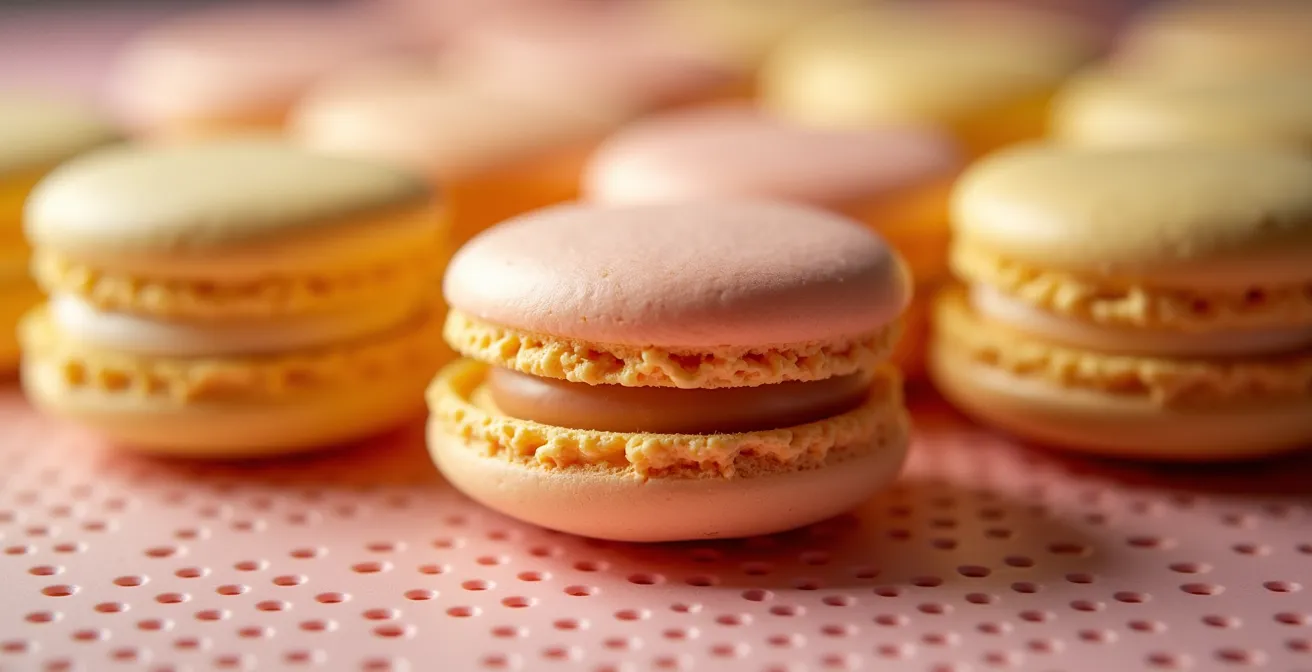
As you can see, the structure of the feet is a direct result of controlled heat. This is not just a theoretical advantage. In their equipment recommendations, The Little French Bakery specifically suggests Silpat mats made by Demarle in France, noting that these original silicone mats provide the consistent heat distribution essential for proper foot development. While cheaper silicone mats exist, the quality and thickness of the original article provide a level of reliability that professionals depend on. It is a one-time investment that pays dividends in consistency.
Nylon vs Disposable: Which Piping Bag Gives You More Control?
The piping bag is the baker’s paintbrush, an extension of the hand used for everything from filling éclairs to decorating a cake with delicate rosettes. The market offers two primary choices: reusable nylon bags and thin, single-use plastic bags. While the environmental appeal of a reusable bag is understandable, from a purely technical and professional standpoint, disposable bags offer a significant advantage in control and hygiene.
The key factor is sensitivity. As noted in the equipment guide for professionals, Modern French Pastry highlights that thin disposable bags offer a superior “tactile feedback.” This is a crucial concept. It means the baker can physically feel the consistency of the batter or cream inside the bag. You can detect air bubbles before they ruin a line of choux pastry, or feel a ganache begin to break from a change in temperature. A thick, opaque nylon bag insulates you from this vital information, turning a delicate process into a blind one.
Thin disposable bags offer superior ‘tactile feedback’, allowing the baker to feel for air bubbles or changes in temperature.
– Modern French Pastry, Equipment Guide
Furthermore, practicality and hygiene are paramount in a professional setting. Large, 18-inch disposable bags are versatile enough for robust batters like pâte à choux and delicate fillings alike. The tip can be custom-cut to fit any size of pastry tip, and using couplers allows for quick tip changes without emptying the bag. Most importantly, they eliminate the chore of cleaning greasy buttercream from a reusable bag, a process that, if not done perfectly, can harbor bacteria and rancid fats that will spoil future creations.
82% Fat Butter: Why French Recipes Fail with American Butter?
This is perhaps the most overlooked “tool” in a baker’s arsenal: the butter itself. Many aspiring bakers follow a French recipe to the gram, only to have their puff pastry or croissants weep butter in the oven, creating a greasy, flat disappointment. The culprit is almost always the butter. A French recipe is written with the expectation of using French-style butter, which has a significantly higher fat content than its standard American counterpart.
The difference is not trivial. Standard American butter typically contains about 80% butterfat and up to 18-20% water. European-style butters, legally mandated in many cases, must contain a minimum of 82% butterfat, with some premium versions reaching 84%. This 2-4% difference is primarily a reduction in water content. Less water means a more stable emulsion, a higher melting point, and a more pliable texture, which is absolutely critical for the process of lamination (creating thin layers of butter and dough).
When you attempt to laminate with lower-fat, higher-water butter, the butter is too soft at room temperature and contains excess water that turns to steam too quickly in the oven. This steam bursts through the delicate dough layers, causing the butter to leak out rather than lifting the pastry. High-fat butter remains solid and workable over a wider temperature range, allowing you to create distinct, separate layers that result in a dramatically flaky and airy final product.
The following table, based on professional analysis, clearly illustrates the performance gap:
| Characteristic | American Butter (80% fat) | European Butter (82-84% fat) |
|---|---|---|
| Water Content | 18-20% | 14-16% |
| Lamination Performance | Weak layers, butter leakage | Distinct, flaky layers |
| Temperature Stability | Softens quickly | Wider working temperature range |
| Puff Pastry Rise | Moderate | Dramatic 3-inch rise possible |
What Does “Napper” Mean and How to Do It Correctly?
In the lexicon of French patisserie, certain verbs carry immense technical weight. “Napper” is one of them. It literally means “to coat,” but in a culinary context, it refers to the specific point when a sauce or custard is cooked enough to lightly coat the back of a spoon. Mastering the ‘nappe’ is a fundamental skill, a low-tech method for gauging temperature and texture with more reliability than a timer.
The classic application is in making crème anglaise (vanilla custard sauce). The mixture of egg yolks, sugar, and hot milk is gently heated, and if it overheats, the eggs will scramble. The nappe test is the visual cue that you have reached the perfect temperature. To perform it, you dip a wooden or metal spoon into the custard, lift it out, and draw a finger across the back. If the line holds and the custard does not run back to cover the line, it has achieved the nappe consistency. This indicates the proteins in the egg yolks have thickened the sauce sufficiently without curdling.
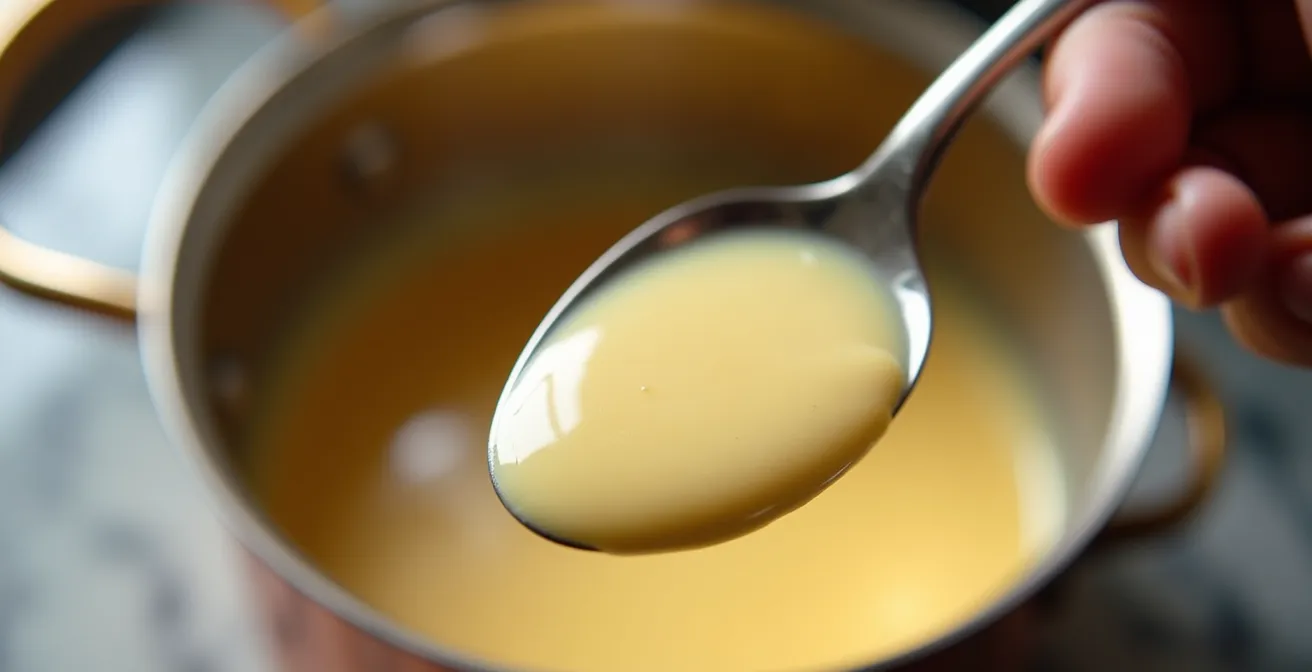
This simple visual test is a stand-in for a thermometer. Professionals know that this specific viscosity is achieved when the custard reaches a temperature between 82-84°C (180-183°F). It is a perfect example of the precision mindset: using a sensory cue that is directly tied to a scientific reality. It is more reliable than a recipe that says “cook for 5 minutes,” as the true time can vary based on your stovetop, your pot, and the starting temperature of your ingredients. The spoon, in this case, becomes a finely calibrated instrument.
Recipe Apps vs Vintage Cookbooks: Which Source Better Sparks Creativity?
In an age of endless recipe apps and food blogs, it’s easy to believe that more options lead to more creativity. However, for the serious student of patisserie, this deluge of information can be a trap. Recipe apps are designed for convenience and quick answers, often presenting recipes as simple, decontextualized instruction sets. True creativity, however, is not born from novelty but from a deep understanding of foundational principles.
This is where vintage or classic cookbooks from masters like Julia Child, Gaston Lenôtre, or Pierre Hermé prove their enduring value. These texts are not just collections of recipes; they are structured curriculums. They force the baker to slow down and focus on mastering the “mother sauces” of pastry: crème pâtissière, pâte à choux, meringue, and genoise. They explain the ‘why’ behind each technique—the function of each ingredient, the science of an emulsion, the purpose of chilling a dough. This is knowledge that a slick app interface rarely provides.
By focusing on these core techniques, a baker builds a robust mental framework. Once you truly understand how and why a pâte à choux puffs, you can then creatively adapt it. You can flavor it, change its shape, or use it as a component in a more complex dessert. An app might give you a recipe for a churro, a gougère, and a Paris-Brest, but a classic cookbook teaches you the single underlying dough that makes all three possible. This foundational knowledge is the true wellspring of creativity.
- Master base recipes: Focus on perfecting classics like pâte à choux and crème pâtissière from authoritative texts before attempting modern variations.
- Practice fundamentals: Repetition is key. Make the same core recipe multiple times to develop muscle memory and an intuitive feel for the process.
- Keep a baking notebook: Document your attempts, noting temperatures, timings, and outcomes. This personalizes the learning process and helps you refine techniques.
- Understand the ‘why’: Actively seek to comprehend the science behind the steps. Why does a meringue need acid? Why must puff pastry be kept cold? This is where true mastery lies.
How to Test Your Oven’s True Temperature Using Sugar?
The oven is the final, and often most unpredictable, variable in baking. You can measure your ingredients to the gram and execute your technique flawlessly, but if your oven’s thermostat is lying, your efforts are wasted. Most home ovens are notoriously inaccurate, with their actual temperature often deviating by 25-50°F (15-30°C) from the set temperature. While an oven thermometer is a good start, a simple, brilliant technique used by professionals allows you to test for precision and map hot spots using a common pantry ingredient: granulated sugar.
The principle is based on a fixed chemical property: pure, granulated sugar begins to melt precisely at 186°C (367°F). This is not an approximation; it is a physical constant. You can leverage this fact to calibrate your oven. Set your oven to 367°F (or 185°C). Place a small pile of sugar on a piece of parchment or in a small oven-safe dish and put it in the center of the oven. If the sugar melts, your oven runs hot. If it remains crystalline, your oven runs cool. You can adjust the temperature dial up or down and re-test until you find the exact point on your dial that corresponds to a true 186°C.
This technique can be taken a step further to perform professional oven mapping. By placing several small piles of sugar in different quadrants of your oven—front-left, back-right, etc.—you can observe which pile melts first. This reveals your oven’s unique heat distribution pattern and identifies any hot spots. Knowing that your oven’s back-right corner is hotter allows you to rotate your pans strategically during baking, ensuring an even bake for everything from a sheet of cookies to a delicate cake. This is the precision mindset in action: not just trusting the machine, but verifying its performance with science.
Key Takeaways
- Mastery in patisserie comes from a ‘precision mindset,’ not from owning a vast collection of tools.
- A digital scale (measuring in grams), high-fat European butter (82%+), and an understanding of your oven’s true temperature are the three most critical, non-negotiable elements.
- Techniques like the ‘nappe’ test and tactile feedback from a piping bag are sensory skills that provide more reliable control than timers or blind execution.
The 4-Ingredient Chocolate Mousse That French Chefs Swear By for Dinner Parties
After exploring the necessity of precise measurements, specialized ingredients, and calibrated equipment, it may seem counterintuitive to conclude with a recipe celebrated for its shocking simplicity. The chocolate mousse popularized by French physical chemist Hervé This—a pioneer of molecular gastronomy—requires only four ingredients: chocolate, water, ice, and a whisk. There are no eggs, no cream, no sugar. It appears to be the antithesis of complex patisserie.
But that is precisely the point. This recipe is the ultimate expression of the precision mindset. It strips a classic dessert down to its absolute scientific core: the creation of an emulsion. By melting high-quality chocolate with a small amount of water and then whisking it vigorously over an ice bath, you are rapidly cooling and aerating the mixture. The fat (cocoa butter) and water are forced into a stable suspension, trapping air bubbles and creating the light, airy texture of mousse. It is pure food science in a bowl.
Hervé This himself insists that this is not a recipe in the traditional sense. It is a demonstration. As he famously stated, “It’s not a recipe but a demonstration of an emulsion.” It teaches the baker a fundamental principle in the most direct way possible. Success depends entirely on understanding the interaction between temperature and agitation. It proves that with high-quality ingredients and a mastery of a core technique, you can create something magical. This mousse is the final lesson: the goal is not to blindly follow a list of instructions, but to understand the scientific ‘why’ so deeply that you can achieve extraordinary results with the simplest of means.
By shifting your focus from accumulating gear to cultivating a mindset of precision, you will find that your baking improves more dramatically and consistently than any single gadget could ever promise. Start with a scale, use the right butter, and commit to understanding the science. That is the true path to baking like a Parisian.