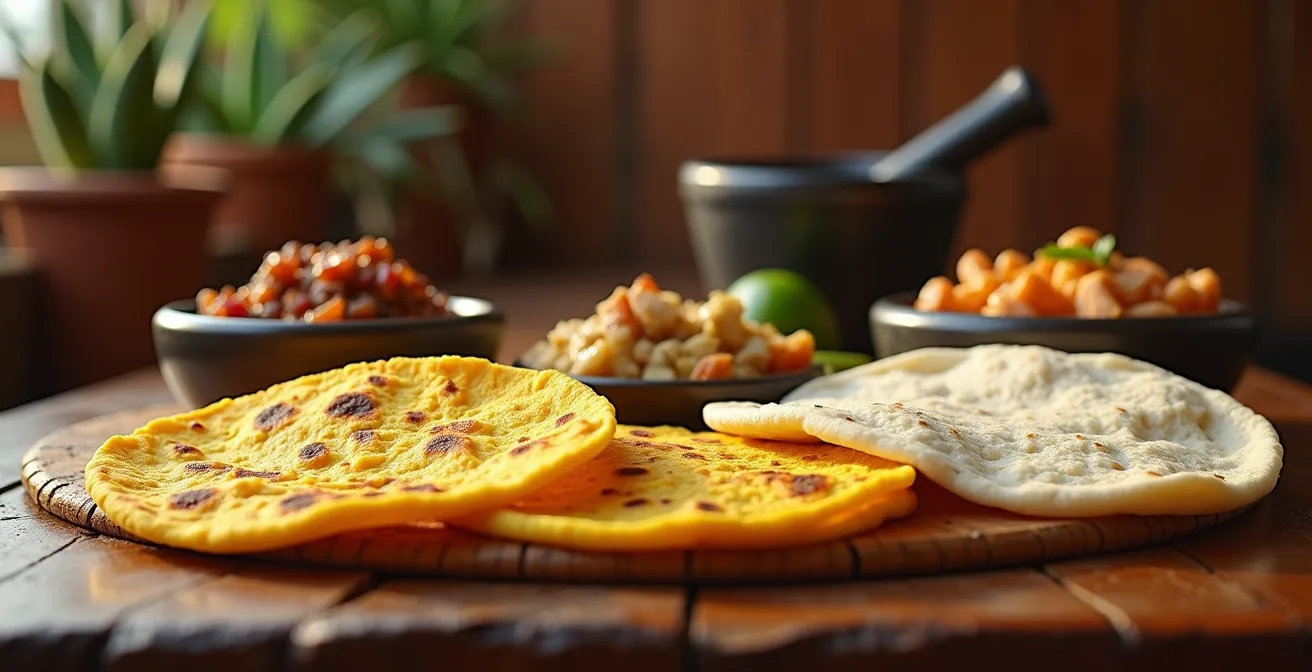
The true difference between corn and flour tortillas isn’t taste, but a 4,000-year-old food science called nixtamalization.
- This alkaline process unlocks corn’s nutrition and creates a natural “pseudo-gluten” network, making the tortilla strong yet tender.
- Authentic pairings, like corn tortillas with barbacoa, are based on this unique structural integrity, not just tradition.
Recommendation: To truly understand tacos, focus on the quality and science of the masa first; the filling is secondary.
The debate between corn and flour tortillas often boils down to personal taste or regional habit. People will tell you “flour for burritos, corn for street tacos” as if it were an immutable law. But in my tortilleria, we know the truth runs much deeper. This isn’t a matter of preference; it’s a matter of science, structure, and respect for the ingredients. The choice of tortilla is not a casual decision—it is the foundational engineering that determines whether your taco will be a triumph or a tragedy.
Most discussions miss the single most important factor: the ancient, transformative process of nixtamalization. This isn’t just a step in a recipe; it’s a chemical miracle that turns a simple grain of corn into a nutritionally complete, structurally sound, and deeply flavorful building block. Forget the simplistic rules. To elevate your tacos, you must first understand the very soul of the tortilla. This guide will walk you through the craft, from the chemistry of the masa to the physics of the perfect “puff,” revealing why the right tortilla isn’t just a better choice, but the only choice for a given filling.
Contents: A Craftsman’s Journey into the Tortilla
- Plastic Wrap Trick: How to Press Tortillas Without Sticking?
- Microwave vs Comal: How to Reheat Tortillas Without Drying Them Out?
- Why Corn Must Be Treated with Lime to Be Nutritious?
- Fridge or Freezer: How Long Does Fresh Masa Last Before Souring?
- The Puff: Why Your Tortilla Didn’t Inflate and How to Fix the Heat?
- Xanthan Gum vs Psyllium Husk: Which Binder Creates Better Bread Structure?
- Cheek or Chuck: Which Cut Yields the Most Tender Barbacoa?
- The “Velvetting” Technique: How to Make Chicken as Soft as Chinese Takeout?
Plastic Wrap Trick: How to Press Tortillas Without Sticking?
Before any science, there is the craft. The first connection to an authentic tortilla is through your hands. When working with fresh masa, the texture tells you everything. It should feel like soft, pliable Play-Doh—not sticky, which means too much water, and not crumbly, which means it’s too dry. This balance is everything. The most common frustration I see is the tortilla sticking to the press, a problem often “solved” with modern shortcuts that disrespect the dough.
The most effective method, a standard in many kitchens, involves using plastic. But not just any plastic wrap. The trick is to cut two perfectly sized circles from a gallon-size freezer bag. Its thickness provides a durable, non-stick surface that flimsy cling wrap can’t match. You place one piece on the bottom of the press, your ball of masa in the center, the second piece on top, and then press. The tortilla releases cleanly every time.
However, what if it still sticks? This is the masa telling you it’s slightly too moist. The instinct is to add flour—never do this. Regular flour introduces gluten and ruins the texture. The craftsman’s solution is to lightly dust the plastic itself with a pinch of masa harina (the flour from which masa is made). This absorbs the excess surface moisture without altering the dough’s internal structure. It’s a simple, elegant solution that honors the integrity of the corn.
Here are the steps to follow for perfect, non-sticky tortillas:
- Step 1: Test masa consistency. Knead the dough until it feels like soft Play-Doh. If it’s too dry and cracks, add water just one teaspoon at a time. If it’s sticky, knead in a tiny bit more masa harina.
- Step 2: Use a freezer bag. Cut a gallon-size freezer bag into two sheets that fit your tortilla press. This is the ideal material for a clean release.
- Step 3: Dust if necessary. If your tortilla sticks despite the plastic, your dough is a bit too wet. Lightly dust the plastic sheets with masa harina, not all-purpose flour, before pressing.
Microwave vs Comal: How to Reheat Tortillas Without Drying Them Out?
A perfectly crafted tortilla can be ruined in the final seconds. Reheating is not a trivial step; it’s an act of reawakening the tortilla, restoring its softness and aroma. The two most common tools for this are the modern microwave and the traditional comal (or a cast-iron skillet). Each has a distinct purpose and yields a profoundly different result. Choosing the right method depends on your priority: speed or flavor.
The microwave is the king of convenience. By wrapping a stack of tortillas in a damp paper towel, you create a steam environment. In 30-45 seconds, the tortillas become uniformly soft and pliable, perfect for quickly assembling a large batch of tacos. However, this method sacrifices texture. You get softness, but you lose the delightful toasted notes and the slight crispness that a dry heat method provides. It’s functional, but it lacks soul.
The comal, on the other hand, is all about soul. Heating a tortilla directly on a hot, dry surface for 15-20 seconds per side is transformative. This direct contact initiates the Maillard reaction, creating the beautiful brown, toasted spots that release an incredible nutty, roasted corn aroma. The tortilla becomes soft on the inside with a slightly more resilient, flavorful exterior. This is the method for savoring a single, perfect taco. The process is a dialogue between the tortilla and the heat.
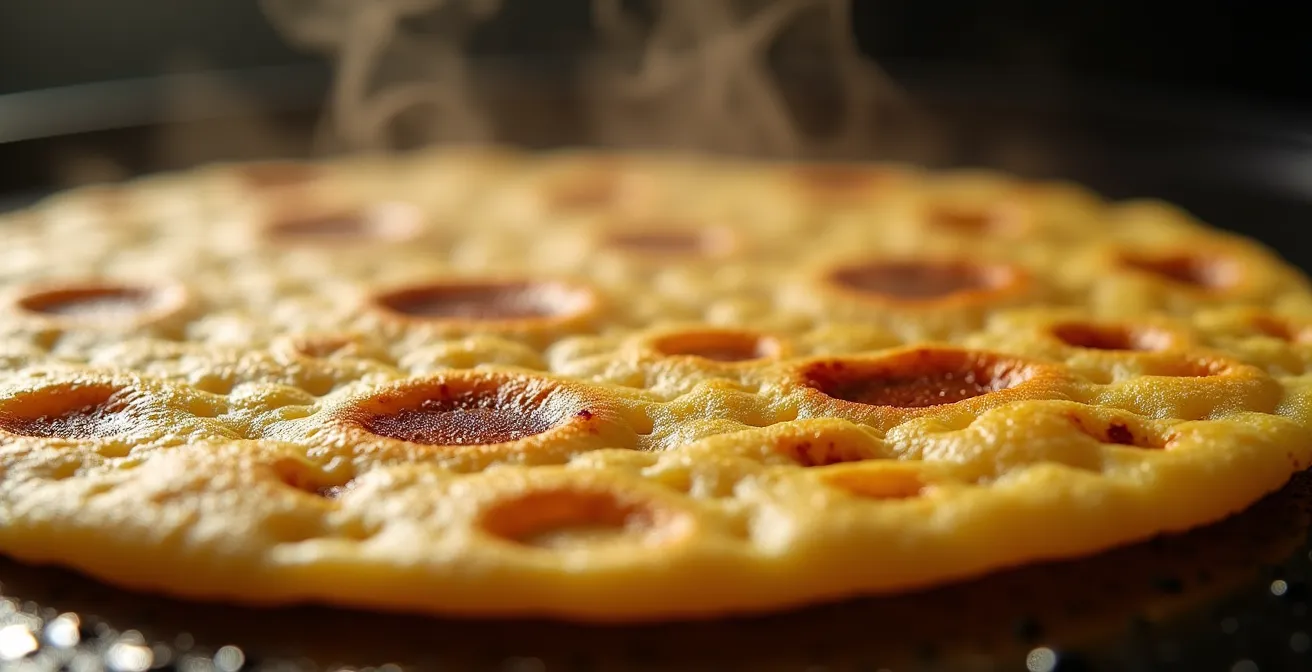
As you can see, the direct heat creates character. For those seeking the best of both worlds, especially with slightly older tortillas, a hybrid method exists. A quick 10-second burst in the microwave brings back moisture, followed by 20 seconds on the comal to develop flavor and texture. This two-step process can revive a day-old tortilla to near-perfect condition. Understanding these methods is key to respecting the finished product.
This comparative table breaks down the choice, helping you decide which method suits your needs.
| Method | Time | Result | Best For |
|---|---|---|---|
| Microwave with Damp Paper Towel | 30-45 seconds | Soft, steamed texture | Quick reheating, multiple tortillas |
| Comal/Skillet (Medium Heat) | 15-20 seconds per side | Toasted spots, enhanced flavor | Single servings, authentic taste |
| Hybrid Method | 10s microwave + 20s comal | Soft interior, crispy exterior | Older tortillas needing revival |
Why Corn Must Be Treated with Lime to Be Nutritious?
Now that we’ve handled the tortilla, let’s step back and understand its very essence. The soul of a true corn tortilla is born from a 4,000-year-old Mesoamerican process called nixtamalization. This is not just “cooking corn.” It’s a profound chemical transformation that is the single greatest difference between authentic masa and simple corn flour (polenta or cornmeal). Without it, corn is nutritionally locked, and a proper tortilla is physically impossible to make.
The process involves steeping dried corn kernels in an alkaline solution, traditionally made with water and slaked lime (calcium hydroxide). This alkaline bath does three critical things. First, it makes the corn safer. Research confirms a 97-100% reduction in dangerous mycotoxins (like aflatoxins) that can be present in raw corn. Second, it unlocks nutrition. The human body cannot access the niacin (Vitamin B3) in untreated corn, which historically led to the devastating deficiency disease pellagra in cultures that ate corn as a staple without this process. Nixtamalization makes the niacin bioavailable, turning corn into a life-sustaining food.
Third, and most crucially for the craft of tortilla-making, it fundamentally changes the corn’s structure. As the experts from the International Maize and Wheat Improvement Center explain, this process is about deep chemical change:
The cooking and steeping in alkaline solution induces changes in kernel structure, chemical composition, and nutritional value – the removal of pericarp reduces soluble fiber while lime cooking increases calcium content, and leads to partial starch gelatinization and protein denaturation.
– CIMMYT Research Team, International Maize and Wheat Improvement Center
That “starch gelatinization” is the magic. It breaks down the corn’s tough outer wall (the pericarp) and allows starches to absorb water and bind together. This is what creates a soft, pliable, and cohesive dough—the masa—from which tortillas can be formed. Simple ground corn flour, which has not undergone this process, will never form a proper dough. It will be a crumbly, unworkable mess. So when you choose a true corn tortilla, you’re not just choosing a flavor; you’re choosing thousands of years of food science.
Fridge or Freezer: How Long Does Fresh Masa Last Before Souring?
Once you have true, nixtamalized masa, you are holding a living product. Unlike dry flour, fresh masa is perishable. Its moisture content and rich nutrients make it a prime environment for fermentation and spoilage. Knowing how to store it correctly is the difference between delicious tortillas and a sour, wasted batch of dough. The clock starts ticking the moment the masa is made.
For short-term storage, the refrigerator is your ally, but only for a very limited time. Fresh masa will last for 2-3 days maximum in an airtight container. Each day, you should do a sensory check: a fresh, sweet corn smell is good; a sour, vinegary, or overly yeasty odor means fermentation has gone too far, and the masa is past its prime. The flavor will be unpleasantly tangy, and its structure will degrade.
For longer-term storage, the freezer is the only option. The key to successful freezing is to minimize exposure to air and control portion size. Form the masa into golf-ball-sized portions—enough for one or two tortillas each. Wrap each ball individually and tightly in plastic wrap, then place them all in a freezer bag. This prevents freezer burn and makes it easy to thaw only what you need. Frozen this way, masa can last for up to 3 months. When you’re ready to use it, thaw the portions in the refrigerator and re-knead, adding a half-teaspoon of warm water at a time until the pliable, Play-Doh consistency returns.
This preservation principle also applies to finished tortillas. As one home cook discovered, modern technology can be a great ally to traditional methods:
I have had good luck vacuum packing the corn tortillas I make and throwing them in a chest freezer. When I need some, I let a still-sealed package thaw out in the fridge. When reheated in a pan or in the oven, the texture and taste seem to me to be unchanged from fresh.
– A reader, Mexican Please
Your Fresh Masa Preservation Checklist: An Audit
- Sensory Check: Before storing, confirm your masa’s state. Does it smell fresh and corn-like, or has a sour, vinegary odor developed?
- Short-Term Storage Audit: If refrigerating, is it in a truly airtight container? Have you marked the date to ensure it’s used within the critical 2-3 day window?
- Long-Term Portioning: For freezing, have you portioned the masa into usable, golf-ball-sized amounts? Are they individually and tightly wrapped to prevent freezer burn?
- Revival Plan: When retrieving from cold storage, have you planned for re-kneading? Is warm water on hand to add, 1/2 teaspoon at a time, to restore its pliable texture?
- Finished Product Integrity: If freezing finished tortillas, are you using vacuum sealing? This is the gold standard for preserving texture and taste upon thawing.
The Puff: Why Your Tortilla Didn’t Inflate and How to Fix the Heat?
The single most satisfying moment in making tortillas—the mark of a true craftsman—is “the puff.” This is when the tortilla, on its final flip, inflates like a balloon. It’s not just for show; this inflation is a sign that everything has been done correctly, from the masa’s hydration to the heat of the comal. The puff creates delicate, separate layers within the tortilla, resulting in a lighter, more tender texture. If your tortillas aren’t puffing, it’s a diagnostic tool telling you something is wrong.
The science behind the puff is simple: trapped steam. To make it happen, three conditions must be met perfectly. First is dough moisture. As we’ve discussed, the masa must be like pliable Play-Doh. If it’s too dry, there isn’t enough water to create the necessary steam. If it’s too wet, the steam escapes too easily. Second is uniform thickness. A perfectly pressed, even tortilla ensures that the steam builds up in the center, rather than escaping through a thin spot. Third, and most critical, is heat management.
You need a very hot, dry comal or cast-iron skillet. The cooking process is a precise three-step dance designed to seal the tortilla’s surfaces and trap steam. Professional tortilla makers recommend this timing: lay the tortilla on the hot comal and cook for 15 seconds on the first side. This quick sear creates the bottom layer. Flip it and cook for 30-45 seconds on the second side. This longer time cooks the interior. The final, crucial step is to flip it back to the first side. The residual heat turns the internal moisture into steam, and with both surfaces now sealed, it has nowhere to go but out, pushing the layers apart and causing the glorious puff. If it needs help, a gentle press on the edge with your fingers or a spatula can encourage the steam to build.
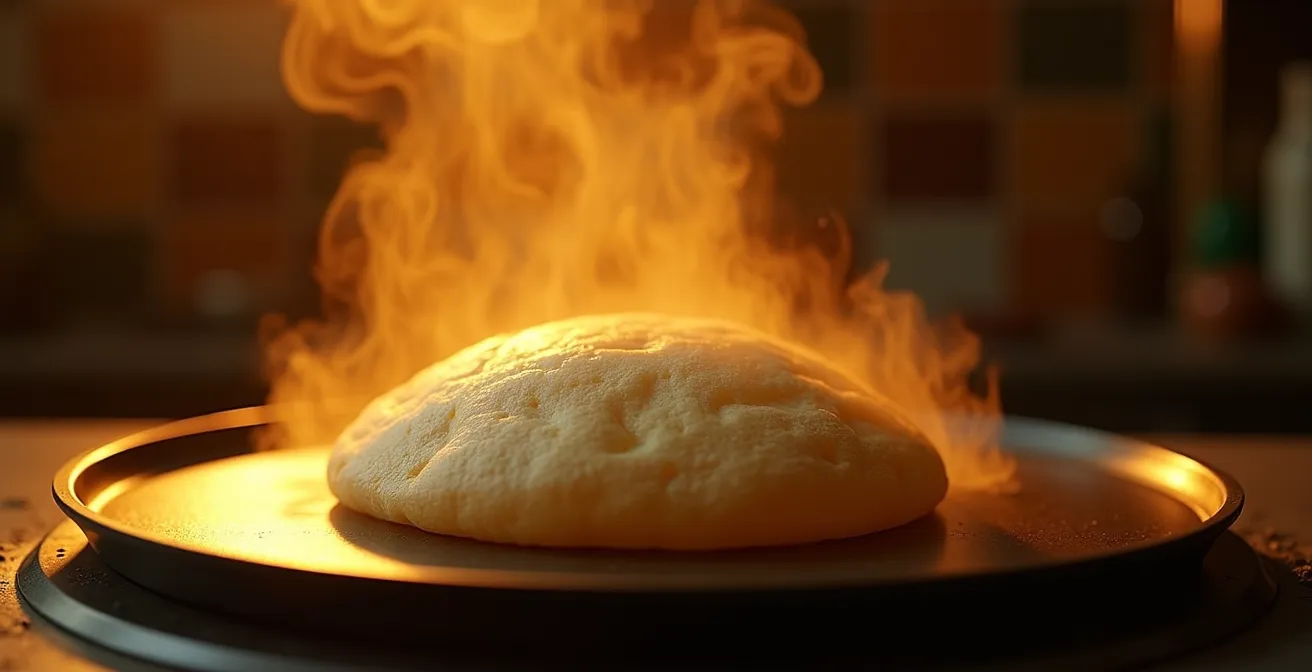
This cross-section illustrates the goal: a pocket of steam separating the two cooked layers. Achieving this consistently is the culmination of all the previous steps. It’s a testament to your understanding of the dough and your control over the heat. Don’t be discouraged if it doesn’t happen at first. The puff is a goal to work towards, a conversation between you and the comal.
Xanthan Gum vs Psyllium Husk: Which Binder Creates Better Bread Structure?
In the world of modern, gluten-free baking, ingredients like xanthan gum and psyllium husk are common. They are binders, designed to mimic the stretchy, structural properties of gluten. So, a common question arises: should you add a binder to your masa to prevent it from being crumbly? As a tortillero, my answer is an emphatic no. Adding a binder to authentic masa is a solution to a problem that shouldn’t exist. It’s a misunderstanding of what a corn tortilla is supposed to be.
A corn tortilla’s structure doesn’t come from a stretchy network like a flour tortilla’s gluten. Its integrity comes from the starch gelatinization we achieved through nixtamalization. This process is so effective that scientific analysis of corn tortilla structure reveals that nixtamalization creates a natural “pseudo-gluten” network. The gelatinized starches bind the dough together perfectly, providing all the structure it needs. It creates a texture that is tender and pliable, with a “short” bite—it should break cleanly, not stretch.
Adding a binder like xanthan gum or, even worse, psyllium husk, fundamentally corrupts this texture. Psyllium husk would create a tough, chewy tortilla, which is the exact opposite of what is desired. Xanthan gum is sometimes used as a crutch in products made from instant masa harina (corn flour that is just precooked and dried, not fully nixtamalized). If the masa harina is of poor quality or isn’t hydrated correctly, a pinch of gum can help hold it together. But this is a modern shortcut, a patch for an inferior product.
If your authentic masa is crumbly, the problem isn’t a lack of binders. The problem is a lack of water or improper nixtamalization. The solution is to go back to the fundamentals: knead in more warm water, a teaspoon at a time, until the dough is pliable. Trust the corn. Trust the ancient process. The structure is already there, unlocked by lime and water. A true corn tortilla needs no artificial help; its perfection lies in its simplicity.
Cheek or Chuck: Which Cut Yields the Most Tender Barbacoa?
Now we arrive at the pairing. Why is a corn tortilla the undisputed, authentic partner for barbacoa? The answer lies in the structural integrity we’ve been building. Barbacoa is not just shredded beef; it’s a preparation method defined by long, slow cooking that liquefies fat and collagen, resulting in incredibly moist, tender meat. A flimsy vessel would disintegrate under this delicious load. This is where the nixtamalized corn tortilla proves its superiority.
Traditionally, barbacoa is made not from chuck roast, but from beef head, specifically the beef cheek (cachete). This cut is rich in collagen, which, when cooked low and slow for hours, breaks down into gelatin. This process creates a uniquely silky, unctuous texture and a deeply rich flavor that a leaner cut simply cannot replicate. The traditional method involves wrapping the meat, burying it in a pit with hot coals, and letting it cook for hours. This gentle, consistent heat ensures the meat becomes softer than the tortilla itself.
This is where the pairing becomes critical. A flour tortilla, with its soft, gluten-based structure, would quickly become saturated and turn to mush under the moisture of true barbacoa. It would tear before it even reached your mouth. A proper corn tortilla, however, has the strength and density from its gelatinized starch network to handle the load. It absorbs some of the juices without losing its structure. For this reason, barbacoa is almost always served on two stacked corn tortillas, toasted on a comal. This double-layer provides the necessary structural insurance to deliver the precious cargo.
The toppings are also telling: just simple diced white onion and cilantro. There’s no need for heavy salsas or cheese because the meat is the star. The corn tortilla is its humble, yet structurally perfect, pedestal. Choosing cheek over chuck and corn over flour isn’t about being a purist; it’s about understanding the physics of a perfect taco.
Key Takeaways
- The core of an authentic corn tortilla is nixtamalization, an alkaline process that unlocks nutrition and creates structural integrity.
- A tortilla’s “puff” is a sign of mastery, caused by trapped steam and requiring perfect dough hydration and heat management.
- Authentic masa does not need artificial binders like xanthan gum; its structure comes from gelatinized starches created during nixtamalization.
The “Velvetting” Technique: How to Make Chicken as Soft as Chinese Takeout?
At first glance, the technique for creating silky, tender chicken in Chinese cooking seems a world away from a Mexican tortilleria. But a true craftsman sees the universal principles of food science that connect them. The “velveting” technique, which gives takeout chicken its signature soft texture, and the nixtamalization of corn are, in fact, chemical cousins. Both rely on the transformative power of an alkaline pH.
Velveting involves marinating chicken in a mixture that often includes egg whites, cornstarch, and, crucially, a small amount of baking soda (sodium bicarbonate). This alkaline environment raises the pH on the surface of the meat. This change inhibits protein from bonding too tightly when cooked, preventing it from becoming tough and dry. The result is an incredibly tender, “velvety” texture. The goal is to alter the protein structure to enhance tenderness.
This is precisely the same principle as nixtamalization, just with a different target. We use slaked lime (calcium hydroxide) to create an alkaline solution for our corn. This environment alters the grain’s structure, breaking down the pericarp and gelatinizing starches. In both cases, we are using an alkaline agent to intentionally manipulate the chemical and physical properties of a raw ingredient to achieve a more desirable culinary result. One targets chicken protein, the other targets corn kernels, but the underlying chemistry is the same.
This table highlights the remarkable parallel between these two ancient techniques from opposite sides of the world.
| Process | Alkaline Agent | Target | Result |
|---|---|---|---|
| Chinese Velveting | Baking Soda (sodium bicarbonate) | Chicken protein surface | Tenderized, silky texture |
| Mexican Nixtamalization | Slaked Lime (calcium hydroxide) | Whole corn kernel | Gelatinized starch, enhanced nutrition |
| Key Similarity | Both use alkaline pH to transform protein/grain structure | ||
This is the ultimate lesson: cooking is chemistry. Whether you are crafting the perfect tortilla or velveting chicken, mastery comes not from blindly following a recipe, but from understanding the “why” behind the technique. The choice between corn and flour is not arbitrary; it’s a decision rooted in science, structure, and purpose. By embracing this knowledge, you move beyond being just a cook and become a true craftsman.
Frequently Asked Questions about Corn Tortillas
Why doesn’t traditional masa need xanthan gum?
Proper nixtamalization with lime creates gelatinized starches that naturally bind the dough, making artificial binders unnecessary and even detrimental to the authentic “short” texture of a corn tortilla.
When might someone add a binder to masa harina?
Only instant corn flour (masa harina), which is not always fully nixtamalized, sometimes benefits from a tiny pinch of xanthan gum if the dough is too crumbly. This is considered a modern shortcut, not an authentic practice.
Would psyllium husk work in corn tortillas?
No, psyllium husk would create an undesirable tough and chewy texture. This fundamentally misunderstands the desired tender, non-stretchy bite of an authentic corn tortilla.