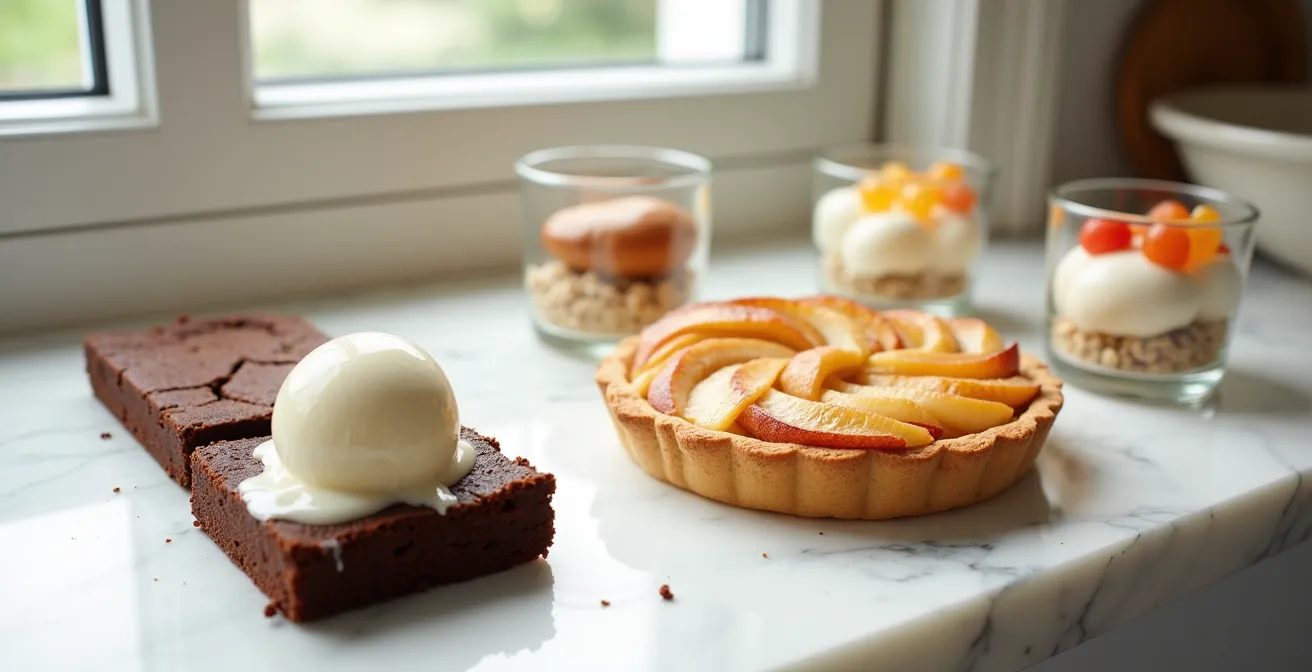
The key to overcoming baking fears isn’t just following recipes, but understanding the simple, scientific principles that make classic dessert pairings foolproof.
- Contrasting temperature (hot/cold) and texture (creamy/crunchy) creates a more dynamic sensory experience.
- Certain ingredients don’t just add flavor, they act as functional barriers or amplifiers for other elements.
- Even visual presentation follows simple, learnable rules that make desserts more appealing.
Recommendation: Instead of fearing failure, start by mastering one of these core principles, like the hot brownie and cold ice cream combination, to build a foundation of confidence.
For any novice baker, the kitchen can feel like a minefield. You follow a recipe to the letter, yet the results are underwhelming. The fear of wasting ingredients, or worse, the disappointment of a failed dessert, can be paralyzing. It’s easy to believe that creating impressive pastries is a special talent reserved for a select few. Many will tell you to just “balance flavors” or “add texture,” but this advice often feels vague and unhelpful, leaving you clinging to the same few safe recipes.
But what if the secret behind those “guaranteed success” combinations wasn’t magic, but simple science? What if the reason classic pairings are classics is because they follow a set of understandable rules? The truth is that pastry arts are built on a foundation of chemistry and physics. Understanding these principles is the real key to unlocking creativity and, most importantly, building unshakable confidence. It’s about moving from a baker who follows instructions to a creator who understands them.
This guide is designed to be your mentor. We won’t just give you recipes; we will deconstruct the “why” behind them. We will explore the sensory architecture of successful desserts, from the thrill of temperature contrast to the structural importance of layering. By the end, you’ll see these classic combinations not as rigid rules, but as powerful tools in your growing baking toolkit, ready to be used with confidence.
In this article, we will explore the core principles that make dessert pairings work. You will learn the science behind timeless classics, giving you a blueprint for success that you can apply to your own baking adventures.
Summary: Unlocking the Science of Perfect Pastry Pairings
- Why Serving Hot Brownies with Cold Ice Cream Works Every Time?
- Almond and Pear: Why This Frangipane Combo is a Timeless Classic?
- Cream, Crunch, Fruit: In What Order Should You Layer a Verrine?
- How Espresso Powder Intensifies Chocolate Flavor in Cakes?
- Jam First or Cream First: What Order Saves the Meringue Crunch?
- Odd Numbers Rule: How to Arrange 3 Elements on a Plate?
- Sorbet or Ginger: How to Reset Your Taste Buds Between Rich Courses?
- Hosting Afternoon Tea: How to Plan a Sophisticated Pastry Menu That Impresses Guests?
Why Serving Hot Brownies with Cold Ice Cream Works Every Time?
The combination of a warm, gooey brownie and a scoop of cold, creamy ice cream is a universal pleasure for a reason, and it’s rooted in a core principle: thermal contrast. Our mouths are incredibly sensitive to temperature differences. When you combine hot and cold, you’re creating a dynamic sensory experience that is far more exciting than a single-temperature dish. The warmth of the brownie melts the ice cream slightly, creating a delicious sauce, while the cold of the ice cream heightens the richness of the chocolate.
This isn’t just a subjective feeling; it’s a phenomenon that chefs deliberately exploit. The goal is to maximize this contrast. A study on sensory perception reveals that the ideal temperature differential for this effect is significant, with a brownie served around 60°C (140°F) and ice cream straight from the freezer at -18°C (0°F). This wide gap ensures each spoonful delivers that delightful shock of hot and cold.
For a beginner, this is the easiest and most reliable “win” you can create. It requires no complex technique, only timing. By simply warming a brownie (even a store-bought one) for about 25 seconds in the microwave and topping it with high-quality ice cream just before serving, you’ve engineered a professional-level dessert experience. This is your first lesson in sensory architecture: temperature is an ingredient.
Almond and Pear: Why This Frangipane Combo Is a Timeless Classic?
The pairing of sweet pear and nutty almond in a frangipane tart is a cornerstone of French patisserie, and its enduring popularity is a lesson in flavor harmony and functional chemistry. It’s more than just two flavors that taste good together; it’s a brilliant example of how ingredients can support each other during the baking process, making it a surprisingly forgiving recipe for novices.
Frangipane, a rich almond cream, can be prone to drying out during its long bake time. This is where the pear becomes a functional hero. As pears bake, they release their moisture. In a frangipane tart, this moisture gently steams the surrounding almond cream, keeping it soft, custardy, and preventing it from becoming dry or crumbly. As noted in a case study from professional culinary schools, this synergy is why pear frangipane is taught as a fundamental recipe; its success is built into the combination itself.
The flavor profile is equally brilliant. The buttery, nutty depth of the almond cream is perfectly cut by the delicate, slightly acidic sweetness of the pear. It’s a lesson in balance: the rich base is lifted by the bright fruit. For a beginner, this combination is a huge confidence booster. You’re not just making a tasty dessert; you’re leveraging a time-tested partnership where the ingredients are actively working together to ensure a successful outcome.

As you can see in the texture of a finished tart, the almond cream remains moist and luscious right up against the soft, cooked pear. This visual proof is the result of that perfect functional pairing. It teaches a crucial lesson: great combinations often involve one ingredient solving a problem for another.
Cream, Crunch, Fruit: In What Order Should You Layer a Verrine?
A verrine, or a dessert layered in a glass, is a beautiful way to present a multi-textural experience. However, its success hinges on a crucial, non-negotiable factor: the order of the layers. For a beginner, this can seem intimidating, but it follows a simple logic based on density and moisture protection. Getting the order wrong results in a soggy, muddled dessert, while getting it right preserves the integrity of each component.
Think of it as structural engineering. The bottom layer must be the most stable and dense to provide a foundation. This is typically a crumble, a piece of cake, or a biscuit. The top layer should be the lightest and most visually appealing, like a fruit coulis or fresh berries, acting as an aromatic invitation. The most critical layer is the one in the middle: a fat-based cream or mousse. Its job is not just to provide flavor and a creamy texture, but to act as a waterproof barrier. It separates the wet fruit layer from the dry crumble layer, preventing the dreaded sogginess.
This principle of a “fat barrier” is universal in pastry. A layer of ganache, buttercream, or dense mousse physically stops moisture from migrating. Without it, the crunchy element would absorb liquid from the fruit and turn to mush within minutes. Therefore, the correct order is almost always: crunch, cream, fruit.
The following table breaks down the function of each layer, demonstrating that the order is based on pure physics and functionality, not arbitrary rules.
| Layer Position | Component Type | Function | Density Level |
|---|---|---|---|
| Bottom | Crumble/Cake | Stable foundation | Most dense |
| Middle | Fat-based cream/mousse | Moisture barrier | Medium dense |
| Top | Fruit coulis/fresh fruit | Visual & aromatic invitation | Least dense |
How Espresso Powder Intensifies Chocolate Flavor in Cakes?
Adding a spoonful of espresso powder to a chocolate cake recipe might seem counterintuitive if you don’t want a coffee-flavored dessert. However, this is one of pastry’s most beloved “secret ingredients,” a perfect example of aromatic amplification. The espresso doesn’t necessarily make the cake taste like coffee; instead, it works on a chemical level to make the chocolate taste more like itself.
Chocolate and coffee share many of the same flavor compounds. When you add a small amount of espresso, its bitter notes help to suppress some of the sweetness in the cake, allowing the more complex, deeper, and earthier notes of the cocoa to come forward. It essentially turns down the “volume” on the sugar and turns up the “volume” on the chocolate. The result is a chocolate flavor that is perceived as richer, darker, and more profound.
This is a fantastic tool for a beginner baker looking to elevate their chocolate creations from “good” to “unforgettable.” The key is the dosage. You want just enough to amplify, not to overwhelm. A common guideline recommended by professional bakers is about 1 teaspoon of instant espresso powder per 1 cup of flour in your recipe. This small amount is usually imperceptible as a distinct coffee flavor but will make a world of difference in the depth of your chocolate cake, brownies, or cookies.
Think of it as a background vocalist that makes the lead singer sound better. This simple addition is a low-effort, high-impact technique that demonstrates a more nuanced understanding of how flavors interact, building your confidence in manipulating flavors beyond the basic recipe.
Jam First or Cream First: What Order Saves the Meringue Crunch?
The debate over jam or cream first on a scone is a matter of tradition, but when it comes to assembling a dessert with a crisp meringue element, like an Eton Mess or a pavlova, the order is a matter of science. To preserve that satisfying, airy crunch, you must protect the meringue from moisture at all costs. The enemy is water, and the hero, once again, is fat.
Meringue is essentially a delicate, dry structure of sugar and egg whites. It’s incredibly hygroscopic, meaning it greedily absorbs moisture from the air and any wet ingredients it touches. A spoonful of water-based fruit compote or jam placed directly on a meringue will start to dissolve it almost immediately. As confirmed by food science research, a naked meringue can turn soggy in under 10 minutes, while one protected by a fat barrier can last for over an hour. This is where cream saves the day.
The answer is unequivocally: cream first. A thick layer of whipped cream, with its high fat content, acts as a hydrophobic (water-repelling) sealant. It creates a protective barrier between the delicate meringue and the wet fruit topping. This principle is fundamental to pastry science, as explained by experts.
Fat is hydrophobic and acts as a sealant. The hydrophobic fat barrier principle is universal in pastry – it’s why we use buttercream on cake layers before adding fruit filling.
– Professional Pastry Science, King Arthur Baking Science Guide
For a beginner, this is a game-changing piece of knowledge. It’s not just for meringues; it applies to layering cakes, filling tarts, and assembling verrines. By understanding the protective power of fat, you can assemble desserts hours in advance and serve them with their textures perfectly intact, a hallmark of a confident and knowledgeable baker.
Odd Numbers Rule: How to Arrange 3 Elements on a Plate?
Once you’ve baked a delicious dessert, the final step is plating. This can be the most intimidating part for a beginner, but it doesn’t have to be. Professional pastry chefs rely on a simple principle from visual arts: the rule of odds. Our brains perceive arrangements of odd numbers (1, 3, 5) as more dynamic and visually interesting than even numbers, which can look static and boring.
As explained by studies in visual psychology, an even number of items allows our brain to pair them up and process the image quickly, leading to less engagement. An odd number leaves one element “unpaired,” forcing our eye to move between the components, creating a sense of movement and tension that is far more appealing. For a beginner, plating in a group of three is the easiest way to harness this effect. You have a main element (the hero), a secondary element (the sidekick, like a sauce or cream), and an accent (the garnish).
But how do you arrange them on the plate? The “Clock Face Method” is a foolproof system that takes the guesswork out of plating. It provides a simple, repeatable structure for creating professional-looking desserts every time. By using this method, you are not just placing things on a plate; you are designing a visual experience.
Your Action Plan: The Clock Face Method for Plating
- Imagine your round plate as a clock face. This creates a simple grid for placement.
- Place the Hero element (your main dessert, like a slice of tart) at the 6 o’clock position, slightly off-center towards you.
- Position the Sidekick (the cream, sauce, or ice cream scoop) at the 10 o’clock position.
- Add the Accent (a small garnish like a mint leaf, zest, or a single berry) at the 2 o’clock position.
- Ensure the three elements form an invisible scalene triangle (a triangle with sides of different lengths), which creates that professional dynamic tension.
Sorbet or Ginger: How to Reset Your Taste Buds Between Rich Courses?
As you gain confidence, you might want to serve multiple desserts or a sequence of rich courses. A key to making this work is understanding the concept of a palate cleanser. Its job is to reset your taste buds, washing away lingering flavors from the previous dish so you can fully appreciate the next one. For beginners, choosing the right cleanser can seem like an obscure art, but it’s based on specific mechanisms.
The three most common and effective palate cleansers work in different ways. A citrus sorbet, like lemon or lime, works through a combination of thermal and acidic shock. The cold temperature numbs the taste buds slightly, and the high acidity cuts through rich fats and dairy, leaving your mouth feeling fresh. It’s an excellent choice after a creamy cheesecake or panna cotta.
Pickled ginger, famously served with sushi, works chemically. It contains a compound called gingerol, which actively neutralizes flavor compounds and resets the palate. Its sharp, spicy-sweet flavor is particularly effective after intensely spiced or fatty desserts. Finally, simple sparkling water works physically. The carbonation acts like a gentle scrub, lifting residual oils and food particles from your tongue. It’s the most neutral and universally applicable option.
Choosing the right tool for the job demonstrates a sophisticated understanding of flavor management. This table compares the mechanisms and best uses for these common palate cleansers.
| Cleanser Type | Mechanism | Best After | Duration of Effect |
|---|---|---|---|
| Citrus Sorbet | Thermal & Acidic Shock | Dairy-rich desserts | Immediate, 2-3 minutes |
| Pickled Ginger | Chemical Reset (gingerol) | Spiced or fatty desserts | 30 seconds, lingering |
| Sparkling Water | CO2 Physical Scrubbing | Any rich course | Immediate, brief |
Key Takeaways
- Baking success comes from understanding the “why”: simple principles of temperature, texture, and flavor science.
- Fat is a baker’s best friend, acting as a “raincoat” to protect crisp textures from moisture.
- You can amplify flavors (like chocolate) with small amounts of other ingredients (like espresso).
Hosting Afternoon Tea: How to Plan a Sophisticated Pastry Menu That Impresses Guests?
Hosting a traditional afternoon tea is the ultimate capstone project for a budding baker. It’s an opportunity to bring together everything you’ve learned about flavor, texture, and presentation into a single, impressive event. The key to a successful afternoon tea is not to have the most complex pastries, but to have a well-planned progression of flavors. A sophisticated menu guides your guests on a sensory journey.
The traditional order of an afternoon tea service is a masterclass in flavor management. You always move from savory to sweet, and within each category, from light to rich. As etiquette expert Laura Akano advises, you should “start with light savory (cucumber sandwiches), move to richer savory (salmon), then to the neutral ‘bridge’ (scones), and finally to the sweet pastries.” This progression prevents palate fatigue and allows each item to be appreciated fully.
Within the final, sweet tier, the same rule applies. You should arrange your pastries to be eaten from the lightest (perhaps a fruit tart or a simple macaron) to the most intense (a rich chocolate torte or a passionfruit-filled pastry). This ensures the delicate flavors aren’t overwhelmed by the bolder ones. The humble scone acts as the crucial “bridge” between the savory and sweet worlds, its relatively neutral flavor profile cleansing the palate before the grand finale of pastries. Planning a menu this way shows foresight and a deep respect for the food and your guests’ experience—a true sign of a confident host.
Now that you understand the principles, the only thing left is to start baking. Pick one of these classic combinations and try it this week, focusing on the “why” as you go. You’ve got this.
Frequently Asked Questions About Classic Pastry Combinations
Why does my crunch layer get soggy in a verrine?
This almost always happens because there is no protective fat-based barrier between the wet layers (like fruit coulis) and the dry layers (the crumble or biscuit). Moisture will always migrate from wet to dry. To prevent this, you must always separate your crunch layer from any fruit or liquid with a thick layer of a fat-based cream, mousse, or ganache, which acts as a waterproof sealant.
Can I prepare verrines in advance?
Yes, you can prepare the individual components (creams, coulis, crumbles) ahead of time. You can even assemble the base and cream layers a few hours in advance. However, to guarantee the best texture, you should always add the final crunch layer (like crumble, toasted nuts, or a biscuit) a maximum of one to two hours before serving. This ensures it retains its satisfying crunch and doesn’t have time to absorb moisture.